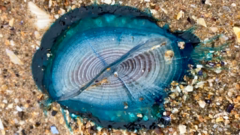
Walk down almost any beach across Anglesey or the west Gwynedd coast this week and you'll run into something bizarre. The sand is scattered with hundreds of glowing, neon-blue shapes that look like tiny glass boats or deflated alien spacecraft.
If you're wondering what these bright blue organisms are, they're called Velella velella. Most people know them as by-the-wind sailors. While they look exactly like small jellyfish, they aren't true jellyfish at all. They're actually massive colonies of tiny individual organisms working together as a single floating structure.
The sudden arrival of this blue tide has caught thousands of Welsh beachgoers completely off guard. In places like Barmouth, the shoreline is practically carpeted with them. They're beautiful. They're strange. But their sudden presence in the middle of June is raising some serious eyebrows among marine scientists.
What are the blue creatures on Wales beaches
A Velella velella colony consists of a flat, oval disc that floats flat on the surface of the water. This disc is made of a tough, chitinous material that feels almost like thin plastic. Built right into the top of that disc is a stiff, triangular sail that sticks straight up into the air.
These creatures belong to the hydrozoan class. Instead of being one distinct animal like a fish or a crab, a single Velella raft is a cooperative living space for hundreds of specialized polyps. Some of these polyps handle feeding. Others handle defense or reproduction. They share a single, interconnected digestive system. They literally survive by teamwork.
The striking blue color isn't just for show. It serves a vital survival function out in the open ocean. Because these colonies spend their entire lives floating right at the surface, they're completely exposed to sunlight and predators from both the air and the sea. The deep blue pigment acts as a natural sunscreen against harsh ultraviolet radiation. It also provides excellent camouflage against the backdrop of the deep ocean water, keeping them hidden from hungry seabirds flying overhead.
How by the wind sailors actually move
Unlike true jellyfish, which can pulse their bells to push themselves through the water, by-the-wind sailors have zero control over where they go. They can't swim. They can't steer. They're completely at the mercy of planetary physics.
The triangular sail on top of the raft is angled across the long axis of the float. This design works exactly like a sail on a boat, catching the breeze and pushing the colony across the water at an angle to the wind. Fascinatingly, nature has divided these colonies into two distinct populations. Some have sails that slant to the right, while others have sails that slant to the left.
This structural split is a brilliant evolutionary insurance policy. A right-sailing colony will drift away from the wind at one angle, while a left-sailing colony will veer in the opposite direction. When strong winds blow across the open Atlantic, one half of the population might get blown directly into a dangerous coastal trap, but the other half will be pushed safely out to deeper waters. It keeps the entire species from being wiped out by a single storm system.
When you see hundreds of them stranded on the sand in North Wales, you're looking at the group that lost the wind lottery. A specific sequence of weather patterns pushed them directly into the coast, leaving them stuck on the sand where they quickly dry out and die.
The difference between a by the wind sailor and a Portuguese man o war
Whenever a mass of bright blue, sail-bearing organisms washes up on a British beach, panic tends to spread. People instantly worry that the dangerous Portuguese man-of-war (Physalia physalis) has arrived. It's an easy mistake to make because the two species look similar and share a close evolutionary relationship, but they are fundamentally different.
A by-the-wind sailor is relatively small, usually measuring between 5 to 7 centimeters in length. Its sail is flat, clear, and rigid. Most importantly, its sting is incredibly mild. For most humans, the venom produced by a Velella colony is practically unnoticeable, though it can cause a slight tickle or mild irritation if it touches sensitive skin or gets rubbed into your eyes.
A Portuguese man-of-war is a completely different beast. It features a much larger, gas-filled bladder that looks like an inflated purple or pink balloon, often reaching up to 30 centimeters long. Hanging beneath that floating balloon are thick, blue tentacles that can stretch for over 30 meters. The sting from a Portuguese man-of-war is notoriously painful and can cause severe, whip-like welts on human skin. In rare cases, the toxins can trigger dangerous systemic allergic reactions.
If you see a small, flat blue disc with a clear, rigid sail, you're looking at a harmless by-the-wind sailor. If you see a large, puffed-up, balloon-like bladder with long, trailing blue cords, keep your distance.
Why a June stranding has marine experts worried
While finding Velella velella on UK shores isn't entirely unprecedented, the timing of this current stranding is highly unusual. Historically, these creatures are swept toward the UK during late autumn and winter when powerful Atlantic storms drive oceanic currents directly onto our western coastlines. Seeing them in massive numbers during mid-June is weird.
Marine experts like Frankie Hobro, who runs the Anglesey Sea Zoo, have pointed out that a spike in early summer sightings signals a shift in our typical seasonal weather patterns. The UK experienced an intense spell of unseasonably warm weather in late May, which was immediately followed by a chaotic, unsettled start to June. This specific combination of shifting ocean temperatures and driving onshore winds created a perfect storm, sweeping the offshore blue fleet right out of their open-ocean habitats and dumping them straight onto Welsh sand.
The real worry among marine biologists isn't just about the Velella colonies themselves. It's about what their early arrival implies for more dangerous species. If changing ocean currents and warming sea surface temperatures are pushing these mild hydrozoans into Welsh waters in June, it means the much more venomous Portuguese man-of-war might start arriving far earlier in the year than we're used to seeing. This shifts the risk profile for summer beachgoers, surfers, and wild swimmers who normally don't have to look out for dangerous stinging organisms until much later in the autumn.
What you should do if you find them
If you're out walking on the beaches of Anglesey, Gwynedd, or Barmouth and come across the blue tide, you don't need to panic. You can safely look at them and appreciate how stunning they look against the sand.
Keep your dogs on a lead when walking through heavily affected areas. While the sting of a by-the-wind sailor is very mild for humans, a curious dog licking or swallowing multiple dried-up colonies can suffer from nasty stomach upsets, localized mouth irritation, or allergic swelling. It's simply not worth the vet bill.
Don't touch your face or eyes if you happen to handle one. Even though the venom won't pierce the thick skin on your fingers, transferring those residual stinging cells to your eyes or lips will cause a sharp, uncomfortable burn.
Leave them where they are. Once these organisms are thrown onto the dry sand by the waves, they cannot crawl back to the water. They will quickly dry out, turning into thin, clear, papery white discs that look like discarded plastic trash. Trying to throw them back into the surf is almost always a useless effort because the wind will just blow their tiny sails right back onto the beach.
Take photos and log your sightings online. You can report these strandings to local marine conservation networks or organizations like the Marine Conservation Society. Keeping an exact track of where and when these creatures land provides vital data for scientists tracking how climate change and shifting Atlantic currents are altering our marine ecosystems in real time.