About 4.25 billion years ago, the Moon had a roaring interior engine. Its core dynamo generated a magnetic field that matched or even beat modern Earth's strength. Then, the core cooled, the molten metal stopped circulating, and the dynamo died. The Moon became a quiet, unshielded rock. Or so we thought.
If you look closely at tiny impact-glass particles brought back by China's Chang'e-6 mission, you'll find a microscopic fossil record of that long-lost magnetic field. Researchers analyzing metallic iron inside these lunar soil grains just identified a face-centered cubic form of metallic iron called gamma-iron, or $\gamma$-Fe, never before seen naturally in lunar samples. Published in the Proceedings of the National Academy of Sciences on September 16, this find comes from a team led by Professor Haifeng Du at the High Magnetic Field Laboratory of the Chinese Academy of Sciences.
Let's break down why this tiny mineral discovery matters and what it actually tells us about our nearest celestial neighbor.
The Physics Problem of Lunar Iron
Under normal conditions, gamma-iron is a diva. It only stays stable at scorching high temperatures. As things cool down, it naturally transforms into alpha-iron ($\alpha$-Fe). So how on Earth—or rather, on the Moon—did gamma-iron survive billions of years in lunar soil?
The answer lies in violent celestial collisions. When meteorites crash into the lunar surface, they melt rock into an incandescent soup that cools down almost instantly. This rapid cooling acts like a flash-freeze, trapping the iron in its high-temperature crystal structure before it can transform.
Add a pinch of carbon and other trace elements, wrap the whole thing inside a protective shell of impact glass, and you get a microscopic time capsule. The glassy matrix shields the fragile interior from space weathering, solar wind, and cosmic rays. It is basically nature's ultimate vacuum-sealed preservation jar.
Why Impact Glass is the Ultimate Time Capsule
Most lunar samples are crushed, battered, and chemically altered by billions of years of exposure on the barren surface. Traditional rocks lose their original magnetic signatures because external magnetic fields and thermal shocks wipe the slate clean.
Impact glass changes the rules. When micrometeoroids slam into the lunar regolith, they create localized impact melts that trap bits of local material.
- Rapid Quenching: Molten rock turns into glass in fractions of a second, locking the mineral structure in place.
- Hermetic Seal: The glass shroud blocks atmospheric and chemical degradation.
- Nanoscale Precision: Using focused ion beam preparation and transmission electron microscopy, scientists can spot tiny iron particles measuring only a few nanometers across.
When Dr. Long Li and his colleagues at HFIPS examined these glass particles, they found that $\gamma$-Fe wasn't just a minor anomaly—it was actually the dominant form of iron in the two impact-glass samples they studied.
Reading the Magnetic Fossil Record
Finding the mineral is only half the battle. The real breakthrough came when the research team used off-axis electron holography to peek at the magnetic behavior of individual $\gamma$-Fe nanoparticles.
They discovered that relatively large $\gamma$-Fe particles form a stable single-vortex magnetic state. When exposed to an external magnetic field, they hold a consistent response. This magnetic stability means these nanoparticles act like miniature compass needles, recording the exact strength and direction of magnetic fields present during the impact event or the era the parent material formed.
Since $\gamma$-Fe and $\alpha$-Fe form under drastically different thermal conditions and possess unique magnetic properties, they act as dual witnesses. Each mineral preserves a different chapter of the Moon's energetic youth. Instead of relying on a single, degraded magnetic history, planetary scientists now have two distinct recording mechanisms baked right into the lunar soil.
What Happens Next in Lunar Science
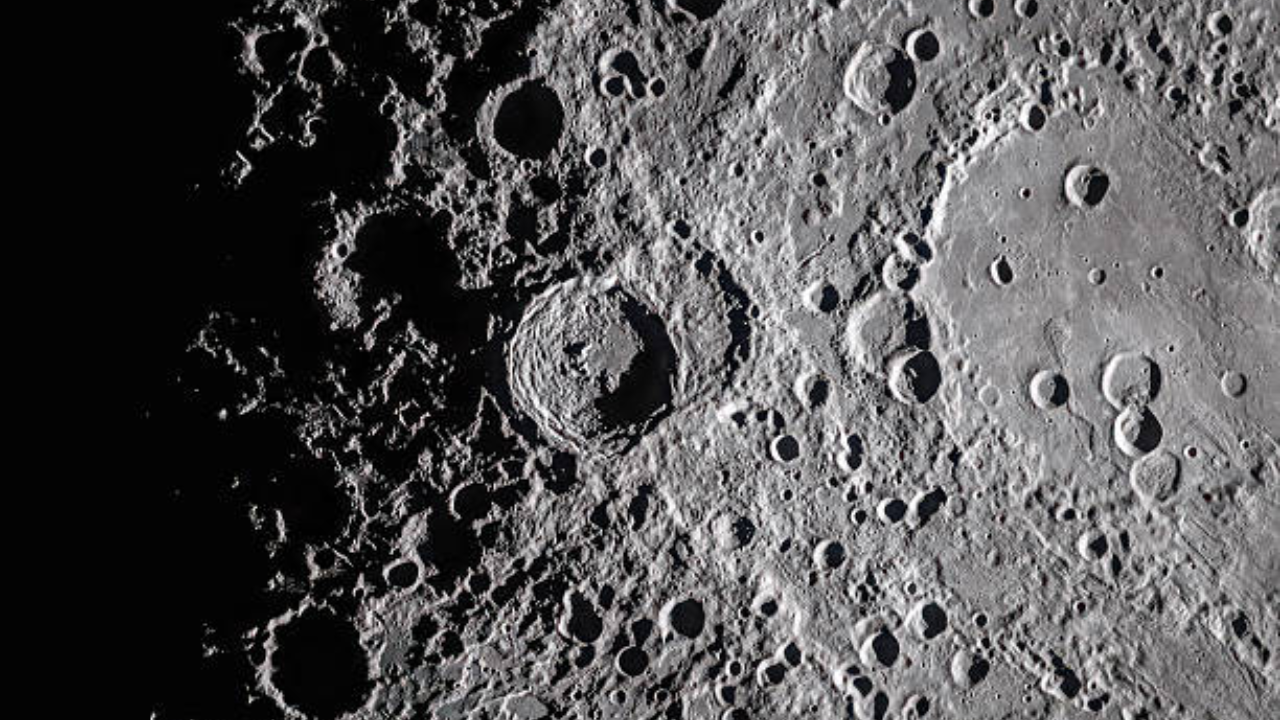
Chang’e-6 made history by retrieving samples from the Moon's far side—specifically the South Pole-Aitken basin, one of the oldest and largest impact craters in the solar system. This region is a goldmine for understanding early impacts and crustal evolution.
We aren't just looking at pretty space rocks. Every time a sample mission returns payload to Earth, analytical tools get sharper. Ten years ago, spotting face-centered cubic iron at the nanoscale inside lunar glass would have been nearly impossible. Today, advanced microscopy lets researchers map individual crystal lattices atom by atom.
If you are following space exploration, keep an eye on subsequent studies coming out of these far-side samples. Researchers are currently working to quantify exactly how much magnetic field data these $\gamma$-Fe crystals can yield over geologic timescales.
The Moon isn't a dead, silent rock. It is a stubborn archive. You just need the right glass to read its story.