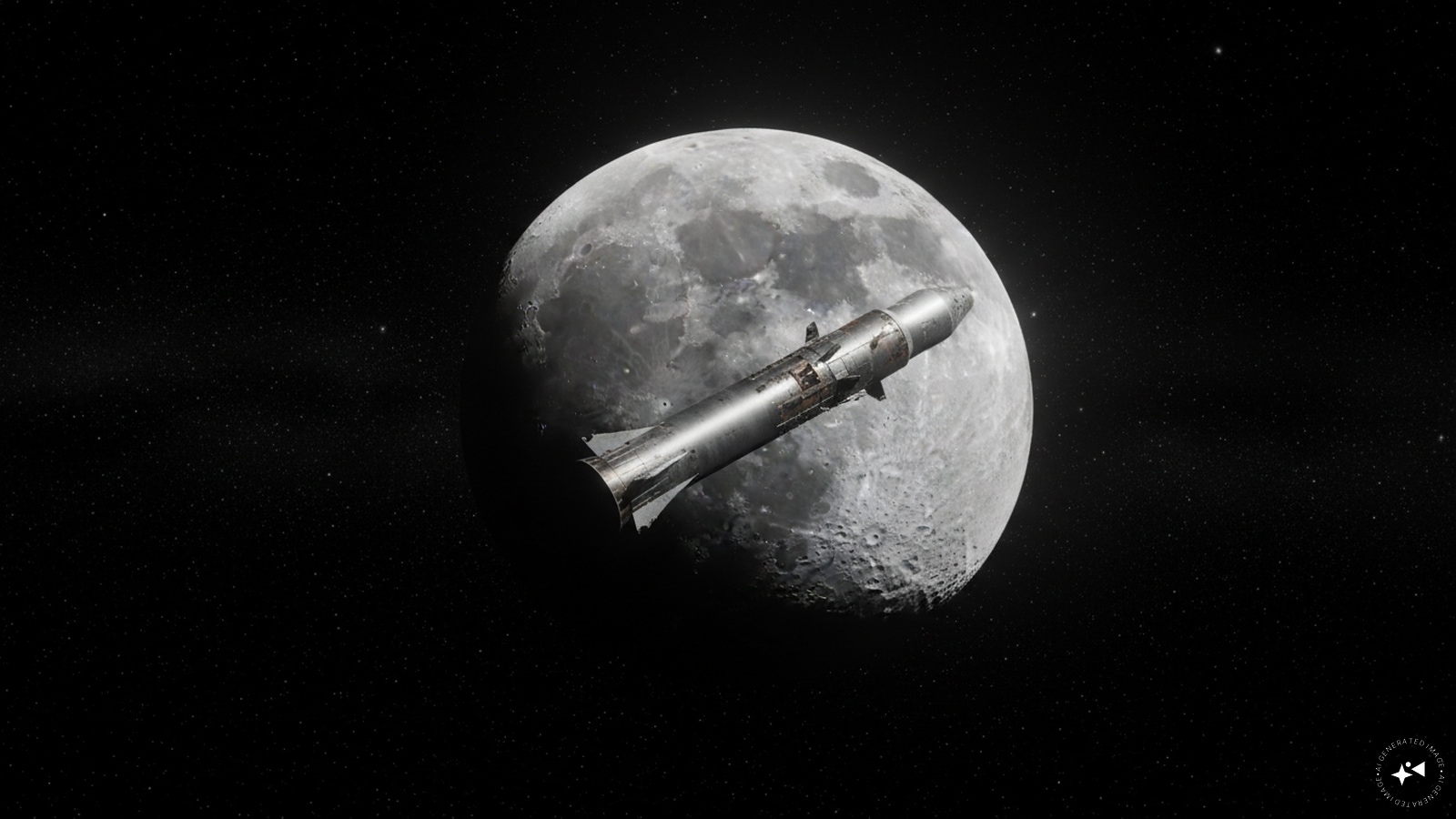
A four-ton piece of dead metal just slammed into the lunar surface at roughly 8,700 kilometers per hour.
You read that right. A discarded Falcon 9 upper stage—left floating in a looping orbit after launching a pair of lunar landers back in January 2025—finally met its messy end near the Moon's Einstein Crater. While it didn't threaten Earth, the high-speed collision has reignited a very real conversation about what we are leaving behind in deep space.
Let's look past the sensational headlines and break down what actually happened, why orbital mechanics turned this booster into a projectile, and what this means for future space missions.
How a Routine Mission Turned Into a Lunar Impact
The upper stage wasn't supposed to hit the Moon. When SpaceX launched the mission, the first stage returned to Earth as planned, while the upper stage successfully pushed its payload toward deep space. SpaceX carried out its standard disposal procedures, but space is messy.
Over the course of a year-long drift, a mix of solar activity and the shifting gravitational tugs of both Earth and the Moon altered the booster's path. Instead of floating harmlessly into a stable orbit, it was nudged onto a direct collision course.
Unlike Earth, the Moon has practically no atmosphere. There is no air resistance to burn up incoming debris before it hits the ground. That means when a school-bus-sized cylinder of aluminum and steel hits the lunar regolith at seven times the speed of sound, it doesn't just fizzle out. It carves out a brand-new crater roughly 60 to 100 feet wide, scattering debris for miles.
What Scientists Learned From the Smash
Most people assume an accidental crash like this is purely a bad thing, but astronomers actually treated it as a rare scientific opportunity. Because orbital trackers like Bill Gray and independent researchers managed to calculate the exact trajectory ahead of time, the scientific community was ready.
Ground-based instruments, such as the European Southern Observatory's Very Large Telescope in Chile, managed to detect distinct chemical signatures—including sodium and lithium—streaking into space from the impact zone. Furthermore, orbiting spacecraft like NASA's Lunar Reconnaissance Orbiter and South Korea's Danuri probe were positioned to study the dust dynamics and snap before-and-after photos of the newly formed crater.
This isn't even the first time humans have accidentally smashed a rocket into the lunar surface. A Chinese rocket segment made an unintentional impact back in 2022, and NASA deliberately hurled hardware at the Moon during the Apollo era to run seismic experiments. However, tracking an uncontrolled commercial booster provides valuable data on how artificial debris behaves in low-gravity environments.
The Real Problem With Lunar Litter
We have a space junk crisis building up, and it's not just crowded in low-Earth orbit anymore. As space agencies and private companies ramp up plans for permanent lunar bases, crewed Artemis missions, and resource extraction, the space between Earth and the Moon is getting busy.
Leaving massive rocket parts in chaotic, unpredictable orbits is a bad habit we need to break. While this specific SpaceX booster posed zero risk to people on Earth, future lunar outposts won't appreciate random four-ton projectiles raining down unannounced.
SpaceX and other aerospace firms are under increasing pressure to refine post-mission disposal maneuvers—such as pushing spent stages into heliocentric orbits around the Sun rather than leaving them dangling in Earth-Moon space.
Keep an eye on upcoming data releases from lunar orbiters over the next week. The photos of the Einstein Crater impact site will give us our clearest look yet at what happens when our industrial past violently meets our planetary future. Stop ignoring the clutter we leave behind in orbit, because the Moon is keeping score.