When a glacier collapse triggered catastrophic flash floods across Nepal on August 26, 2026, it didn't just wash away homes and bridges. It completely severed entire communities from basic survival infrastructure.
Today, thousands of displaced residents crammed into relief camps face a grim daily reality. While official relief trucks drop off cartons of instant noodles and basic rations, survivors are forced to trade that very food for hard cash just to buy life-saving prescription medicines.
If you look past the standard disaster headlines, the true human cost lies in these desperate grassroots exchanges and the sheer ingenuity required to cross fractured geography.
The Harsh Arithmetic of Camp Life
Disaster response rarely matches individual medical needs. When you're displaced and grieving, generalized aid boxes don't account for chronic illness.
Take Suresh Kumar Karanjit. Staying at a temporary relief center in Devighat within the Nuwakot district, Karanjit lost his younger brother to the floods. On top of that grief, the local camp distribution center didn't stock the specific heart medication he requires.
His solution? He traded a carton of government-provided relief noodles for 400 rupees—roughly $2.60 USD—to secure the cash needed for his prescription.
Multiply this scenario across dozens of camps housing over 4,500 displaced people in Nepal, and a clear picture emerges. Basic food distributions are keeping people fed, but they aren't keeping them alive. Bureaucratic relief frameworks often fail to bridge the gap between mass food supply and targeted healthcare.
Nepal’s disaster management agency, led by officials like Dharam Raj Uprety, has maintained that health centers staffed by doctors are operational in these shelters. Yet on the ground, specialized prescriptions or exact drug formulations remain frustratingly out of reach for many survivors who spent their last pennies before the floods hit.
Crossing the Trishuli River on a Wire
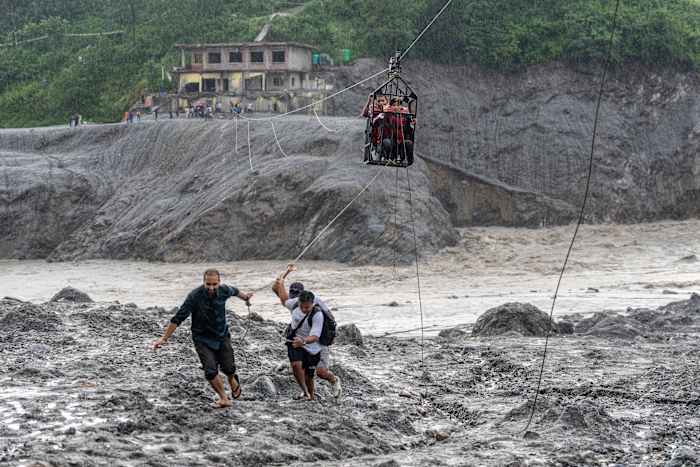
Physical isolation poses an equal threat. With bridges smashed and roads turned to rubble by the glacier-fed torrents along a 60-mile stretch of the Trishuli River and Lende Khola, communities found themselves trapped.
Government heavy machinery takes time to mobilize. People couldn't wait.
In Bidur town, residents took matters into their own hands. They rigged a makeshift steel-wire zipline across the raging Trishuli River. Army personnel now assist locals and commuters onto the zip line, pulling them across the gap just to maintain basic mobility.
It’s dangerous. It’s improvised. It’s also the only way across for miles.
While international partners and specialized rescue teams from countries like India, China, and the United States focus heavy equipment on trapped workers inside hydroelectric project tunnels—such as the Trishuli-3A excavation site where hundreds remained missing—ordinary citizens rely on gravity and steel cables to cross the water.
The Wider Crisis Behind the Statistics
The scale of the disaster is staggering. Official figures place the death toll above 1,200 people, with thousands more missing. Across the northern border in Tibet, the same weather system claimed dozens of lives and left hundreds missing.
Disaster response experts point to a recurring systemic failure in Himalayan flood zones: infrastructure is built to withstand seasonal monsoons, not sudden, catastrophic glacial lake outburst floods. When an entire mountain valley changes shape in minutes, standard emergency playbooks break down.
Relief agencies are slowly adapting. Cargo drones and traditional Himalayan porters are being deployed to reach cut-off mountain clusters where roads no longer exist. But for those sitting in temporary tarps waiting for the next phase of rebuilding, survival remains an hour-by-hour negotiation.
If you are tracking international relief efforts or looking to support grassroots medical pipelines in South Asia's flood zones, focus your contributions on organizations specializing in direct pharmaceutical logistics rather than bulk food distribution. Getting the right pill to the right tent matters just as much as keeping the kitchen fires lit.