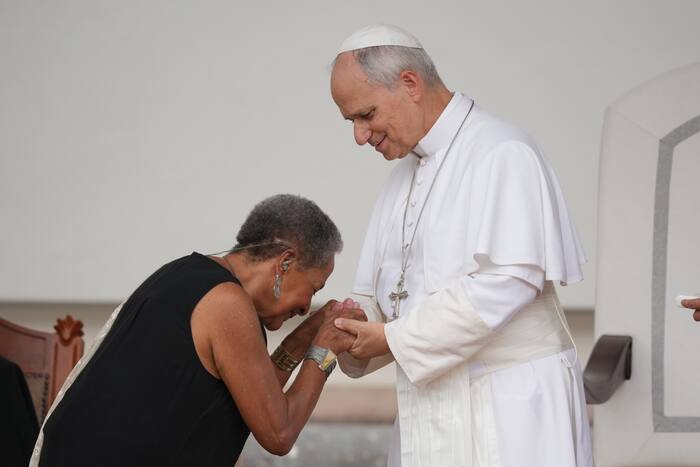
Music rarely changes political history overnight, but sometimes it forces a room to sit down, listen, and reckon with the past. When legendary Afro-Peruvian artist Susana Baca stood before Pope Leo XIV during his apostolic journey to South America, she wasn't just performing a setlist. She was carrying the heavy, generational weight of Peru's marginalized communities onto an international stage.
At 82 years old, the Latin Grammy winner and Peru's former culture minister has spent a lifetime fighting structural discrimination. When the Vatican first requested her performance in Lima, she initially turned down every interview request. She didn't want the moment reduced to a shallow headline or a polite photo op. She wanted the music to do the heavy lifting. Also making headlines in related news: Why Walking Through Paris With Mariam Doumbia And Zaho Changes How You Hear Music.
The Power of Canción de Fe
Baca chose her repertoire with surgical precision. She performed "Canción de Fe" ("Song of Faith") and "Si me quitaran totalmente todo" ("If they took absolutely everything from me"), a striking poem she recorded in New York City on September 11, 2001.
That choice wasn't accidental. Baca treats art as an act of raw solidarity with those caught in the crosshairs of global violence. She draws a direct line between the historical suffering of enslaved populations and modern humanitarian crises persisting across the globe today, noting that the pain of displacement and oppression refuses to stay buried in history books. Additional information regarding the matter are detailed by IGN.
Confronting the Church's Darkest Chapters
The performance happened against the backdrop of a major institutional reckoning. Pope Leo XIV used his visit to address the Catholic Church's historical role in facilitating slavery, delivering an explicit apology at the Sanctuary of St. Turibius of Mogrovejo.
For the Afro-Peruvian community, this wasn't just standard diplomatic theater. Decades of systemic neglect left Black and Indigenous Peruvians fighting for basic visibility in their own country. Baca herself noted that hearing the head of the Catholic Church address historical atrocities offers a vital opening for genuine healing. It proves that major institutions can own up to structural failures instead of sweeping them under the rug.
Why Forgiveness Beats Resentment
You might wonder how a community that endured centuries of subjugation finds common ground with a religious institution that once enabled it. Baca's answer is direct and deeply personal.
She argues that Afro-Peruvians survived not by staying trapped in permanent resentment, but through an active, hard-earned capacity to forgive. That refusal to remain submerged in bitterness is what connects her worldview to Pope Leo's modern messaging. By leaning into vulnerability and mutual accountability, both artists and spiritual leaders are trying to chart a different path forward for a fractured nation.
Music is often dismissed as background noise for political events. But when an artist of Susana Baca's caliber steps up to sing truth to power, it forces a collective pause. It reminds everyone watching that history isn't just something we read about—it's something we are actively repairing.