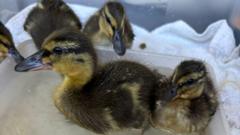
You don't expect to find life starting inside a wastewater treatment tank. Honestly, it's pretty much the last place any sane creature would build a home. Yet, a couple of utility workers in Devon just proved that nature doesn't care about our infrastructure boundaries.
When James Blakesley and Josh Corderoy set out for routine tank cleaning at the Totnes Sewage Treatment Works, they expected sludge and mechanical maintenance. Instead, they spotted a fragile bird nest resting precariously on floating matter right inside one of the active processing tanks. It was an absolute disaster waiting to happen. The slightest shift in wastewater levels would have flipped the nest, destroying the seven unhatched eggs inside.
What followed wasn't a standard corporate protocol. It was a chaotic, brilliant bit of field improvisation that saved five newborn mallards from a grim fate.
The makeshift rescue that actually worked
Most wildlife rescues fail when untrained people try to intervene too quickly. But Blakesley, a catchment technician, and Corderoy, a wastewater operator, realized the clock was ticking. The nest was actively drifting.
They grabbed a standard industrial rubble sack, padded it out to cushion an impact, and tied it securely to a rope so it would float on the surface. Using a long sampling pole—the kind normally used to check water quality parameters—they gently nudged the eggs out of the nest and directly into the floating bag.
Moving wild eggs without cracking them is incredibly difficult. Doing it with a long pole over a pool of raw sewage is a miracle. They recovered all seven eggs without a single crack.
Instead of leaving them to chill, Blakesley took the eggs home and set up an incubator. Six hatched. Five survived those volatile first few days. Today, those five ducklings are actively thriving, swimming in a backyard paddling pool, and sleeping inside a repurposed children's playhouse.
Why water treatment plants attract nesting birds
It sounds bizarre to us, but birds frequently mistake industrial water infrastructure for natural wetlands. From an aerial view, a massive, circular open-air settlement tank looks exactly like a calm, predator-free lake.
The concrete walls keep land predators like foxes, rats, and feral cats entirely at bay. For a mother duck, it feels like a fortress.
The problem is the hidden mechanics. Treatment tanks use active machinery, rotating scrapers, and aggressive aeration bubbles to break down organic material. The water density in aeration lanes is lower because of the forced air, meaning birds can struggle to stay buoyant and drown. The floating crust or scum layers might seem solid enough for a nest, but they constantly shift, dissolve, or get sucked into filtration intakes. It's a classic ecological trap. Animals are drawn to an environment that appears ideal but is highly lethal in practice.
What it actually takes to keep orphaned ducklings alive
If you think raising ducklings is all cute waddling and paddling pools, you're dead wrong. It's an exhausting, messy commitment. Wild ducklings are precocial, meaning they hatch fully alert and able to feed themselves within hours. But they are also completely unable to regulate their own internal body temperature for the first four to six weeks of life.
Without a mother duck to provide brooding warmth, they will quickly succumb to hypothermia. Blakesley had to rely on a precise heat lamp setup, slowly lowering the temperature by five degrees each week as the birds grew.
Then there's the waterproofing issue. Baby ducks are covered in soft down fur, not feathers. In the wild, a mother duck rubs her own uropygial gland oil—a specialized waterproofing wax found near the tail—onto her ducklings. Orphaned ducklings lack this protective coating. If they swim for too long without it, their down gets waterlogged, they lose core heat, and they can drown in a couple of inches of water.
The complex reality of releasing captive-raised wildlife
Right now, the Totnes ducklings are living the good life. The Blakesley family plans to transition them from the playhouse to a larger indoor enclosure, and eventually into a modified chicken coop situated next to a natural stream and pond on their property.
It sounds like a perfect fairytale ending, but integrating hand-reared wild ducks back into the ecosystem is incredibly risky.
- Imprinting issues: When ducklings spend their formative weeks interacting with humans, listening to children play, and getting fed without effort, they lose their natural fear of people. A wild duck that approaches humans looking for food is highly vulnerable to domestic pets, traffic, and hunters.
- Foraging deficits: While diving and surface feeding are largely instinctual, a mother duck teaches her brood exactly what to eat and where to find it during seasonal shifts. Captive diets of starter crumbs and garden bugs don't fully replicate the competitive realities of a wild riverbank.
- Flock dynamics: Survival in the wild requires integration into local mallard populations for winter migration and predator defense. Safe transition takes time.
Blakesley’s strategy of using a soft release—letting the birds gradually explore the stream and pond on his property while still providing a secure shelter—is the best way to handle this. It allows the ducklings to naturally wild-up at their own pace.
How to safely handle a wild nest discovery
If you ever stumble across a wild bird nest in an unsafe area, don't just grab a bucket and take the eggs home. In the UK, wild birds, their nests, and their eggs are strictly protected under the Wildlife and Countryside Act 1981. It's technically illegal to take or possess wild eggs unless you can prove you acted strictly for the purpose of saving a bird in immediate danger.
If you find a nest in a dangerous location, follow these steps immediately.
- Assess the immediate threat: Is the nest actively flooding or about to be crushed by machinery? If the parents are nearby and the location is stable, leave it completely alone.
- Contact local experts: Call a registered wildlife rehabilitation center or organizations like the RSPCA. They have specialized incubation equipment and licensing to handle wild species properly.
- Provide emergency insulation: If you must move eggs to prevent immediate destruction, keep them upright and warm. Do not shake them. Rapid temperature swings or rough handling will detach the internal embryo, killing the chick instantly.
The Totnes rescue was a rare victory born out of quick thinking and a lot of luck. But the real work for these five small ducklings has only just begun as they learn to navigate a world that doesn't involve paddling pools and human playhouses.