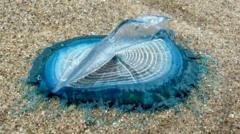
Stumbling across hundreds of vibrant, neon-blue discs scattered across a sandy shore looks like walking onto an alien planet. That is precisely what beachgoers experienced recently at St Bees beach in Cumbria, northwest England, when persistent westerly winds drove massive fleets of marine drifters onto the coast.
If you spot these striking organisms, you aren't looking at ordinary jellyfish. You are staring at Velella velella—commonly known as by-the-wind sailors. They measure a mere two inches across, flaunt an electric blue hue, and possess a stiff, translucent diagonal sail. For a closer look into this area, we suggest: this related article.
Most people completely misunderstand what these organisms actually are and why they end up stranded en masse. Let's break down the reality behind these coastal visitors.
What Are By-the-Wind Sailors Really
They look like jellyfish, but they aren't. Biologically speaking, each individual by-the-wind sailor is actually a floating colony of specialized polyps working as a single, unified organism. To get more background on this development, detailed reporting can also be found on NBC News.
Individual polyps inside the colony divide up the labor. Some handle feeding, others manage reproduction, and the rest take care of defense. That translucent sail on top isn't just for show. It catches the surface breezes, propelling the colony across open ocean waters.
Because they rely entirely on surface winds to travel, they have zero control over their steering. When strong, persistent onshore gales blow for days, these open-ocean drifters get trapped. They wash ashore by the thousands, creating a striking but tragic coastal spectacle.
Are They Dangerous to Touch
Local wildlife organizations, including the Cumbria Wildlife Trust, immediately issued warnings when the recent strandings occurred: look, but do not touch.
They belong to the same broader taxonomic group as the infamous Portuguese man o' war. While their sting is significantly milder and rarely causes severe medical emergencies in healthy adults, handling them can still trigger a nasty skin reaction or irritation, especially if you accidentally touch your face or eyes afterward.
If you're walking your dog along a strandline littered with these blue drifters, keep your pets away. Dogs might try to investigate or ingest them, which can lead to unnecessary stomach upset or localized irritation.
The Fleeting Lifecycle on Land
Once these creatures land on the beach, their time is strictly limited. Out in the open water, their brilliant blue pigment shines under the sun. Once stranded, they dry out rapidly.
Within hours or days of a mass stranding, the vibrant blue color fades completely. They turn a papery, translucent white as they decompose, eventually leaving behind little more than their thin plastic-like internal sails. Beach scavengers like gulls quickly arrive to feast on the sudden influx of marine biomass, turning a sterile stretch of sand into a temporary, active ecosystem.
Strandings happen periodically following heavy winter or spring storms. They serve as a stark reminder of how closely connected our shorelines are to deep ocean weather patterns.
Next time you spot a patch of brilliant blue on the tide line, take your photos from a safe distance, respect the local wildlife warnings, and leave the stranded colonies to nature.
Strange Blue Creatures Invade Oregon Beaches
This video provides a close-up look at thousands of Velella velella washing ashore and explains how their unique sails catch the wind to drive them across the open ocean.