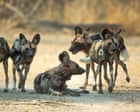
Imagine walking across an entire country just to find a date. Three male African wild dogs didn't just imagine it; they actually pulled it off. In July 2025, these three littermates packed up and left their birth group—known as the Mayukuyuku Pack—deep inside Zambia's Kafue National Park. Eight months later, GPS tracking revealed they had covered an astonishing 4,126 kilometers.
Published in the journal Ecology and led by researchers like Scott Creel of Montana State University alongside the Zambian Carnivore Programme, this tracking data documents the longest recorded dispersal of any African land mammal in history. It is an unbelievable feat of endurance. But it is also a glaring warning about how fragmented our natural world has become. Learn more on a related subject: this related article.
Why African Wild Dogs Travel Such Insane Distances
If you don't know much about African wild dogs (Lycaon pictus), their social structure is rigid. They live in tight-knit, cooperative packs, but close inbreeding is strictly forbidden. When pups hit two or three years of age, nature forces a choice. They disperse.
These young adults leave their birth packs to search for unrelated animals of the opposite sex to form brand new breeding groups. Four of these brothers' sisters actually left the very same Mayukuyuku Pack roughly two weeks before the males did. While dispersal is entirely normal, the sheer scale of what these three brothers endured takes your breath away. Additional journalism by AFAR explores similar perspectives on this issue.
Think about the math for a second. The absolute straight-line distance between where they started in Kafue National Park and where they finally settled near the Luano Game Management Area was only about 419 kilometers. Yet, they racked up 4,126 kilometers on their pedometers. Why? Because modern Zambia isn't a straight line of pristine wilderness anymore.
Navigating Concrete and Obstacles
The trio's route reads like a masterclass in spatial problem-solving. They didn't just jog across an empty savanna. Instead, they navigated a chaotic patchwork of protected zones, busy roads, massive reservoirs, and sprawling human infrastructure.
When the brothers headed north toward industrial hubs like Kitwe and Ndola, they didn't march straight through downtown. They hit the urban boundaries, recognized the danger, and turned around. On one specific stretch, they retraced their steps for nearly 200 kilometers just to find a safer way around.
Large bodies of water presented identical headaches. Rather than testing their luck swimming across massive reservoirs, the dogs detoured entirely around them. They eventually pushed east toward the Luangwa Valley ecosystem, weaving through game management areas like Chisomo and Petauke before finally putting down roots near the Great Rift Escarpment.
By November 2025—just a few months into the trip—they had already crossed 2,300 kilometers. They kept going.
The Grim Reality Behind the Triumph
Stories like this make for incredible headlines, but conservationists aren't popping champagne just yet. Matt Becker, CEO of the Zambian Carnivore Programme, points out a bitter truth: extreme movement doesn't automatically mean long-term survival.
Wild dogs face devastating threats outside of national parks. Snares set by poachers pose an invisible, deadly hazard across unprotected lands. Other tracking groups monitored during the same research project met tragic ends. One female named EWD-1355 journeyed 2,300 kilometers into Mozambique only to be killed by an illegal snare.
The landscape is broken. Roads slice through migration paths. Farms and towns cut off traditional corridors. When animals are forced to walk 4,000 kilometers just to find a mate, it proves that isolated national parks are no longer big enough to sustain megafauna on their own.
What Needs to Happen Next
If we want species like the African wild dog to avoid extinction—with only around 6,000 individuals left across the entire continent—we have to change how we manage land.
Protected areas are basically islands in a human-dominated sea. To fix this, conservation groups are aggressively pushing for functional wildlife corridors. These are natural strips of land that bridge the gap between separated habitats, allowing predators to move safely without dodging traffic or running into snare lines.
The epic journey of the three Zambian brothers highlights an undeniable resilience. These animals want to survive, and they possess the physical capability to adapt to a changing world. But they shouldn't have to run a 4,126-kilometer marathon just to keep their species alive. Supporting cross-border conservation initiatives and expanding protected corridors isn't optional anymore. It is the only way these incredible runners will have a finish line tomorrow.