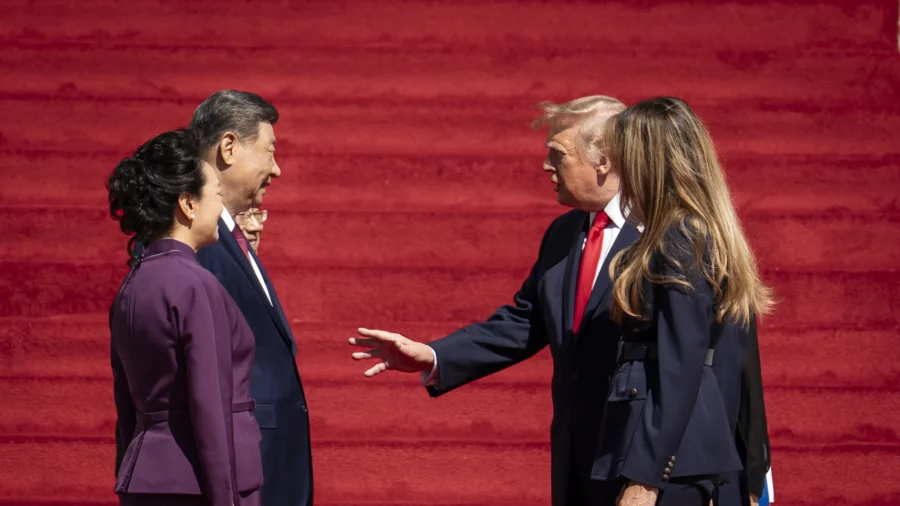
When Chinese President Xi Jinping recently told Donald Trump that the famous Thucydides Trap can be overcome, international media outlets scrambled to parse the ancient Greek reference. People love a good historical analogy. It makes complex geopolitical friction feel neat, tidy, and predictable. But applying a 2,500-year-old framework about Athens and Sparta to modern nuclear-armed superpowers is lazy analysis that obscures what is actually happening on the ground between Washington and Beijing.
You don't need a degree in classical history to see that the world's two largest economies are locked in a high-stakes, structural rivalry. Yet treating conflict as a historical inevitability ignores how global supply chains, economic interdependence, and modern deterrence have completely rewritten the rules of engagement. In similar developments, take a look at: Why India And Russia Are Quietly Rewriting Their Strategy At The Un.
Breaking Down the Ancient Analogy
The whole concept rests on a simple premise: when a rising power threatens to displace an established ruling power, fear takes over, and war results. Harvard political scientist Graham Allison popularized this idea, looking back at historical cases where an emerging challenger spooked a dominant hegemon.
Beijing and Washington have spent years talking around this framework. Xi has brought it up repeatedly, from his early visits to the United States to high-profile summits. The underlying messaging is consistent. China wants to signal that it views itself as a peer rather than a subordinate, while simultaneously insisting that a cataclysmic clash isn't written in stone. TIME has provided coverage on this important subject in extensive detail.
Washington policymakers view the framing with deep skepticism. American strategy focuses heavily on guardrails, technological containment, and securing domestic industrial supply chains. When Xi asserts that the trap can be beaten, he is pitching a model of managed coexistence. He wants an arrangement where both countries can expand their economic and technological footprint without triggering an open military collision.
Why Modern Coexistence Looks Nothing Like Athens and Sparta
Ancient Greece didn't have globalized financial markets, semiconductor supply chains, or mutual assured destruction. If Athens and Sparta fought, trade stopped and soldiers clashed directly. Today, trying to decouple the American and Chinese economies completely is like trying to untangle a bowl of cooked noodles without breaking a single strand.
Look at what actually happens day-to-day. Corporate leaders from Apple, Tesla, and Nvidia sit across the table from government officials in both countries, hammering out commercial realities. Critical minerals like yttrium sit at the center of fierce export controls, showing that leverage isn't just about military might—it's about who controls the raw components powering the next generation of advanced manufacturing and artificial intelligence.
China isn't just a rising manufacturing hub anymore. It's an exporter of electric vehicles, batteries, renewable energy, and telecommunications infrastructure. At the same time, the United States maintains massive structural advantages in frontier research universities, capital markets, advanced microchips, and global military projection.
Neither side can afford to destroy the other without inflicting catastrophic self-harm. That commercial and technological integration changes the math entirely. It creates a brutal, unyielding form of competition, but it builds structural friction that resists sliding into outright war.
The Real Flashpoints Nobody Wants to Solve With History Books
History books won't solve the immediate disagreements dividing the two nations. The real danger zones are specific and operational.
Taiwan remains the most sensitive core issue in the relationship. Beijing views the self-governing democracy as an absolute red line, warning that mishandling the issue risks pushing bilateral ties into a perilous freefall. Washington maintains a policy of strategic ambiguity while continuing arms sales and upholding strong commercial ties with Taipei.
Beyond territorial disputes, the race for dominance in artificial intelligence presents a brand-new frontier of tension. Both governments recognize that whoever controls advanced algorithms and automated systems holds the keys to future economic and military supremacy. That's why recent diplomatic talks have increasingly zeroed in on keeping AI under human control and establishing baseline technical safeguards against catastrophic misuse.
Moving Beyond the Rhetoric
If you're trying to make sense of where global markets and international security are heading, stop waiting for a historic war or a miraculous reconciliation. Neither is coming.
The reality is messy, sustained, and highly competitive coexistence. You're going to see continuous tariff battles, export restrictions on high-end technology, and intense posturing over regional security. Businesses operating internationally must bake this permanent friction into their long-term supply chain strategies, assuming that cross-border volatility is the baseline rather than an exception.
Pay attention to practical crisis-management mechanisms rather than grand philosophical declarations. When military leaders maintain open communication channels and governments agree on basic guardrails for emerging technologies, the risk of accidental escalation drops dramatically. Focus on the mechanics of containment rather than the poetry of ancient history.