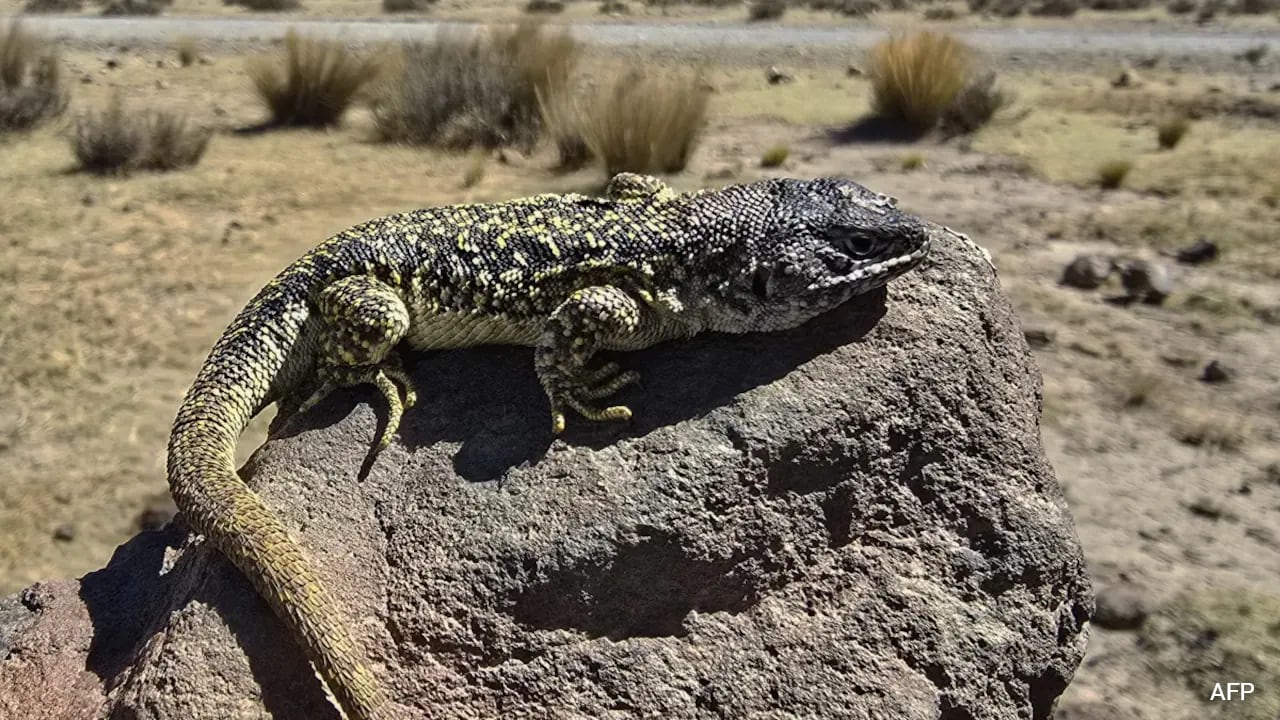
High up in the freezing, punishing heights of the southern Peruvian Andes, life finds a way. Scientists working over 4,800 meters above sea level in the Arequipa region just proved this once again. They discovered a brand-new reptile species, pushing Peru's known lizard count to 296.
Meet Liolaemus archipensis.
Announced by the Natural History Museum of San Marcos University and detailed in the Swiss scientific journal Diversity, this tiny creature shows just how much wilderness remains completely unexplored. Biologist Ling Huamani-Valderrama led the research team that brought this animal to light. Finding any vertebrate at an altitude of nearly 16,000 feet is impressive. Finding something entirely unknown to science is a massive win for South American field biology.
Life at the Extremes
Most people picture lizards lounging on sun-baked tropical rocks. They don't imagine them freezing at high-altitude passes where oxygen is scarce and temperatures drop drastically overnight. Yet, Liolaemus archipensis thrives in these harsh alpine conditions.
Measuring a modest six to eight centimeters long—roughly 2.4 to 3.2 inches—this miniature survivor has adapted perfectly to its rocky, unforgiving home. To survive, it relies on a specialized diet. It feeds on plants and small arthropods, including spiders, beetles, true bugs, and insect larvae that somehow also manage to exist in this extreme biome.
Survival up there isn't just about what you eat. It's about avoiding being eaten.
Spotting the Invisible
Nature has equipped Liolaemus archipensis with subtle, gender-specific camouflage. Males and females look distinctly different, an evolutionary trait that helps them blend into their rocky surroundings.
Females sport square-shaped spots across their backs. Males feature oblique markings paired with pale white scales. These patterns break up their outlines against the jagged stones of the high Andes, hiding them from sharp-eyed avian predators cruising the mountain thermals.
Spotting them requires immense patience. Field researchers don't just stumble upon these animals by accident. Finding a tiny reptile in a sprawling mountain range takes meticulous surveying, harsh weather endurance, and deep ecological knowledge.
Why Finding One More Lizard Matters
When news breaks about a single new lizard, skeptics often ask why it matters. After all, the world has millions of species. What difference does one tiny cold-blooded animal make?
Biologists will tell you that every single discovery acts as a baseline metric for ecosystem health. Peru ranks among the most biodiverse countries on the planet. Its varied terrain—stretching from the Amazon basin up to the freezing Andean peaks—creates isolated microclimates where unique species evolve independently.
When researchers map these populations, they gain vital data on how animals adapt to altitude, climate shifts, and changing weather patterns. Documenting these organisms before environmental pressures wipe them out is urgent work.
The Broader Picture of Peruvian Discovery
This lizard discovery isn't an isolated event. Peru's wilderness continues to surprise researchers year after year.
Expeditions across the country routinely uncover hidden biodiversity. Past surveys in remote Amazonian forests have revealed bizarre creatures like web-footed "amphibious mice," new species of fish, rare butterflies, and rodents previously unknown to science. Paleontologists working in the Ocucaje Desert have even unearthed ancient fossilized skeletons of prehistoric marine creatures dating back millions of years.
Each discovery chips away at the illusion that we have fully cataloged our planet. We haven't. The wilderness still holds countless secrets, waiting for scientists willing to climb high enough, dig deep enough, or look closely enough.
If you want to support or follow ongoing biodiversity research in South America, look into field institutions like San Marcos University or international conservation programs actively funding field expeditions. The work happening on these remote mountain slopes protects ecosystems we are only just beginning to understand.