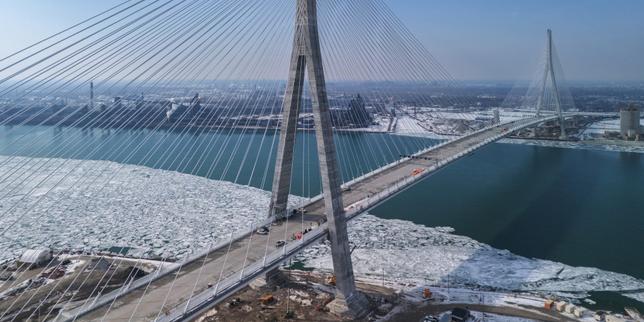
The ribbon-cutting ceremony was scheduled for Friday. Invitations were out. Workers on both sides of the Detroit River had spent years piecing together a $5.7 billion mega-project designed to ease North America's busiest commercial artery. Then, on Thursday morning, everything ground to a sudden halt.
The Windsor-Detroit Bridge Authority dropped a bombshell statement announcing that Canada and the United States have agreed to postpone the opening of the Gordie Howe International Bridge. The official reason? To resolve "outstanding issues" and take the necessary time to ensure readiness. No new date. No timeline. Just an indefinite delay.
If you believe this is a routine engineering hiccup, you're missing the real story. This isn't about concrete curing or cable tension. It's about a high-stakes geopolitical game of chicken between Ottawa and the White House.
The Geopolitical Standoff Over a Span of Steel
To understand why a nearly finished bridge is sitting empty, you have to look back at what happened earlier this year. In February, President Donald Trump threw a massive wrench into the gears. He publicly threatened to block the bridge from opening unless Canada agreed to a series of steep demands.
His biggest condition? Canada must hand over at least half the ownership of the bridge to the U.S. federal government.
Here's the problem with that demand. The Gordie Howe International Bridge is jointly owned by Canada and the State of Michigan, but Canada entirely financed the $5.7 billion project. The Canadian federal government paid the bill with the explicit plan to recover its massive investment through toll revenues over the coming decades. Trump's demand to suddenly split ownership—without chipping in for the construction costs—is a total non-starter for Ottawa.
He also blasted Canada for not using enough American materials during construction, claiming the U.S. had absolutely nothing to gain from the project.
For months, the project's fate hung in limbo. A brief window of hope opened when Michigan Governor Gretchen Whitmer and White House Chief of Staff Susie Wiles held talks, prompting those Friday opening invitations to go out. But behind closed doors, the fundamental disagreement didn't budge. The U.S. federal government requested the delay, and Canada ultimately agreed to hit pause rather than force a confrontation.
What's Really at Stake for Cross-Border Trade
People aren't just upset about a delayed party; they're worried about the massive economic fallout. The Windsor-Detroit corridor handles roughly 25% of all surface trade between Canada and the United States. Every single day, thousands of trucks haul auto parts, agricultural goods, and manufactured products across the border.
Right now, the aging Ambassador Bridge bears the brunt of this traffic. It's a privately owned, century-old bottleneck. If something happens to it, a quarter of cross-border commerce instantly chokes. The Gordie Howe Bridge was built specifically to eliminate this single point of failure, connecting directly to major highways on both sides: Interstate 75 in Michigan and Highway 401 in Ontario.
Windsor Mayor Drew Dilkens didn't hold back his frustration after the announcement. He posted on social media that while everyone wants the bridge to open, Canada shouldn't cave under pressure. He explicitly called on Canadian Prime Minister Mark Carney to stand firm and secure a fair trade deal rather than fall on a bent knee.
Honestly, he's right. If Canada gives up half the bridge's equity now, it sets a terrible precedent for future cross-border infrastructure.
What Happens Next for Commuters and Logistics Firms
If you run a logistics company or drive a truck for a living, you're basically stuck playing the waiting game. The immediate next steps don't involve construction crews; they involve diplomats and trade lawyers.
Here is what you should watch closely in the coming weeks to figure out when traffic will actually start moving:
- Watch the Toll Revenue Negotiations: Look for leaks or statements regarding how toll collections might be split or adjusted. If Ottawa compromises on giving the U.S. a cut of the revenue without giving up actual ownership, that might satisfy Washington.
- Track Carney's Trade Statements: Prime Minister Mark Carney has stayed relatively tight-lipped, citing "technical aspects" to reporters. Watch if his tone shifts toward broader trade talks, as the bridge is clearly being used as leverage for larger economic concessions.
- Monitor the Status of the Ambassador Bridge: The current crossing will continue to see heavy congestion. Logistics managers should plan for extended wait times at customs, as the expected relief from the new span won't arrive this summer.
Don't expect a quick fix. When a multi-billion-dollar trade asset becomes a political hostage, resolving the deadlock takes time. Until Washington and Ottawa find a way to save face, one of the greatest engineering feats in North American history will remain an expensive, quiet monument spanning the Detroit River.