National security shouldn't be treated like a short-term volatility hedge on Wall Street. When policymakers soften export controls, slow down blacklists, or intervene in corporate boardrooms just to calm equity markets, they're trading long-term strategic safety for a quick bump in share prices. We've seen that exact tension play out in November 2026 across AI chips, tariffs, and Washington's clash over how much risk the stock market can stomach.
Honestly, it's a scandal that keeps repeating in new outfits. One week, tariffs rattle the S&P 500 and trigger walk-backs to stop the bleeding. Another week, export-control enforcement around advanced AI chips gets tangled up in lobbying, cabinet friction, and sudden CEO drama, sending semiconductor stocks swinging wildly before a high-profile reinstatement whips the market right back up. Investors cheer the green candles. National security analysts look at what got compromised along the way.
Where Stock Market Pressure Meets National Security
Look at how fast market anxiety forces Washington's hand. In April 2025, broad tariff announcements sparked a sharp sell-off in the S&P 500 and pushed 10-year Treasury yields higher, prompting swift adjustments and reversals as reported by the Peterson Institute for International Economics. Markets hate uncertainty, especially when supply chains and profit margins get squeezed all at once.
AI hardware raises the stakes even higher. Advanced processors aren't just another consumer gadget or industrial commodity anymore. They power frontier AI models, defense logistics, intelligence analysis, and next-generation compute clusters. When export rules tighten, chipmakers face real revenue headwinds and supply-chain headaches. When enforcement lags or rules get watered down, foreign buyers find workarounds—including renting remote compute capacity through offshore data centers.
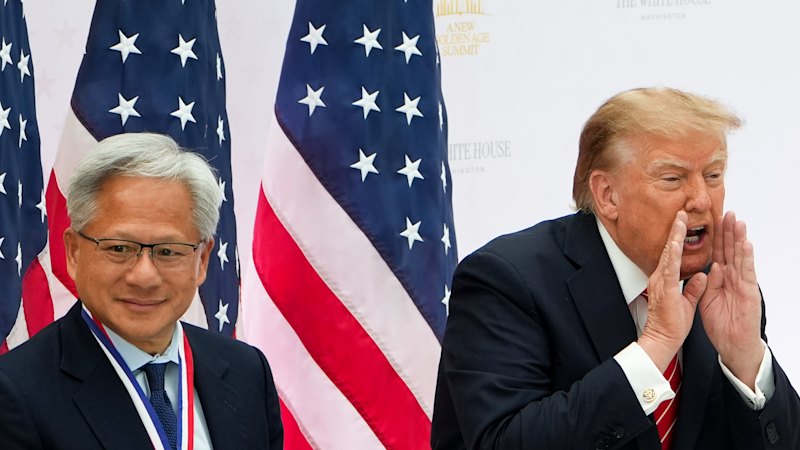
Take the November 2026 Nvidia saga. After reports surfaced linking former executive Alice Huang—with whom CEO Jensen Huang had an affair—to Singapore-based Megaspeed and allegations of Chinese intelligence contacts and chip smuggling or remote-access loopholes, Nvidia's stock took a beating. Jensen Huang resigned on November 12, 2026, shares slid roughly 24% over the month, and Washington scrambled. By November 16, the Commerce Department rolled out tighter rules targeting remote AI chip access via overseas data centers, and by November 23, reports indicated the administration moved to add Megaspeed to a trade blacklist while Nvidia's board reinstated Jensen Huang following White House outreach.
Watching a trillion-dollar chipmaker's leadership and regulatory posture bounce around in real time shows how tightly intertwined market sentiment and statecraft have become. That doesn't mean every market dip proves a betrayal. Sometimes a sell-off is just investors pricing in slower growth or higher compliance costs. The real problem starts when protecting a stock chart becomes the primary goal, pushing security guardrails into second place.
The Loophole Trap in Chip Controls
Export controls sound neat on paper. Ban certain shipments, require licenses for others, and keep sensitive hardware out of restricted hands.
In practice, it's whack-a-mole. If direct sales hit a wall, buyers look at third-country routing, shell intermediaries, or cloud rental arrangements where companies in restricted jurisdictions access high-end chips hosted elsewhere. That's why Washington has had to keep chasing gaps—from tightening data-center rules in countries like Singapore and Malaysia to debating whether controls should reach cloud compute and model weights.
Why Cabinet Friction Makes Enforcement Messy
National security policy isn't made by a single voice. Treasury, Commerce, Defense, and the White House often weigh different priorities at the exact same moment. One official worries about economic blowback, market stability, or allied pushback. Another focuses on adversary capability, enforcement speed, or intelligence warnings.
When those priorities clash—as seen in public tension around Commerce Secretary Howard Lutnick's handling of chip restrictions and Treasury Secretary Scott Bessent's comments on enforcement—the market senses hesitation. Delays in entity listings or mixed signals on compliance don't just confuse investors. They give bad actors breathing room while allies wonder how firm the rules actually are.
Why Short-Term Market Calm Creates Long-Term Danger
Here's the mistake people make when they defend market-friendly compromises: they treat national security as an abstract future problem and stock prices as a real-time scoreboard.
That math is backward. A market rally built on weak enforcement or selective exemptions is fragile. If a major security breach, smuggling crackdown, or geopolitical shock hits later, the rebound evaporates fast—and the strategic damage can't be undone with a press release or a board vote.
At the same time, you can't ignore economic reality either. Overly blunt trade rules can hurt domestic manufacturing, strain allies, or push rivals to build self-sufficient tech stacks even faster. Good policy requires discipline, clear rules, and consistent follow-through—not knee-jerk swings every time a ticker flashes red.
National security isn't a dial you turn up on Mondays and turn down on Fridays to juice equity sentiment.
What Investors and Policymakers Should Do Next
If you follow markets, run a tech or supply-chain business, or care about how policy gets made, waiting for headlines to settle isn't a strategy. You can start taking practical steps right now:
- Audit your supply-chain and cloud exposure: Map where your hardware, chip access, and compute workloads originate or route through third countries so sudden licensing changes don't blindside operations.
- Price in regulatory whiplash, not static rules: Stress-test financial models and vendor contracts against abrupt export updates, blacklists, and enforcement sweeps rather than assuming current exemptions will last.
- Track enforcement actions over rhetoric: Pay closer attention to actual entity listings, DOJ or BIS investigations, and congressional oversight than to soothing speeches or single-day stock bounces.
- Demand transparent security standards: Push for clear, consistent rules backed by credible compliance checks so national security and economic competitiveness reinforce each other instead of colliding.