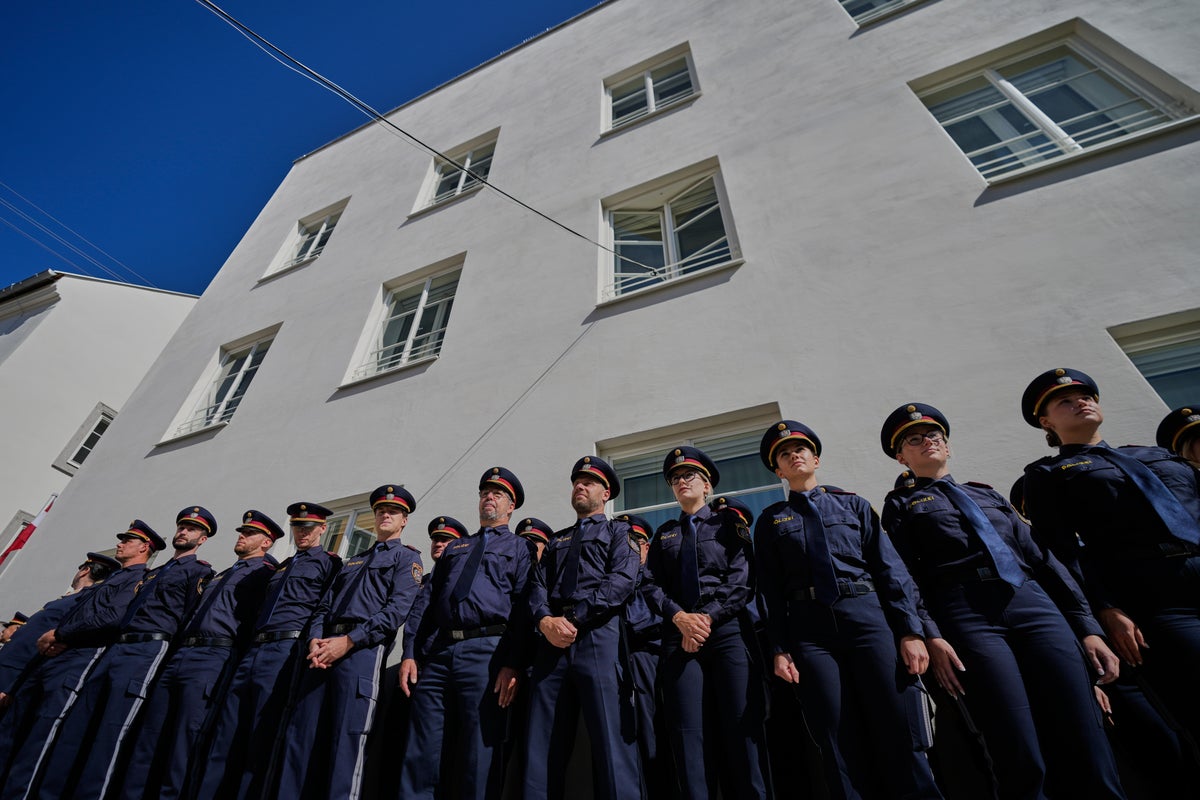
Walk down Salzburger Vorstadt street in the quiet border town of Braunau am Inn, and you'll spot a bright white, clean-lined building that looks completely unremarkable. That's entirely by design.
Austria spent roughly 20 million euros stripping away the architectural identity of the 17th-century structure where Adolf Hitler was born in 1889. The arched windows are gone, replaced by standard rectangles. The ochre-yellow paint was replaced with plain white. Today, it officially reopens as a working police station and a human rights training center for Austrian officers.
The government’s logic sounds clean on paper: fill the space with the state’s primary law enforcement entity—the very organization tasked with defending democratic rights—and you strip away the dark "mythical appeal" that has drawn far-right pilgrims to the address for decades.
It’s an aggressive attempt at architectural neutralization. But if you talk to Holocaust survivors' groups, local historians, or civil rights advocates, you'll quickly realize that painting over dark history rarely cleanses it. It just hides it.
The Problem With Erasing Concrete History
For decades, Austrian officials agonized over what to do with the building.
After WWII, the state rented the site to prevent misuse, eventually subletting it to a local charity supporting adults with special needs. That arrangement collapsed in 2011 when the private property owner refused to allow critical renovations or sell the building. A fierce legal battle dragged on until 2017, when Austria’s highest court authorized a compulsory purchase.
Once the government owned the keys, the debate turned radical. Demolish it entirely? Leave it empty? turn it into a museum?
Politicians ultimately pushed for complete neutralization. They brought in an expert commission that recommended an architectural makeover so thorough that the original house would no longer be recognizable. Contractors were even instructed to dispose of construction debris at secret locations so neo-Nazis wouldn't steal bricks as souvenirs.
The official goal was noble: destroy the dictator's cult of personality. Yet, critics argue this approach borders on historical amnesia.
Groups like the Mauthausen Committee, Austria's premier Holocaust survivors' network, voiced sharp opposition. Their counterpoint is hard to ignore: converting a site of historic fascism into a state police headquarters feels uncomfortably close to sweeping difficult history under the rug.
"Every year at the Mauthausen concentration camp memorial, there's a ceremony to say: never again," Robert Eiter of the Mauthausen Committee noted during the redevelopment debate. "And in Braunau, they're saying: let's forget as soon as possible."
Neutralization Doesn't Stop Extreme Tourism
The core idea behind establishing a active police precinct was simple deterrence. Neo-Nazis aren't going to pull up, take photos, or lay flowers outside a building filled with armed officers, right?
Maybe. But you can't block a physical address from internet GPS or erase historical facts from search engines.
Hitler only lived in the upper floor of the Braunau house for a few weeks as an infant before his family moved away. That single historical fact didn't stop far-right extremists from treating the spot like a shrine for 80 years. As recently as 2024, visitors were caught performing illegal Hitler salutes outside the window recesses.
Changing the facade doesn't undo what happened or who was born there. Extreme groups don't visit the building because of its window frames; they visit the geographical location. Putting a "Police" sign on the front door forces extremists to be slightly more discreet, but it doesn't confront the underlying ideology that drew them there in the first place.
A Missed Opportunity for True Education
Rather than hiding the site behind administrative uniforms, Austria had a genuine opportunity to do something transformative: turn a symbol of dark tyranny into a brutal, honest educational center against fascism.
Instead of administrative offices, imagine a public museum or research institute detailing how a democracy collapses into total dictatorship. Imagine hosting mandatory educational field trips for students across Europe to analyze the rise of extreme political propaganda.
By opting for administrative neutralization instead of active, confrontation-style education, the state chose the easy way out.
The local town council did insist on keeping one critical piece of history intact: a memorial stone carved from granite brought directly from the Mauthausen concentration camp, placed on the pavement right outside. Its inscription remains:
"For freedom, democracy and liberty. Never again fascism. Millions of dead remind us."
That stone—small, jagged, and direct—does far more heavy lifting for public memory than a 20-million-euro renovation ever could.
Where We Go From Here
For citizens, activists, and travelers tracking how Europe navigates its darkest historical sites, Austria’s experiment in Braunau am Inn offers a major lesson: administrative erasure is not a substitute for active educational remembrance.
To truly neutralize extremists, societies shouldn't camouflage historical sites. Here's what actually works when dealing with difficult history:
- Support active education over passive silence: Prioritize museums, public archives, and transparent educational memorials over bureaucratic takeovers.
- Engage with local civil rights groups: Follow organizations like the Mauthausen Committee that fight to preserve genuine historical context rather than political whitewashing.
- Confront uncomfortable truths directly: True reconciliation requires confronting historical complicity, not simply placing law enforcement over difficult landmarks.
Slapping a coat of paint and a new sign on a historic building might make politicians feel better, but true anti-fascist work happens when we confront history head-on—no matter how uncomfortable it makes us feel.