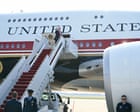
When Donald Trump arrived in Ankara for the NATO summit earlier this month, he stepped off a glowing, newly retrofitted Boeing 747-8 gifted by Qatar. The red, white, and navy jet was supposed to represent a massive upgrade. Yet when it came time to fly home, the President mysteriously ditched his shiny new toy and boarded a decades-old, baby-blue Air Force One instead.
At the time, Trump brushed off questions from reporters. He claimed he was taking the legacy aircraft "for old time's sake" while sending the Qatari plane to a military base in England so troops could tour it. That explanation sounded flimsy from day one.
Now we know why it happened.
US intelligence detected a credible threat from Iranian proxy forces targeting the president as he prepared to leave Turkish airspace. The Secret Service stepped in with an urgent warning. The upgraded luxury VIP jet simply didn't have the defensive muscle needed to guarantee his safety in a hot zone.
A Luxury Jet Without Armor
When the US military retrofitted the Qatari-gifted Boeing 747-8, officials spent nearly $400 million turning it into a floating White House. The problem? They rushed it.
To get the aircraft ready for immediate presidential travel, engineers bypassed several complex defensive upgrades. The jet lacked the advanced missile detection systems, radar-jamming tech, and anti-aircraft countermeasures standard on legacy presidential planes.
It looked pristine on the tarmac. Inside, it was a palace. But defensively speaking, it was surprisingly vulnerable.
When intelligence chatter revealed that Iranian-backed groups were eyeing the flight path out of Ankara, the lack of hardware became an immediate liability. Intelligence didn't suggest the proxies were specifically hunting the new Qatari plane. They were hunting Trump himself.
If someone fired a shoulder-launched missile or attempted to intercept the flight, the legacy Air Force One had proven countermeasures to defeat the threat. The Qatari jet didn't.
Secret Service agents didn't argue. They told the president to switch planes immediately.
Blackout Curtains and Disabled Transponders
The flight out of Turkey wasn't a standard presidential departure. It felt more like an extraction from an active battleground.
As reporters boarded the legacy baby-blue 747, flight crews gave them strict instructions to keep all window blinds drawn tight. They kept the cabin lights dim. When journalists pressed Trump on why they were flying in the dark, he offered a typical jab, blaming "sleazebags" in Tehran.
Things got stranger once the plane hit the air.
Commercial flight tracking services lost the plane's transponder signal shortly after takeoff from Ankara International Airport. While other NATO heads of state flew home on visible, trackable routes, Air Force One went completely dark on civilian radar.
Turning off a presidential transponder is a drastic move. You see it when a president flies into Bagram in Afghanistan or an undisclosed airfield in Iraq. You don't expect it during a departure from a major capital belonging to a NATO ally.
That single detail proves how serious the Secret Service considered the threat. They weren't taking any chances.
The Escalating War of Words With Tehran
This emergency plane swap didn't happen in a vacuum. It went down right as the conflict between the United States and Iran spiraled into dangerous new territory.
Only hours before Trump took off from Turkey, American forces executed heavy airstrikes against target sites in Iran following repeated militia attacks on Red Sea shipping lanes. Tehran fired back with drone salvos aimed at regional bases.
Trump has publicly stated multiple times that he sits at the top of Iran's assassination list. He even revealed standing orders for the Pentagon to wipe out Iranian infrastructure if Tehran makes a move on his life.
"I have a threat all the time. I'm No. 1 on their list," Trump told reporters mid-flight.
The tension remains high. While diplomatic backchannels are technically open, defense spending for the regional conflict has already topped $37 billion.
Why the White House Tried to Cover It Up
Nobody in the administration wanted to admit that the president had to abandon his prized jet because of security flaws.
Accepting a $400 million gift from Qatar had already sparked fierce political debate in Washington. Critics questioned the optics and the wisdom of flying top-tier government officials in an aircraft built by a foreign power. The White House countered those doubts by promising the plane met every single security standard required for commander-in-chief transport.
Admitting that the jet was unsafe in a real-world threat environment would have blown that defense to pieces.
So the administration spun a cover story. Trump publicly announced that both planes would fly to Royal Air Force Mildenhall in Britain. The Qatari jet would stop by so airmen could marvel at its luxurious interior, while Trump would fly the old plane home for nostalgic reasons.
It was a clever distraction. It kept the media focused on the luxury of the Qatari plane rather than its missing military defenses.
When journalists at major news outlets began digging into the real reasons behind the plane swap, the Justice Department even issued subpoenas seeking their confidential sources. Federal prosecutors eventually backed off those subpoenas, but the aggressive legal posture showed just how sensitive the administration was about the plane's security shortcomings.
The Problem With Fast-Tracking Military Hardware
This incident exposes a fundamental truth about executive transport. You cannot cut corners on defensive systems, no matter how much money or political willpower you throw at the project.
Standard Air Force One aircraft are not just luxurious commercial jets. They are hardened flying command centers. They carry heavy shielding to protect against electronic attack, advanced flares to redirect incoming heat-seeking missiles, and military-grade communication arrays designed to operate during nuclear chaos.
Retrofitting those systems takes years. The Air Force tried to rush the Qatari Boeing 747-8 through modification in record time so the president could show it off on the world stage.
In doing so, they left off essential gear. Defense analysts had warned that the Qatari plane was really only suitable for low-risk domestic flights. Flying it directly into a volatile region like the Middle East was always a gamble.
When Iranian proxies pushed the issue, the gamble failed.
What Happens Next for Presidential Travel
Moving forward, expect the Pentagon to rethink how it handles modified presidential aircraft.
The Qatari-gifted Boeing 747-8 will likely head back to a secure hangar for the complete suite of defense upgrades it should have received in the first place. Until engineers install standard countermeasure suites and missile defense tech, expect the president to stick with the classic, heavily armored baby-blue fleet whenever he travels anywhere near active conflict zones.
Optics matter in politics, but survival wins every time. The Secret Service made the right call in Ankara. Shiny paint jobs don't stop missiles. Real armor does.