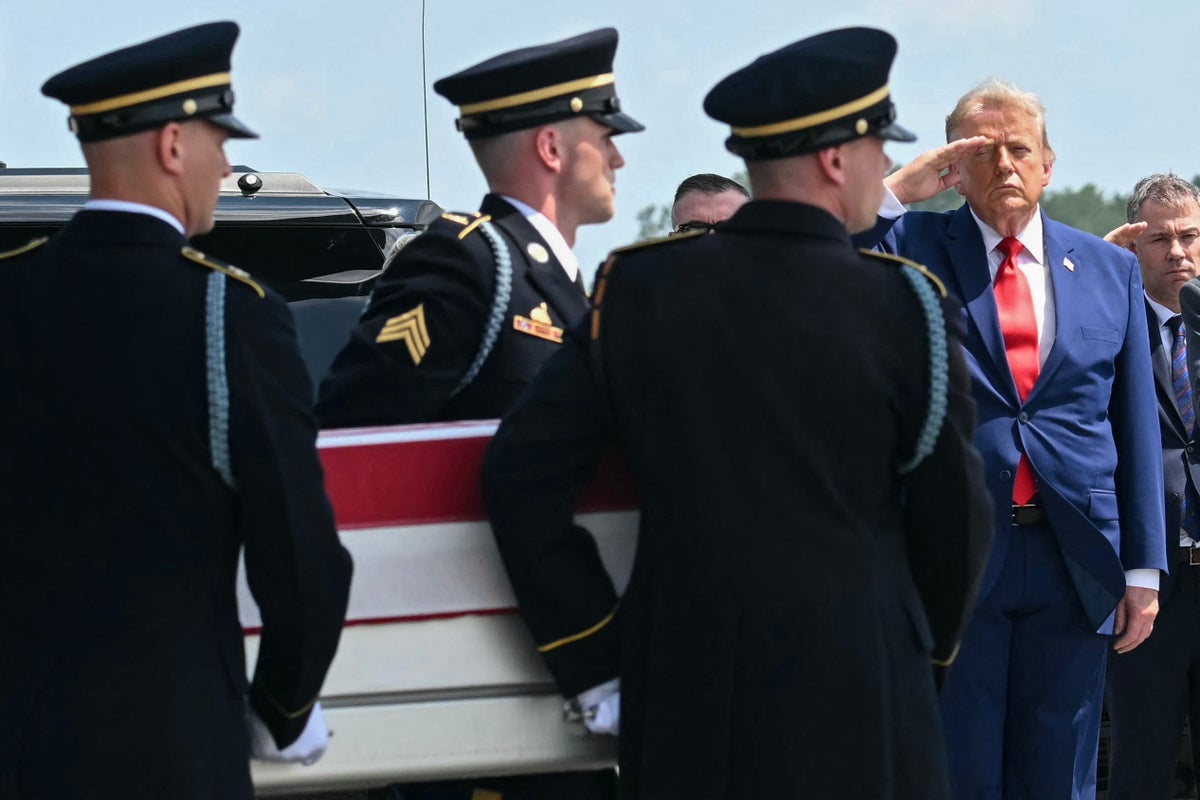
On his way to Dover Air Force Base to receive the remains of fallen American service members, Donald Trump made a claim that left military families and political observers stunned.
Standing on the tarmac at Joint Base Andrews, the president asserted that the U.S. troops recently killed in the Middle East had personally expressed support for his war rationale before their deaths.
"All of them said very strongly, 'We cannot let Iran have a nuclear weapon,'" Trump told reporters before boarding Air Force One.
There is no record, statement, or evidence suggesting that any of the dead service members ever spoke those words to the president or anyone else. The remark arrived during an ongoing escalation of Operation Epic Fury, a military campaign that started in February and has drawn growing public resistance across the political spectrum.
Putting words into the mouths of dead soldiers isn't just a questionable political move—it's a deliberate tactic to shield an increasingly controversial war from accountability.
The Flight to Dover and a Controversial Statement
The timing of the president's remarks made the situation far worse. Trump was heading to Delaware to attend a dignified transfer, the somber protocol where fallen service members return home in flag-draped cases.
Among the dead returning from Jordan and Iraq were 1st Lt. Tyler James Feehan, 25; Pvt. Isabella Gonzales, 19; and Sgt. Angel S. Rampersad, 28. They lost their lives when Iranian-backed fire struck Muwaffaq Salti Air Base.
Reporters pressed Trump on whether he intended to contact the families.
"Of course I will," he replied. "I always do. Yeah."
Yet hours before taking off, Trump posted a chart on social media highlighting that only 18 service members had died in the conflict so far. He compared the casualty count favorably against larger historic wars like Vietnam and Afghanistan, demanding that reporters print "the real facts."
Veterans groups and lawmakers reacted with immediate fury. Minimizing American casualties to score political points right before meeting grieving families struck many as deeply disrespectful.
Dissecting the War Rationale
The administration launched strikes against Iran months ago, promising a quick, decisive campaign. Now in its fifth month, the conflict shows no sign of slowing down.
When pressed on how a short intervention turned into a prolonged engagement, Trump shifted the goalposts.
"This is a far bigger job that we're doing," Trump said. "We were doing a little job in stopping them from having a certain capability, now we're just ending it."
Military analysts and lawmakers have raised sharp objections to this vague target. Retired Navy pilot and Arizona Senator Mark Kelly pointed out that airpower alone rarely forces an adversary to capitulate without a clear exit plan.
Diplomats note that before hostilities erupted, Iran was not actively testing a nuclear warhead, though its enrichment levels were elevated. By claiming that every fallen troop died specifically to block a nuclear threat, the administration attempts to turn a messy, open-ended conflict into a straightforward moral crusade.
Public Opinion vs Public Claims
During the same tarmac press briefing, Trump insisted that the American public strongly backed the war effort.
"Americans aren't against the war," Trump declared. "A poll just came out. Americans don't want high gasoline prices, but they're not against the war."
Polling data paints a very different picture. Broad national surveys consistently show majority opposition to the military campaign. Even support among the president's core MAGA base has dropped sharply. Recent polling shows MAGA voter support for the war fell by 13 percentage points between May and July.
Gas prices have climbed, international shipping lanes in the Strait of Hormuz remain vulnerable to missile attacks, and regional allies are bearing the brunt of retaliatory strikes. People are feeling the strain at home while watching the casualty list grow.
Why Rhetoric Matters for Military Families
Service members enlist to carry out lawful orders from civilian leadership, not to serve as rhetorical props for white-hot political debates.
Attributing personal political views to fallen soldiers deprives their families of their true, individual memories. Troops come from every political background imaginable. Some may agree with foreign military interventions, while others simply do their job honorably regardless of who sits in the Oval Office.
When a president claims to speak for dead troops, it eliminates their nuance and forces grieving families into a partisan spotlight they never asked for.
What Happens Next and How to Track the Conflict
As the confrontation with Iran drags on, keeping track of the facts requires looking past official talking points. Here is how you can stay informed and evaluate war claims objectively:
- Check official Defense Department casualty releases directly through Defense.gov rather than relying on social media posts or press summaries.
- Monitor Congressional War Powers resolutions and public roll-call votes to see if lawmakers are attempting to enforce constitutional limits on executive power.
- Compare public polling from non-partisan sources like Pew Research or Gallup rather than taking unverified claims about public support at face value.
- Follow updates from international maritime organizations regarding shipping disruption through the Strait of Hormuz to understand the economic impact on global energy markets.
Demand clear objectives and transparent accounting from leadership whenever military action is expanded.