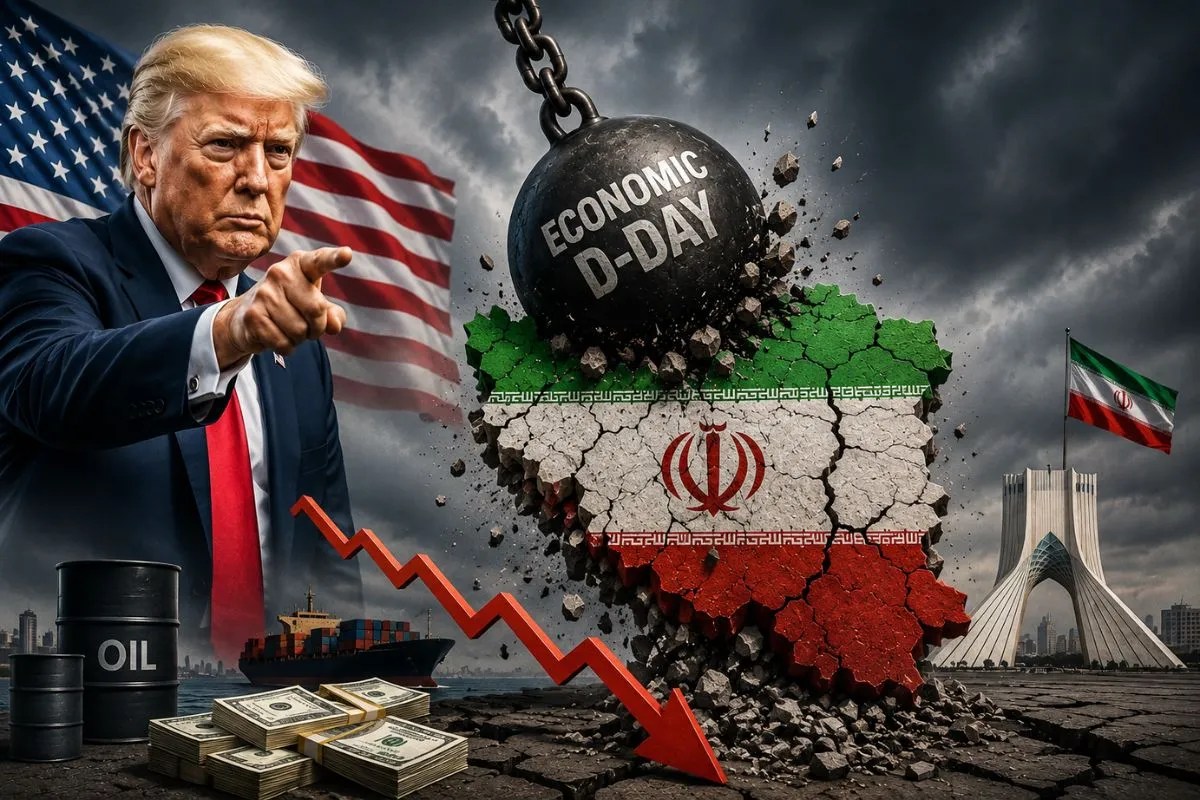
For nearly half a century, Washington has relied on a predictable playbook of penalties, warnings, and slow-bleed trade restrictions against Tehran. That playbook is officially gone. Donald Trump and Treasury Secretary Scott Bessent have shifted gears from physical warfare to financial asphyxiation, rolling out what they term an "economic D-Day" against the Islamic Republic.
If you think this is just another round of routine banking restrictions, you're missing the entire picture. The administration isn't just targeting Iranian assets anymore; they are explicitly threatening global secondary sanctions against any nation, ally or adversary, that continues trading with Tehran. Recently making news in related news: What Treasury Secretary Bessent Gets Wrong About The New Iran Sanctions Threat.
The Anatomy of Financial Asphyxiation
The Iranian rial has crashed to unprecedented lows, trading near 2 million to the US dollar on unregulated currency markets. Domestic inflation is running at extreme rates, destroying purchasing power for ordinary citizens who are already exhausted by years of compounding economic crises. Meanwhile, oil exports—the traditional lifeline of the Iranian budget—have been choked off by an ongoing US naval blockade across the Persian Gulf and the Strait of Hormuz.
Treasury Secretary Scott Bessent outlined the philosophy behind this push in recent financial columns, declaring that Washington has entered the final endgame of its pressure campaign. The core argument from the White House is straightforward: conventional military action has structural limits, so total economic isolation is designed to accomplish what airstrikes and naval standoffs couldn't. Additional information regarding the matter are covered by Al Jazeera.
Yet, looking at this strictly through an American lens ignores how Tehran operates under extreme duress. Iran has spent decades perfecting the art of sanctions evasion. Underground shipping networks, cryptocurrency-enabled transactions, and backchannel trading with major Asian buyers have kept the regime afloat through generations of isolation.
Why Secondary Sanctions Change the Game
The real teeth of this new strategy don't lie in freezing domestic Iranian bank accounts. Those accounts were largely cleared out of the Western financial system long ago. Instead, the strategy targets international third parties, forcing global corporations, financial institutions, and governments to choose between accessing the American financial ecosystem or conducting commerce with Tehran.
This creates an immense diplomatic squeeze. Major energy importers and regional trading hubs across Asia and the Middle East now find themselves in the crosshairs. If the US Treasury aggressively enforces secondary penalties against foreign firms moving Iranian crude or processing trade settlements, supply chains will face immediate disruption.
Mohsen Rezaei, secretary of Iran's Supreme National Security Council, fired back immediately, warning that any country participating in or supporting this economic campaign will be treated as committing an act of war. Tehran has also kept the strategic Strait of Hormuz effectively restricted or heavily monitored, driving up global shipping insurance rates and keeping energy markets on a knife-edge.
What Most Media Commentary Gets Wrong
Most mainstream coverage treats this escalation as a sudden, isolated pivot driven purely by political impulse. That interpretation misses the underlying structural reality. Following months of stalemate after initial military engagements, domestic political calculations ahead of upcoming mid-term elections forced a drastic realignment in Washington's strategy.
Voters care deeply about inflation, fuel prices, and economic stability, not endless overseas interventions. By leaning heavily into financial warfare, the administration hopes to project absolute dominance without committing ground troops or risking prolonged military entanglements that drain political capital.
At the same time, internal fractures inside Iran are becoming impossible for leadership to hide. Moderate factions within Tehran have openly debated whether to seek a settlement before conditions deteriorate past the point of no return, while hardliners push back with severe regional threats and uncompromising rhetoric.
The Structural Realities of Sanctions Resistance
Having watched decades of international sanctions policy evolve, I can tell you that financial warfare is rarely a clean switch. When you cut a nation off from formal SWIFT banking channels and traditional maritime shipping routes, commerce doesn't simply vanish—it mutates.
Smuggling networks adapt. Barter systems emerge. Energy commodities are relabeled on the high seas through ship-to-ship transfers in clandestine waters. This is why financial analysts often emphasize humility when evaluating sweeping economic declarations. While the macroeconomic numbers look catastrophic for Tehran—with the International Monetary Fund forecasting deep contractions and currency devaluation—authoritarian states often manage to preserve bare-minimum operational budgets for security forces long after the civilian economy has buckled.
The critical variable isn't just whether the US can impose sanctions; it's whether America's major trading partners in Europe and Asia are willing to enforce them with absolute compliance. If key economies carve out exemptions or look the other way, the "economic D-Day" risks becoming a paper tiger. If, however, Washington uses its regulatory leverage ruthlessly against non-compliant foreign banks, the squeeze will tighten exponentially.
Historical Parallels and Financial Warfare Lessons
History shows that comprehensive embargoes rarely trigger instant political collapses on their own. Past maximum pressure campaigns against energy-dependent states demonstrate that dictatorial or centralized regimes absorb massive amounts of public suffering before altering strategic calculations.
When ordinary citizens face soaring prices and currency devaluation, public anger can flare up into street protests, as seen in previous waves of anti-government demonstrations inside Iran. However, security apparatuses backed by state resources typically contain domestic unrest through heavy policing long before it translates into regime change.
This creates a brutal paradox for US strategists. The harder the economic vice grips the country, the more isolated the political leadership becomes, cutting off avenues for diplomatic compromise and hardening the resolve of hardline factions who view any concession as fatal weakness.
Supply Chain Realities and Global Energy Shockwaves
Beyond bilateral diplomacy, the weaponization of the international financial system has immediate practical consequences for global trade. Shipping firms operating in the Persian Gulf face unprecedented insurance premiums and security risks.
When naval blockades restrict tanker movements out of key regional ports, global energy markets react with immediate volatility. Even if domestic US production cushions American consumers, European and Asian economies remain highly sensitive to disruptions in Middle Eastern crude flows.
Global logistics managers are already rerouting shipping lanes and recalculating fuel costs to account for potential secondary enforcement actions. Any financial institution caught processing transactions for blacklisted entities faces devastating compliance penalties, leading to widespread over-compliance where banks cut off legitimate trade partners entirely out of caution.
Navigating the Uncharted Waters Ahead
We're standing in genuinely uncharted economic waters. When a global superpower deploys its currency and financial architecture as a blunt-force weapon against secondary markets, the collateral damage ripples across international borders instantly.
Commodity prices, marine logistics, and regional security alignments are shifting in real-time. Keep a close eye on how major trading nations respond as the Treasury rolls out enforcement mechanisms. The outcome of this financial showdown will set the precedent for economic warfare in the modern era.