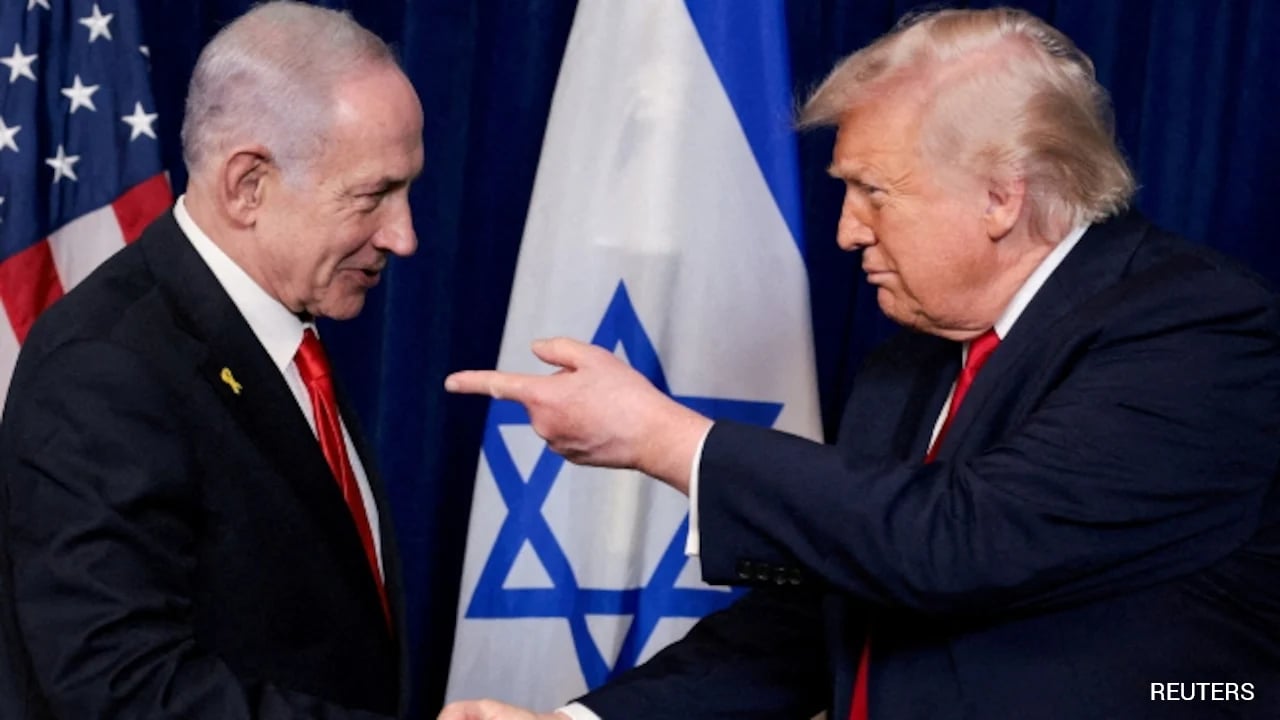
Donald Trump wants out of the Middle East conflict, and he wants out now. He needs a win to cool down domestic anger over spiked gas prices. He needs a grand diplomatic trophy. He just signed a massive memorandum of understanding with Tehran, kicking off a intense sixty-day clock to lock down a permanent peace deal. It is a classic high-stakes poker game, but there is an aggressive wildcard at the table who refuses to fold.
Benjamin Netanyahu has other plans.
The friction between the two men boiled over into the public eye, forcing Trump into an awkward balancing act. Standing at the unveiling of a new Air Force One plane—a flashy gift from Qatar—Trump tried to patch over the cracks. He called Netanyahu a warrior prime minister. He shouted that people should give the Israeli leader credit. He insisted their relationship remains great.
Do not let the praise fool you. It was a tactical smoke screen.
Behind closed doors and in recent public broadsides, Trump has been furious. He has reportedly called the Israeli leader crazy in private interviews and openly warned him to stop rocking the boat. This public praise is damage control. It came directly on the heels of a damning US intelligence assessment warning that Netanyahu is actively trying to torpedo the administration's peace deal with Iran.
The two leaders are locked in a structural collision. Their individual political survival strategies are completely incompatible.
The US Intelligence Warning
A leaked intelligence report, first revealed by the Washington Post, confirms what many regional experts feared. US intelligence agencies assessed that Netanyahu is highly likely to take military actions that will completely shatter the fragile peace framework.
The core of the issue sits in southern Lebanon. The new US-Iran framework demands an absolute cessation of military operations. Yet, the Israeli military shows zero intention of pulling back from its fight against Hezbollah. According to current and former officials cited in the intelligence report, the Israel Defense Forces are actively preparing to ramp up strikes against the Iran-backed militant group.
This is not just a tactical disagreement about border security. It is raw politics.
Netanyahu faces a brutal Knesset election this fall. His hold on power is razor-thin, dependent entirely on a fragile coalition of hard-right partners who view any ceasefire as total surrender. The intelligence analysis explicitly points out that Netanyahu's political fate hangs on keeping Israeli boots on the ground in southern Lebanon. If he stops fighting, his government falls. If his government falls, his legal troubles and political career are effectively over.
So, Netanyahu chooses survival. He wants the freedom to hunt Hezbollah, even if it means blowing up Washington's biggest diplomatic breakthrough in years.
Trump Diplomatic Gamble
Trump's sudden rush toward an Iran deal is driven by heavy economic reality back home. The prolonged regional conflict has taken a massive toll. American voters are exhausted by foreign entanglements, and more importantly, they are angry about their wallets. The fighting has choked energy corridors, keeping global oil prices high and driving inflation up at the worst possible moment for the administration.
Trump needs a rapid off-ramp. His strategy mixes immense military intimidation with sudden diplomatic offers. He sent two aircraft carrier strike groups, including the USS Abraham Lincoln, to the Arabian Sea as an explicit threat to Tehran. Then, he offered them cash flow and open streets through sanctions relief if they signed on the dotted line.
The resulting framework is a fourteen-point agreement that aims to restrict Iran's nuclear ambitions and curtail its regional proxies. It is a far cry from the massive, multi-page agreements of past administrations. It is short, direct, and aggressive.
The Iranian government, battered by internal economic pressure and the constant threat of American bombing, took the deal. Omani mediators managed to stitch together direct talks in Geneva between Middle East envoy Steve Witkoff, Jared Kushner, and Iranian Foreign Minister Abbas Araghchi.
The deal is on the table, but it requires absolute calm to survive the next two months. Every time an Israeli jet drops a bomb in southern Lebanon or hits a target near Damascus, the entire architecture shakes.
The Illusion of Friendship
For years, Netanyahu touted Trump as the greatest friend Israel ever had in the White House. He bragged about the embassy move to Jerusalem. He celebrated the return of hostages. He aligned Israel's long-term fortunes almost exclusively with Trump's political brand.
That bet is now blowing up in his face.
Trump possesses no permanent alliances, only immediate transactions. When Netanyahu's military objectives aligned with Trump's anti-Iran stance during his first term, the partnership worked. Now that Netanyahu's military actions threaten Trump's economic goals, the rhetoric has turned vicious.
Trump has openly lashed out at Netanyahu in recent weeks, reminding everyone that without American backing, Israel would not exist. He publicly demanded that Israel be more responsible regarding Lebanon. The sudden shift stunned the political establishment in Jerusalem, but it shouldn't have. Trump views Netanyahu's regional escalation as a personal insult and a direct threat to his domestic agenda.
Calling him a warrior prime minister is not an endorsement of his strategy. It is an attempt to stroke Netanyahu's ego while publicly boxing him into a corner. Trump is trying to give Netanyahu a rhetorical victory so he can force him to accept a physical ceasefire.
Four Presidents and One Prime Minister
Netanyahu has managed to alienate four consecutive American presidents. Bill Clinton found him insufferable. Barack Obama openly despised his back-channel maneuvers with Congress. Joe Biden struggled constantly to restrain his war cabinet. Now, Trump is using public humiliation as a foreign policy tool.
The underlying problem has never changed. Israel is a dependent superpower that often acts like an independent one. The bipartisan consensus in Washington that once guaranteed blank-check support for Israeli military campaigns has fundamentally fractured.
The American public has shifted. Elements on the left are deeply alienated by the human cost of these prolonged conflicts. Elements on the right are increasingly isolationist, questioning why billions of American tax dollars are flowing into a perpetual war zone while domestic infrastructure crumbles. Trump is riding that exact wave of populist fatigue.
What Happens Next
The clock is ticking down on the sixty-day negotiation window. If you want to understand how this crisis unfolds, watch these specific pressure points instead of listening to the political speeches.
First, watch the troop movements at Ben Gurion Airport. The US military has already started reducing its forces and tanker aircraft stationed in Israel. This is a quiet, direct signal from Washington. Trump is cutting back the logistics tail that enables long-range Israeli strikes. He is telling Netanyahu that if he starts a fresh war with Iran, he might find himself completely on his own.
Second, monitor the price of West Texas Intermediate crude oil. If oil stays below sixty-five dollars a barrel, Trump has the domestic breathing room to let negotiations play out. If a sudden flare-up pushes oil back toward one hundred dollars, Trump will likely use every piece of financial and military leverage to force a shutdown of Israeli operations.
Third, look at the internal polling for the upcoming fall Knesset elections. If Netanyahu's numbers drop, expect him to order more dramatic strikes in Lebanon to rally his nationalist base. He has shown time and again that he will prioritize his own political life over the wishes of the American president.
The warrior prime minister tag is a title Netanyahu wears proudly, but right now, it is a gilded cage built by an American president who is running out of patience.
Watch this detailed breakdown of the geopolitical shifts to understand how the White House is using both threats and diplomacy to force a breakthrough in the region:
Donald Trump Calls Israeli PM Benjamin Netanyahu a Warrior PM Amid Peace Deal
This short news segment captures the exact moment Trump used the warrior prime minister rhetoric at the aircraft unveiling, offering crucial context on the fragile public relationship between the two leaders during these tense nuclear negotiations.