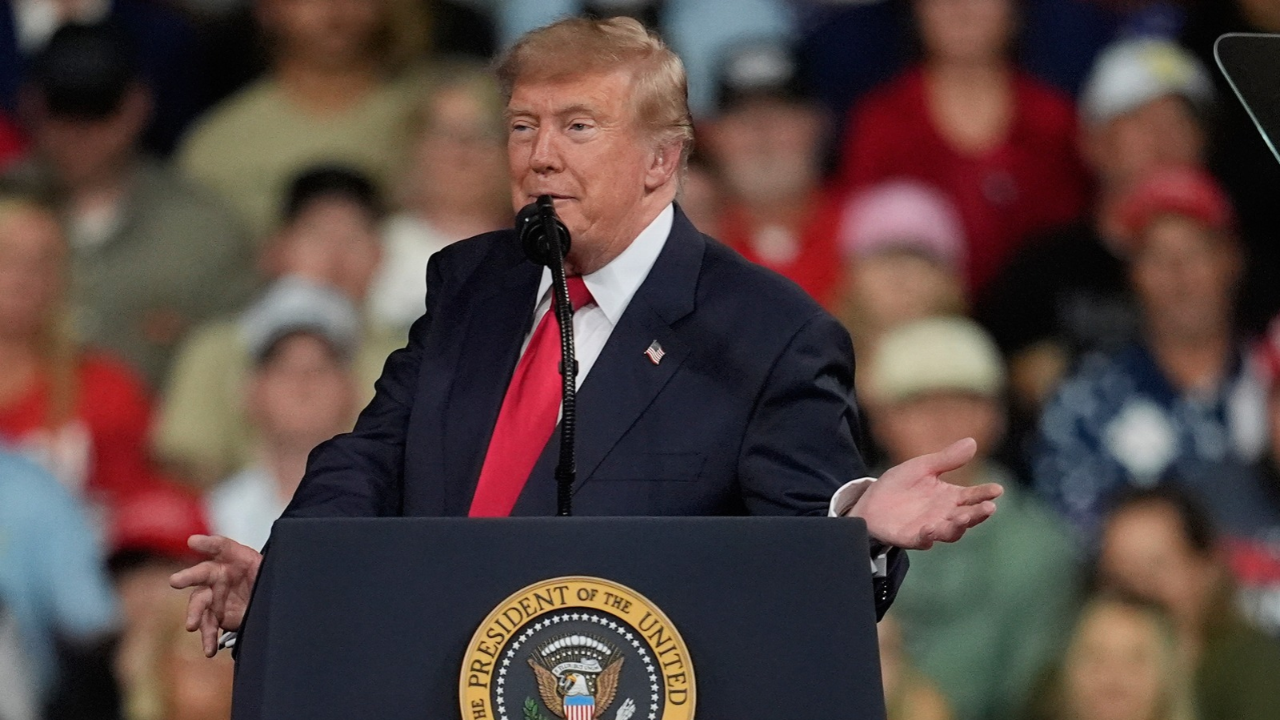
Foreign policy paradoxes don’t get much sharper than this. Donald Trump recently stood before a campaign crowd in Georgia and dropped a remark that sounds like dark satire yet captures the raw, chaotic calculus of modern statecraft: he needs to stop targeting top Iranian officials simply because there is nobody left to sit across the bargaining table.
If you've followed Washington's escalating friction with Tehran, you know the stakes. But Trump's blunt admission lays bare a fundamental flaw in decapitation strategies. When you systematically wipe out the upper echelons of a hostile regime's command structure, you don't just secure a military victory. You accidentally trap yourself in a diplomatic vacuum.
Let's look at what's really happening behind the headlines.
The Diplomatic Vacuum Created by Military Overkill
Trump didn't mince words during his rally speech. He pointed to intense military engagements, referencing operations like Operation Midnight Hammer and subsequent strikes that battered Iran's military and leadership tiers. According to his framing, top-level and second-tier commanders are gone, warships lie at the bottom of the sea, and jet fighters have been wiped out.
From a purely kinetic standpoint, it's a massive show of force. But from a negotiation standpoint, it's a disaster.
You can't sign a treaty with a ghost. Diplomacy requires an active counterpart who holds enough internal authority to make a deal stick. When you eliminate every high-ranking interlocutor who has the political survival capital to negotiate, you are left talking to empty chairs. Trump's quip—"I gotta stop because I gotta figure out who the hell we're negotiating with"—highlights the exact contradiction of modern military intervention. Maximum pressure works too well at destroying the room for compromise.
Why Past Nuclear Deals Haunt Current Strategy
To understand why Trump keeps swinging between threats of total annihilation and the desire for a "big, beautiful agreement," you have to look backward. He pulled the US out of the 2015 Joint Comprehensive Plan of Action (JCPOA) negotiated under Barack Obama, calling it fundamentally flawed.
His administration's stated goal has always been simple: Tehran must never possess a nuclear weapon. Yet, the path to achieving that goal has oscillated wildly. On one hand, you have high-intensity military operations designed to cripple Iran's enrichment capacity and naval assets. On the other hand, you have public hints that Tehran actually wants to make a deal.
The catch? Trust and structure. As Trump noted when asked if the US would strike again, the issue isn't just whether Iran wants a deal, but whether they will actually hold it. And how can a fractured, heavily battered leadership structure guarantee compliance when their entire chain of command has been scrambled by targeted strikes?
Tehran's Defiant Stance and the Reality on the Ground
Of course, the view from Tehran looks entirely different. Iranian officials aren't sitting quietly waiting for Washington to figure out its next move. Parliament Speaker Mohammad Bagher Ghalibaf recently made it clear that Iran views US policy as a crisis born of miscalculation.
Ghalibaf rejected the notion that military threats or media pressure would ever force the Iranian nation to fold. He framed modern Iran as a fortified state with deep defensive capabilities, explicitly warning that threats of war or assassinations won't force compromises on national interests. Meanwhile, Foreign Minister Abbas Araghchi argued that the regional security landscape has fundamentally shifted, pointing out that vital shipping corridors like the Strait of Hormuz will never return to their pre-conflict state.
This rhetoric matters because it exposes the limits of brute force. Washington might boast about naval victories and grounded jets, but institutional defiance hardens when an adversary feels existentially threatened.
The Core Dilemma Facing US Foreign Policy
The fundamental question underlying this entire saga is one most politicians try to avoid: What is the end game?
If your strategy relies entirely on kinetic dominance—taking out leaders, sinking ships, and forcing economic collapse—you will eventually run out of targets. More importantly, you will run out of partners. True geopolitical stability doesn't come from turning an adversary's leadership structure into ash. It comes from establishing a durable framework where both sides have incentives to maintain peace.
Trump's candid admission reveals that Washington often acts first and calculates the diplomatic aftermath later. Until American leadership figures out how to reconcile the urge to strike with the necessity of dialogue, any talk of a new agreement remains wishful thinking.
The next move requires recognizing that destroying an enemy is infinitely easier than negotiating with the vacuum left behind.