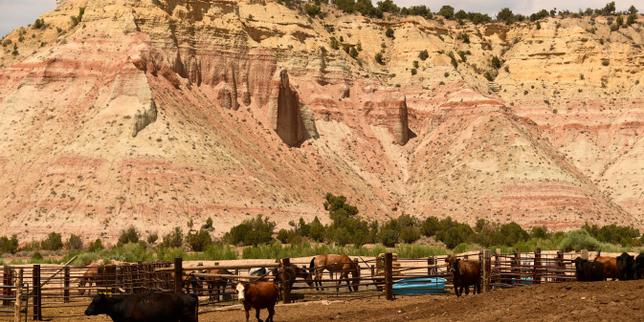
The federal land battle in the American West just hit a boiling point. On Monday, July 13, 2026, President Donald Trump signed two executive proclamations that did not just chip away at Utah’s protected lands. They essentially vaporized them.
By shrinking the Bears Ears and Grand Staircase-Escalante national monuments down to a tiny fraction of their former size, the administration has opened up millions of acres of pristine desert to energy companies, mining operations, and ranching.
If this sounds like a rerun of 2017, it is. But this time, the cuts go far deeper, the political strategy is more aggressive, and the legal battle ahead could rewrite the rules of American conservation forever. Here is what you need to know about the drastic changes in Utah and why this isn't just a local dispute.
The Reality of the Cuts
To understand how radical this move is, you have to look at the numbers. We aren't talking about a minor boundary adjustment.
- Bears Ears National Monument: Established by Barack Obama in 2016 at roughly 1.36 million acres, Trump has slashed this sacred tribal landscape to approximately 121,100 acres. That’s a staggering 91% reduction.
- Grand Staircase-Escalante National Monument: Created by Bill Clinton in 1996 at around 1.87 million acres, it has been carved down to just 181,500 acres—a 90% cut.
Combined, these monuments once covered over three million acres of southern Utah—an area roughly the size of Connecticut. Today, they represent less than 303,000 acres combined.
In his first term in 2017, Trump cut these same monuments, but those cuts left Grand Staircase at 1 million acres and Bears Ears at 213,000 acres. When Joe Biden took office in 2021, he fully restored the original boundaries. This latest action by Trump goes far deeper than his previous attempt, reducing the protected zones to what the administration calls the "smallest area compatible" with protecting specific historic and scientific objects.
"They took the land from the people quite honestly," Trump said during the White House signing ceremony on Monday, standing alongside Utah’s Republican delegation. "We're giving it back."
The Industrial Prize Underground
Why southern Utah? While tourists flock to the region’s stunning red rock canyons, arches, and ancient cliff dwellings, developers and state politicians see a different kind of value locked beneath the surface.
The areas removed from monument status hold massive, lucrative resources:
- Uranium: The Bears Ears region contains significant deposits of uranium, a critical mineral for nuclear energy and national security.
- Coal: Grand Staircase-Escalante, specifically the Kaiparowits Plateau, sits on top of one of the largest untapped coal reserves in the United States.
- Oil and Gas: The broader region is ripe for fossil fuel exploration, which aligns directly with the administration's push to expand domestic energy production.
Under the protective umbrella of a national monument, new mining claims, oil drilling, and commercial logging are strictly banned. By stripping these protections, the administration is effectively rollings out the red carpet for resource extraction. Trump’s Interior Secretary, Doug Burgum, has made no secret of the fact that reviewing national monuments is a core pillar of the administration's aggressive strategy to boost American energy independence.
Sacred Ground vs. Local Control
The debate over these monuments exposes a deep cultural and philosophical divide.
For Native American tribes, the downsizing of Bears Ears is a direct assault on their heritage. Bears Ears was the first national monument ever established at the explicit request of a coalition of tribal nations, including the Navajo, Hopi, Zuni, Ute Mountain Ute, and Uintah-Ouray Ute. The landscape is packed with ancestral villages, rock art, and burial sites. Under Biden, a historic co-stewardship model was established, giving these tribes a formal role in managing the land.
Tribal leaders say they were completely shut out of this new decision. Davina Smith-Idjesa, a citizen of the Navajo Nation and co-chair of the Bears Ears Inter-Tribal Coalition, noted that while tribal leaders braced for this outcome after the election, the lack of consultation remains a betrayal of treaty obligations.
On the other side of the fence, Utah's state leadership is celebrating. Governor Spencer Cox and Senator Mike Lee have long argued that massive monument designations are a federal "land grab" that bypasses Congress and hurts local economies by locking up land that could be used for grazing, timber, and mining.
The Antiquities Act Loophole
The entire battle hinges on a century-old law called the Antiquities Act of 1906.
This law gives the president unilateral authority to declare federal lands as national monuments to protect "historic landmarks, historic and prehistoric structures, and other objects of historic or scientific interest." However, the act states that these reservations must be limited to the "smallest area compatible with the proper care and management of the objects to be protected."
Here is the legal catch: while the Antiquities Act clearly gives presidents the power to create monuments, it is completely silent on whether a president has the authority to shrink or abolish them.
Environmental groups like Earthjustice and the National Parks Conservation Association (NPCA) are already preparing lawsuits, arguing that Trump’s cuts are flatly illegal. They maintain that only Congress has the power to alter monument boundaries.
However, the legal landscape has shifted since the 2017 battles. In 2021, Supreme Court Chief Justice John Roberts hinted that the high court might be open to reigning in the Antiquities Act, suggesting the law has been used to set aside "vast and amorphous expanses of terrain." By tailoring his new proclamations to match Roberts’s language regarding the "smallest area compatible," Trump is likely hoping to bait a legal challenge that goes all the way to a sympathetic Supreme Court, potentially weakening the Antiquities Act permanently.
What Happens Next?
If you are wondering what this means for the immediate future of these lands, the short answer is chaos.
- Immediate Court Filings: Expect a deluge of lawsuits from environmental coalitions and tribal nations seeking temporary injunctions. These lawsuits will attempt to freeze any mining or drilling activity while the courts decide if Trump's proclamations are legal.
- Stalled Industry Actions: Even though the land is technically open for business, many mining and energy companies may hesitate to invest millions of dollars into drilling or digging in areas that could easily be tied up in litigation for years or reversed by a future administration.
- Local Land Management Shifts: The Bureau of Land Management (BLM) and the U.S. Forest Service will have to scramble to rewrite their management plans, reversing years of collaborative planning with local tribes.
For outdoor enthusiasts, hikers, and conservationists, the best way to stay informed and get involved is to support organizations actively leading the legal defense of these public lands, such as the Southern Utah Wilderness Alliance (SUWA) or the Bears Ears Inter-Tribal Coalition. The outcome of this legal showdown won't just decide the fate of Utah's red rocks—it will set the precedent for public land conservation across the entire country.