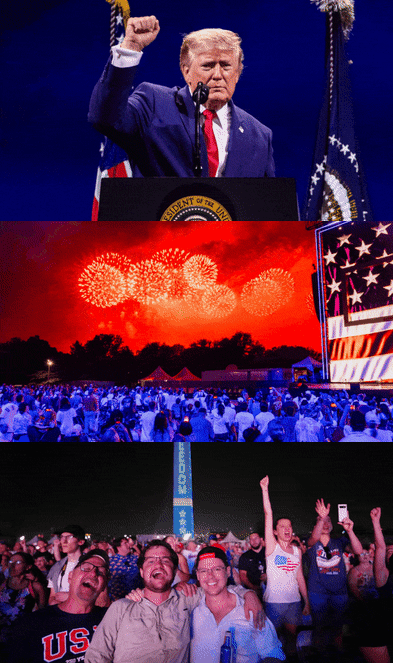
Traditional Independence Day addresses are supposed to be safe. They usually offer a predictable blend of history, unifying platitudes, and a shared nod toward the future. But Donald Trump threw out the old playbook for America’s 250th anniversary, turning a historic quarter-millennium milestone into a highly charged, combative political message designed for his loyal base.
Standing on the National Mall in Washington D.C., the president mixed soaring rhetoric about American exceptionalism with direct broadsides against his political enemies. If you expected a non-partisan celebration of unity, you weren't paying attention to the lead-up. This wasn't just a birthday party for the republic. It was the unofficial opening salvo of the highly contested midterm election cycle.
Defying the Storms for a Triumphalist Stage
The physical setup of the event perfectly mirrored the political storm surrounding it. An intense summer heatwave coupled with violent thunderstorms ground the capital to a halt. Security screening was suspended. The National Mall had to be evacuated for roughly two hours. Thousands of attendees huddled in makeshift shelters or retreated from the blinding rain.
Many thought the event would be scrapped or moved indoors. Trump rejected that completely. Taking to social media, he declared that storms bring luck and that he would speak even if it meant doing so in front of just one person at four in the morning. When he finally walked out onto the stage at 11:15 PM, the message was clear. It was about personal grit as much as national survival.
The backdrop featured historic American flags symbolizing major turning points in the country's history. One flag had been draped over Abraham Lincoln’s casket. Another had flown on the plane piloted by the Wright brothers. Trump shared the stage with World War II veterans and one of the first Black officers to lead a Special Forces team in Vietnam. These choices aimed to project deep historical authority. But the language that followed pulled the event straight out of the history books and into contemporary political warfare.
Patriotism Laced with Campaign Rhetoric
Trump began with standard celebratory language, calling the semi-quincentennial one of the most glorious milestones of all time. He spoke about the Declaration of Independence and the unique freedoms granted by the Constitution. But he quickly shifted from historical reverence to current policy debates.
Instead of focusing solely on the shared heritage of the nation, he explicitly championed the SAVE America Act. This controversial voting bill requires proof of citizenship and identification to cast a ballot. The legislation has split lawmakers and faced significant pushback even from some congressional Republicans. Bringing it up on a national stage during a ceremonial holiday sent a direct message to Congress.
He didn't stop there. He used the platform to reinforce his stance on the Second Amendment and doubled down on intense anti-communist rhetoric. This line of attack has become a staple of his recent public appearances. By framing his domestic political opponents not just as rivals but as a threat to the nation itself, he changed the entire energy of the evening.
“For 250 years, the United States of America has been the hope, the promise, the light and the glory among all of the nations of the world... Tonight, our country is stronger, freer, richer, safer and prouder than ever before.”
— Donald Trump, July 4, 2026
The Mount Rushmore Prelude
To fully understand the tone of the Washington D.C. address, you have to look at what happened the night before in South Dakota. Speaking at the foot of Mount Rushmore, Trump delivered an even sharper speech that set the tone for the entire holiday weekend.
Under the carved faces of Washington, Jefferson, Roosevelt, and Lincoln, the president launched into an attack on what he termed a domestic menace. He openly labeled his progressive political opponents as enemies of July 4th and warned that radical ideologies pose an existential threat to the American way of life.
This two-step approach—hitting hard at Mount Rushmore and then weaving those same themes into the official D.C. celebration—shows a deliberate strategy. The administration bypassed the traditional, bipartisan anniversary commission created by Congress a decade ago. White House organizers took full control of the planning, ensuring the music, the speakers, and the overall aesthetic matched the style of Trump's signature rallies. Country singer Lee Greenwood opened the festivities with his familiar anthem, erasing any line between an official state event and a campaign rally.
A Visual Metaphor and the Realities on the Ground
Every detail of the celebration felt calculated to project power, though some efforts faced unexpected hurdles. The administration had ordered a $14.7 million renovation of the iconic Reflecting Pool, aiming to treat the water so it would gleam an American Flag blue in time for the 250th anniversary. Instead, a massive algae bloom took over, turning the water a stubborn, bright green. White House officials quickly blamed the setback on political vandals.
Outside the secure perimeter, the atmosphere reflected a deeply divided country. Thousands of National Guard troops patrolled the streets of Washington following weeks of heightened security. While supporters inside the gates cheered Trump’s promises of a new golden age, other groups gathered nearby to offer a completely different view of the country's milestone.
Meanwhile, prominent Democrats used the day to push a contrasting message. They described America as a constant work in progress rather than a finished masterpiece. Their statements focused on fixing systemic flaws and protecting democratic institutions, highlighting the ideological gap that defines modern American politics.
The Midterm Strategy is Already Here
This speech was not an isolated incident. It was a clear preview of how the administration intends to campaign over the coming months. By using the nation’s 250th birthday to draw sharp lines between his vision and that of his opponents, Trump has effectively nationalized the upcoming midterm elections around themes of patriotism and cultural identity.
For voters, the takeaway is unmistakable. The traditional boundaries between ceremonial civic pride and active political campaigning have dissolved. As the country moves past its historic milestone, the focus shifts immediately to the ballot box, where these two vastly different visions for America’s next chapter will face their next major test.
If you want to track how this speech changes the political map heading into the fall, look closely at these key indicators:
- Watch the legislative progress of the SAVE America Act to see if Trump’s public push pressures wavering congressional Republicans into alignment.
- Monitor voter turnout metrics in early primary states to see if the intense cultural rhetoric effectively mobilizes the base.
- Track how moderate candidates in swing districts adjust their messaging to either embrace or distance themselves from the highly partisan tone set at the National Mall.
The 250th anniversary celebration showed that in the current political climate, even a historic milestone is fair game for campaign strategy.