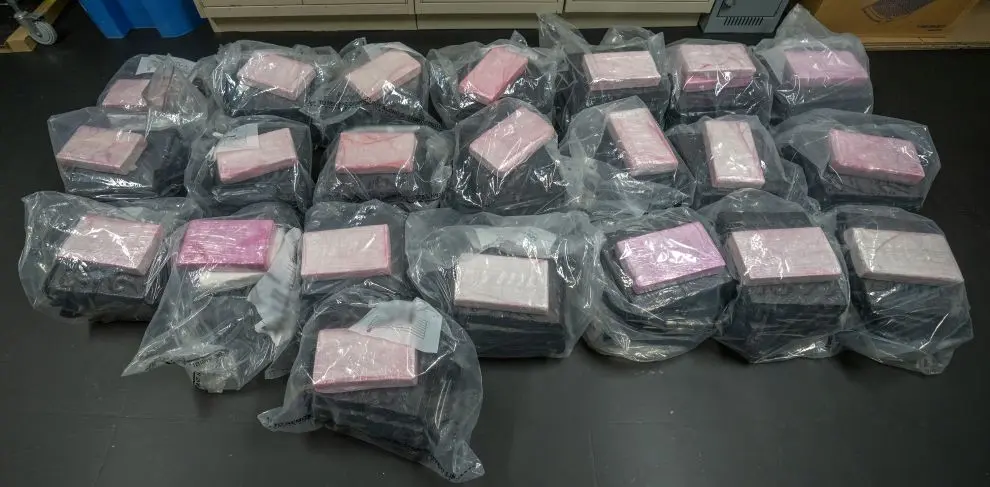
You don't just stumble into 260 kilograms of high-grade cocaine hidden inside a shipping container from Panama. It takes a massive logistical network to orchestrate, and as it turns out, it takes a highly coordinated multi-agency response to take it down.
When York Regional Police and the Canada Border Services Agency announced the massive haul from Project Golden Frog, the sheer numbers grabbed the headlines. We are talking about $20 million worth of cocaine pulled off the market alongside a cool $2.5 million in cold, hard cash. Six people from Kitchener are now facing a mountain of serious federal charges. If you enjoyed this piece, you might want to look at: this related article.
But if you look past the standard police press release fluff, this bust exposes a fascinating and disturbing shift in how illicit supply chains are feeding the Greater Toronto Area. The old playbook of keeping operations confined to downtown cores is dead. Instead, international cartels and local syndicates are using quiet, mid-sized Ontario hubs as their staging grounds.
The Panama to Kitchener Pipeline
The trouble started in May 2026 at a Canadian port of entry. Border agents intercepted a shipping container arriving from Panama. Frontline CBSA officers have a tough job. They screen thousands of containers daily, looking for anomalies in manifests, weird structural changes in shipping crates, or tips from international intelligence partners. This time, their instincts or their data hit the jackpot. Tucked inside the cargo was a massive stash of suspected cocaine. For another angle on this development, check out the latest coverage from Associated Press.
Instead of just seizing the bricks and calling it a day, the feds played the long game. They contacted York Regional Police investigators.
Why York? Because the intelligence suggested this massive pipeline was destined to flood York Region and the broader Greater Toronto Area. As investigators began pulling on the thread, the trail didn't lead to a high-rise condo in Toronto or a warehouse in Vaughan. It led straight to Kitchener.
This is a classic tactical maneuver by modern drug syndicates. They choose secondary cities like Kitchener to set up their distribution hubs. It makes sense if you think about it from a risk-management perspective. In a smaller city, industrial parks are cheaper, traffic is easier to navigate without hitting gridlock, and storage units draw way less scrutiny than they do in a heavily monitored metropolis. You hide in plain sight, build a quiet base of operations, and then run your product down the highway into the lucrative GTA market as needed.
Inside Project Golden Frog
The takedown wasn't a single cinematic raid. It was a slow, deliberate squeeze that played out over several weeks in June 2026. Once the police mapped out the players, they struck in waves.
The first major blow landed on June 11. Officers moved in on three suspects, taking them into custody without incident. Simultaneously, police teams executed search warrants at a residential home and a local storage locker in Kitchener. Storage lockers are the holy grail for drug investigators. They are neutral, easily accessible, and frequently used by traffickers who don't want to keep millions of dollars in contraband under the same roof where their kids sleep.
That first raid hit the syndicate where it hurts the most. Their cash reserves. Investigators found and seized $2.5 million in Canadian currency.
Think about the sheer volume of that much cash. It isn't just a few neat stacks of bills. It is boxes and bags of sorted, untraceable currency that represents thousands of street-level transactions. Seizing the money is often more damaging to a criminal enterprise than seizing the drugs. Without cash, you can't pay your suppliers in South America, you can't pay your couriers, and you definitely can't secure bail easily.
Six days later, on June 17, the second wave hit. York police officers went back to Kitchener with another round of warrants. This time they targeted a residence, a local business, and yet another storage locker. They bagged two more suspects, more cash, and an additional stash of cocaine that had already entered the local supply chain. The final piece of the puzzle fell into place on June 23, when investigators tracked down and arrested the sixth and final suspect tied to the ring.
The Real Mechanics of Border Interceptions
Everyone loves to focus on the dramatic street arrests, but the real heavy lifting happens at the border. The partnership between the CBSA and local police forces like the YRP is the only reason a bust of this magnitude works.
When a shipment from a high-risk transit hub like Panama comes across the radar, border officers have to make a choice. They can do a hard seizure right then and there, which secures the contraband but allows the domestic conspirators to vanish into thin air. The moment a shipment doesn't arrive on time, the local cell knows they've been burned. They burn their burner phones, abandon their stash houses, and start over under a new name.
The alternative is a controlled delivery or a deep intelligence handoff. By alerting York Regional Police immediately, the CBSA allowed local detectives to set up surveillance on the receiving end. They watched who came to collect the paperwork, who showed up with the transport trucks, and where those trucks went. That is how a border seizure in May turns into six arrests and millions in cash seized by late June. It requires patience, immense trust between different levels of law enforcement, and flawless operational security. One leak ruins the entire project.
Why 260 Kilograms of Cocaine Hits the GTA Hard
To understand the scale of this seizure, you have to understand the economics of the Ontario drug trade. A single kilogram of wholesale cocaine can fetch anywhere from $50,000 to $70,000 depending on purity and market supply. When you multiply that across 260 kilograms, the bulk wholesale value sits comfortably north of $15 million.
But criminals don't sell by the wholesale brick on the street. By the time that product is stepped on, cut with adulterants to increase volume, and broken down into individual grams or half-grams, the street value easily skyrockets to the $20 million mark cited by authorities.
Removing 260 kilograms from the ecosystem creates an immediate, violent ripple effect throughout the local criminal underworld.
- Supply Shortages: Street-level dealers suddenly find their regular re-up options dried up.
- Price Spikes: As supply plummets while demand remains identical, the price per ounce jumps overnight.
- Quality Drifts: Wholesale distributors will cut their remaining product even harder to stretch their supplies, leading to unpredictable and dangerous purity levels on the street.
- Territory Disputes: When a major player loses $20 million in inventory, they owe money up the chain. Debt collection in this world isn't handled via civil court. It leads to turf wars as rival groups try to fill the vacuum left by the dismantled Kitchener cell.
This isn't just about keeping people from getting high. It's about cutting off the financial oxygen that fuels organized crime. That $20 million wouldn't have just sat in a bank account. It gets reinvested into illegal firearms, human trafficking networks, and high-end real estate laundering schemes that distort the legitimate economy.
Meet the Six Facing Serious Charges
The judicial system is now dealing with the aftermath of Project Golden Frog. The six individuals arrested are all Kitchener residents, ranging in age from 22 to 48. This wide age gap suggests a structured hierarchy inside the group, combining older, presumably more experienced coordinators with younger operatives handling the physical logistics.
The accused are Germaine Dunn, 48, Jeremiah Dunn, 22, Dean Daly, 48, Patrick Nkoranyi Kizito, 36, Abdifatah Abdirahman Omar, 33, and Natasha Thomas, 47.
The federal charges leveled against them are incredibly heavy. We aren't looking at simple possession here. The core of the crown's case rests on major conspiracy and importation offenses.
The two oldest and youngest suspects, the Dunns, face an absolute gauntlet of counts. They are staring down charges of possession for the purpose of trafficking, unlawfully importing a schedule one substance, conspiracy to commit an indictable offense, and possession of proceeds of crime over $5,000.
Under the Controlled Drugs and Substances Act, unlawfully importing a schedule one substance carries a mandatory maximum of life in prison. While life sentences for first-time offenders are rare, a conviction involving 260 kilograms practically guarantees a lengthy stay in a federal penitentiary. The inclusion of conspiracy charges indicates that police have digital or physical evidence showing these individuals explicitly planning the operation together over a sustained period.
It is crucial to remember that none of these charges have been tested in a court of law yet. The defense teams will undoubtedly scrutinize every single search warrant executed in Kitchener. They will look at whether the CBSA had reasonable grounds to search the initial container and whether York police maintained a clean chain of custody over the $2.5 million in cash.
What Happens Next on the Street
York Regional Police Deputy Chief Ryan Hogan was quick to praise the operation as a major win for community safety. He is right. Stopping 260 keys of cocaine from hitting the pavement in York Region and the GTA saves lives, reduces street violence, and disrupts a sophisticated network.
But let's be totally honest with ourselves. The drug market is incredibly resilient. When a multi-million-dollar supply line gets severed, another one is usually already being built somewhere else. The demand for cocaine in the GTA hasn't gone down just because six people in Kitchener got caught.
For everyday citizens in York Region and Kitchener, the immediate takeaway from Project Golden Frog is a reminder of how invisible these networks really are. Your quiet neighbor down the street, or that unassuming commercial storage unit you pass on your way to work every day, could easily be the linchpin for an international smuggling operation rooted in Central America.
If you have any information regarding unusual activity in your local commercial zones or suspect illicit distribution in your neighborhood, don't stay silent. Contact York Regional Police or submit an anonymous tip through Crime Stoppers at 1-800-222-TIPS. Keeping communities safe requires more than just excellent police teamwork. It requires people keeping their eyes open.