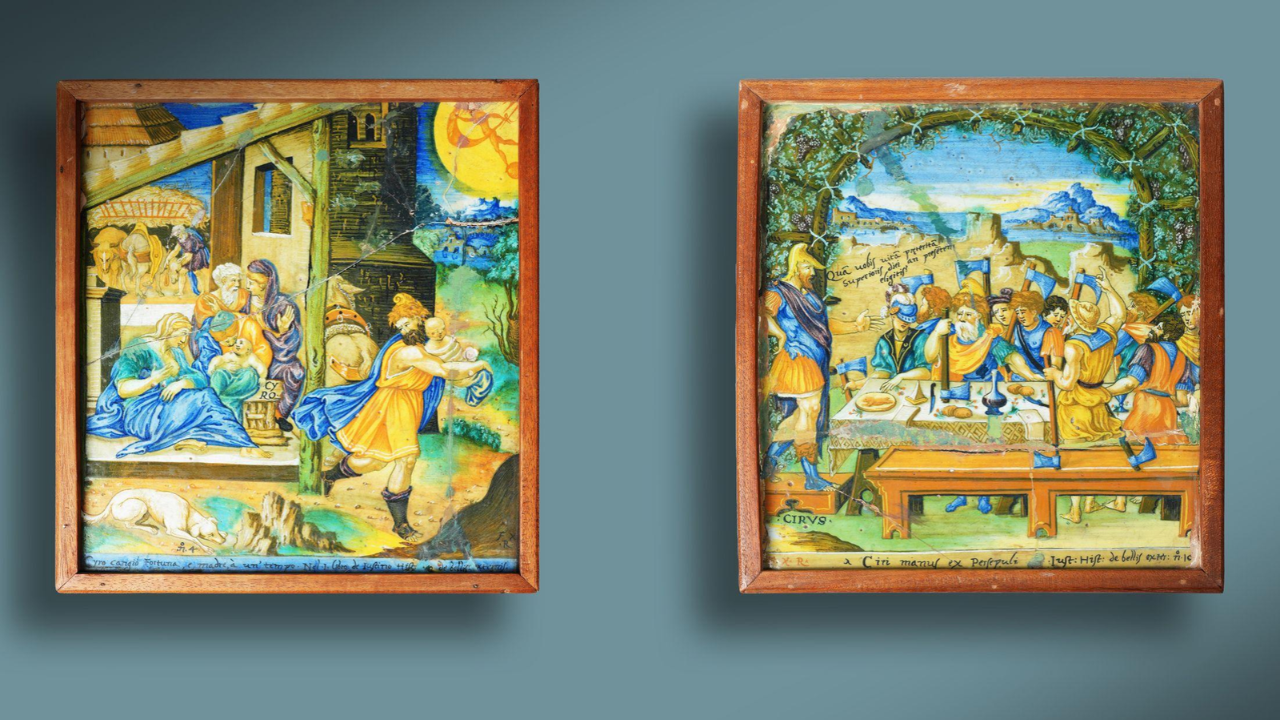
Most people assume high-value museum artifacts are safely locked behind bulletproof glass or cataloged in institutional vaults. They aren't. Sometimes, a pair of priceless sixteenth-century masterpieces spends over a century functioning as ordinary wall decor in a suburban family hallway.
That exact scenario played out when two lost Renaissance maiolica plaques, missing from public view since an 1884 London auction, reappeared in an English country home. When the owners finally decided to email photographs to specialist auction house Woolley and Wallis in Salisbury, they had no idea they were sitting on a six-figure payday. The ceramic panels fetched a combined hammer price of £100,000, bringing a 142-year art mystery to a close.
If you have old heirlooms gathering dust, understanding how this discovery unfolded reveals how easily provenance gets lost—and how you can spot hidden value in your own home.
The 1884 Disappearance and the Pitt Rivers Connection
To understand why these pieces caused a stir among European ceramics experts, you have to look at their origin. Crafted in 1536, the panels are part of a renowned series of roughly 39 maiolica pieces painted by Francesco Xanto Avelli, an iconic master working out of Urbino, Italy. Xanto became famous for vibrant tin-glazed earthenware depicting classical mythology, ancient history, and biblical narratives.
Records show these specific panels—numbered 4 and 10 from a famous sequence detailing the story of Cyrus the Great—were last seen publicly at a London auction in 1884. General Augustus Henry Lane Fox Pitt Rivers, a legendary nineteenth-century archaeologist and founder of the Pitt Rivers Museum in Oxford, purchased them at that sale.
"To find two lost pieces from such a famous series hanging quietly in a family hallway is the sort of discovery every auctioneer dreams about." — John Axford, Woolley and Wallis
After the General passed away, the plaques remained in his family, handed down quietly through generations across South West England. Over 140 years, the historical context faded completely. The descendants forgot the origin story, treating the fragile ceramics as casual wall ornaments while people walked past them every single day.
How Xanto's Maiolica Survived Unscathed
Working with tin glaze during the Italian Renaissance was an unforgiving craft. Artists had to paint directly onto raw, unfired glaze. The pigments absorbed instantly, leaving zero room for error or second chances.
Despite decades of hanging unprotected in an open hallway, the Dorset panels retained remarkably vivid colors, including deep cobalt blues and rich copper-lustre highlights. To put their rarity into perspective, only a tiny fraction of Xanto's Cyrus the Great series remains in private hands. Matching panels from this exact 1536 sequence reside securely inside the permanent collection of the Louvre Museum in Paris under accession numbers OA9028 and OA9029.
Finding matching pieces outside of a major national institution is practically unheard of.
What This Means for Estate Heirlooms Today
Most families holding antique items make a critical mistake: they rely on family lore instead of professional appraisal. Stories get distorted over a century of telephone-game inheritance. An object labeled as a "cheap souvenir from Italy" by a great-grandparent might actually be a sixteenth-century masterwork.
If you suspect you own something of historical significance, take a systematic approach:
- Examine the backs and bases: Look closely for artist signatures, monograms, maker's marks, or old auction labels. The Dorset plaques carried Xanto's distinct "F.X.R." initials alongside series numbering.
- Photograph under natural light: Clear digital images of maker's marks and overall condition are essential when reaching out to specialized auction houses.
- Contact boutique specialists: General antique shops often miss niche items. Reach out to department heads at established regional auctioneers who handle specific European or fine art categories rather than general estate liquidators.
Historic English country homes and suburban properties still conceal lost chapters of European art history behind everyday picture hooks. You don't need a museum badge to find them; you just need to look closer at what's hanging on your walls.