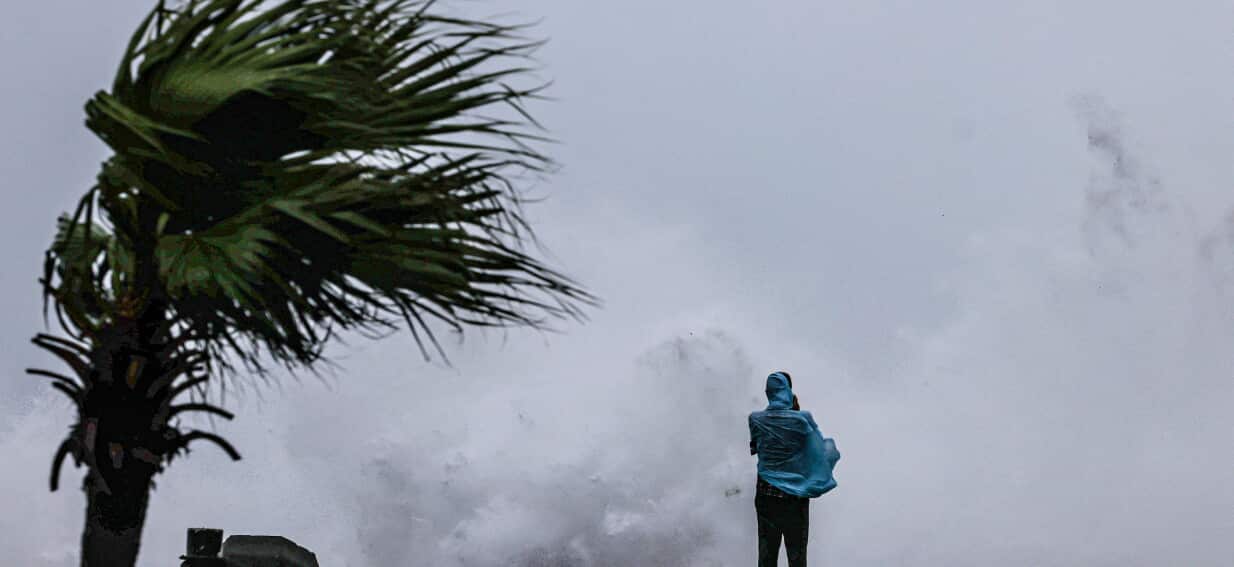
The Brutal Reality of a Overstretched Coastline
You can't fully appreciate the scale of a crisis until you look at the raw numbers. Right now, eastern China is dealing with a logistical nightmare. Over 1.8 million people have been packed up, evacuated, and moved inland as Typhoon Bavi slams into the coast. This isn't just a standard storm warning. It's a massive, coordinated evacuation trying to outrun a storm that spans nearly 1,000 kilometers in diameter.
If you think this is just standard protocol for East Asia, you're missing the real story. The region is already exhausted. Just days ago, Typhoon Maysak tore through the area, leaving 39 people dead, causing rivers to burst their banks, and collapsing a reservoir dam. Now, before communities can even dry out their living rooms, Bavi is bringing sustained winds of 137 kph and gusts tracking up to 173 kph. Learn more on a related subject: this related article.
Wenzhou, a sprawling coastal economic hub of nearly 10 million people, is sitting directly in the crosshairs. Local officials haven't minced words, stating that they're pulling out an "all-out mobilization, sparing no effort or cost" to avoid absolute catastrophe. This isn't corporate speak. It's code for a city terrified of what happens when a massive tropical system hits ground that's already completely saturated.
When Natural Disasters Get Weird
We often talk about storms in terms of rainfall metrics and wind speeds, but the reality on the ground gets chaotic very quickly. Take the city of Hengzhou, for example. Following the initial floods from the previous storm, a commercial breeding facility was overwhelmed by rising waters. The result? Around 900 snakes, many of them highly venomous, escaped straight into the floodwaters. Further reporting by The Washington Post explores related views on this issue.
It sounds like a bad horror movie, but it's exactly what emergency crews are navigating. You aren't just wading through water to save your belongings; you're actively dodging displaced wildlife.
Farther inland, even Beijing felt the pressure. The capital had to shift over 100,000 residents out of harm's way simply because managers of the massive Miyun Reservoir had to aggressively discharge water to prevent the dam from failing. When a storm thousands of miles away forces a capital city to drain its reservoirs and clear out neighborhoods, you know the entire country's infrastructure is maxed out.
The Broader Impact Across East Asia
Bavi didn't just appear off the coast of Zhejiang province out of nowhere. It left a path of disruption stretching across the western Pacific.
- Taiwan: The island narrowily avoided a direct landfall, but the sheer size of Bavi meant northern Taiwan was still hammered. Businesses shut down for days, 14,000 people fled mountainous regions prone to mudslides, and 170,000 homes lost power entirely. Parts of the island braced for up to a meter of total rainfall.
- Japan: The remote southwestern islands took a direct hit. In the Miyako region, over 18,000 homes lost power. Winds were so violent that commercial airlines scrapped dozens of flights, leaving over 26,000 travelers completely stranded.
- The Philippines: Even without a direct hit, the storm supercharged the seasonal monsoon. The resulting landslides and torrential rain claimed 18 lives and displaced 11,000 people.
The sheer geographic footprint of this storm tells you everything you need to know. It’s an absolute monster of a system.
What the Experts Aren't Saying Out Loud
Meteorologists point to a simple, alarming trend. Tropical cyclones are changing. Data from the European Union's Copernicus Marine Service confirmed that ocean temperatures are hitting record highs. Warm water acts as literal rocket fuel for these storms.
Xiangbo Feng, a tropical cyclone researcher at Imperial College London, noted that Bavi spent an unusually long time intensifying over the open, warm waters of the Pacific. When a storm sits over a hot ocean, it sucks up massive amounts of moisture and energy. That’s why we’re seeing storms that aren't just faster, but incredibly massive in physical size.
The traditional emergency playbooks are struggling to keep pace. When you have back-to-back typhoons hitting the same coastline within a two-week window, there is zero time for recovery. Infrastructure can't cope, soil can't absorb the water, and emergency budgets get wiped out instantly.
Survival Steps for Coastal Storms
If you live anywhere along a vulnerable coastline, you can't rely purely on municipal infrastructure to keep you safe. Waiting for an official evacuation order before you pack your bags is a recipe for disaster.
First, look at your local geography, not just your house. If you are downhill from a reservoir or near a river that has flooded in the past decade, you need to leave the moment a major system tracking over 1,000 km approaches.
Second, rethink your emergency supplies. Standard medical kits don't factor in local industrial hazards or displaced wildlife like the situation in Hengzhou. Keep heavy leather boots, thick gloves, and reliable headlamps ready. Flashlights on your smartphone won't cut it when the grid goes dark for a week and you need your hands free to move debris.
Secure your property early. Taping windows and bracing shop shutters with wooden planks helps against flying debris, but it won't stop a storm surge. If local authorities say move, move immediately. Property can be rebuilt; you can't.