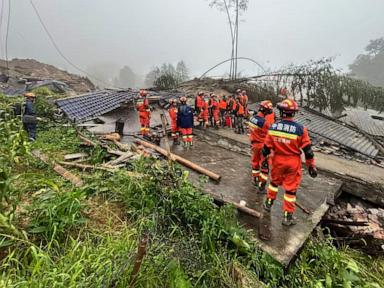
When the hillside gave way in Jiangxi province, it didn't just swallow a dozen houses; it instantly shattered peaceful mountain routines. Torrential downpours from Typhoon Saudel battered eastern China, triggering devastating mudslides that left emergency responders scrambling against the clock.
The immediate human cost is severe. The death toll climbed to three following relentless weekend rains, while rescue crews searched desperately for missing residents. Suichuan County bore the brunt of the early Saturday disaster, with local infrastructure severely compromised and entire neighborhoods buried under heavy sludge.
The Anatomy of a Mountain Disaster
Why do these severe weather events turn catastrophic so quickly in rural parts of eastern China? Mountainous topography combined with saturated soil creates an unstable mix. When systems like Typhoon Saudel make multiple landfalls—hitting Zhejiang Province and later pushing inland as a tropical storm toward Fujian—the prolonged moisture leaves steep slopes vulnerable to sudden failure.
State broadcaster CCTV confirmed that more than 5,300 people across the affected county had to be evacuated swiftly to safer ground. It wasn't just Jiangxi feeling the strain. Downpours reached neighboring regions like Hunan province, where subsequent flooding and landslides claimed additional lives.
Evacuation Pressures and Infrastructure Failures
Disaster management in these scenarios demands immediate action, but logistical hurdles remain massive. In Suichuan County's mountainous town of Gaoping, flash flooding completely washed away a critical bridge. Fortunately, local officials had closed off the structure prior to its collapse, preventing an even worse tragedy on the roads.
Yet, the economic and personal disruption is staggering. Early regional reports estimated direct financial losses reaching hundreds of millions of yuan as agricultural lands and rural roads vanished beneath mud and debris. Power networks and communication signals took days to fully restore in the hardest-hit pockets.
Preparing for Next Season
Extreme weather events are testing local disaster responses to their absolute limits. If you live in or travel through storm-prone provinces during typhoon season, staying ahead of local meteorological alerts is non-negotiable. Monitor official state broadcaster updates, respect evacuation orders instantly, and never underestimate the speed at which mountain terrain can shift under continuous heavy rainfall.
Typhoon Saudel-triggered landslide killed at least five in E. China; over 5,000 evacuated
This video provides on-the-ground visual context of the rescue efforts and infrastructure damage in Jiangxi province following Typhoon Saudel.