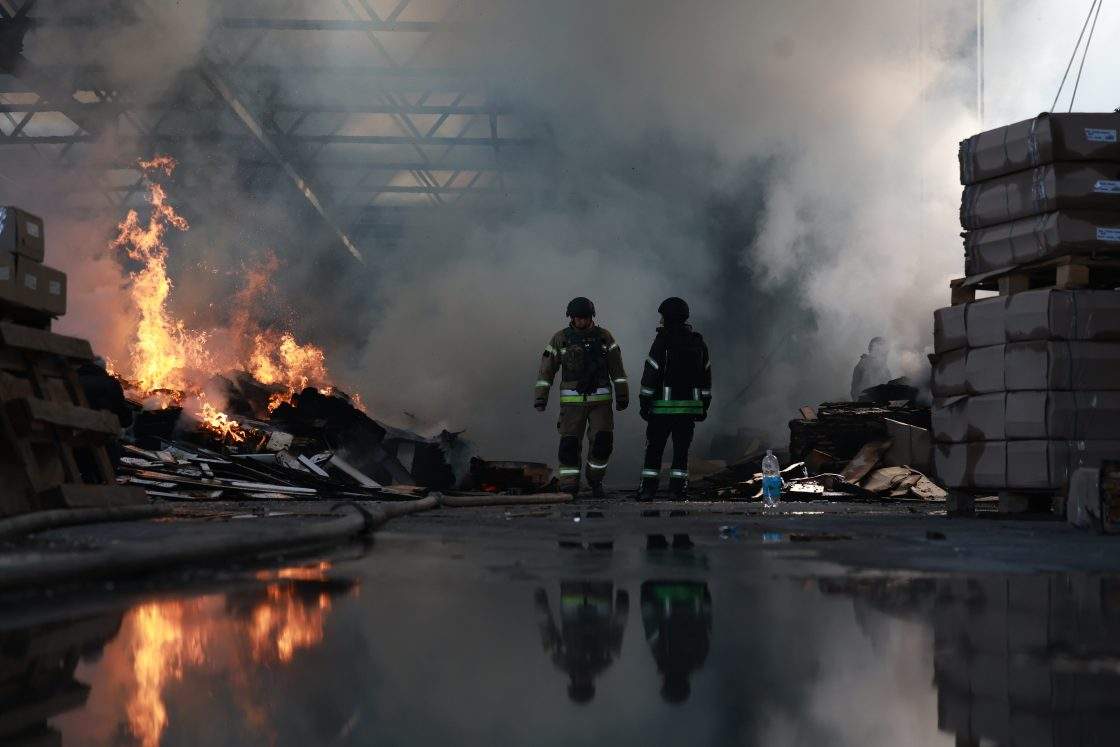
The rules of long-range aerial combat are changing, and almost nobody outside military intelligence is paying close attention to the scale of what's happening. Ukraine didn't just throw a few homemade quadcopters across the border recently. Kyiv unleashed a massive swarm of nearly 900 drones into Russian territory, hitting oil infrastructure, sparking massive refinery fires, and forcing Moscow to intercept hundreds of flying objects over the Moscow region alone.
If you think this is just standard background noise in a long war, you're missing the strategic transformation. This massive drone campaign is rewriting how asymmetric warfare works.
The Shift in Long-Range Strike Economics
For years, the narrative was simple: Russia held air superiority, bombarding Ukrainian cities with cheap Iranian-designed drones and expensive ballistic missiles while Kyiv begged Western allies for air defense systems. Patriot batteries are great, but they cost millions per interceptor. A long-range drone costs a fraction of that.
Ukraine has flipped that math on its head. By scaling up domestic production of long-range loitering munitions, Kyiv can project power hundreds of miles deep into Russia. We're talking about targets reaching past the Urals and Siberia. When nearly 900 drones fill the sky in a single multi-front wave, air defense systems get overwhelmed. Moscow Mayor Sergei Sobyanin admitted that hundreds of aircraft flew toward the capital region alone, stretching Russian radar and interceptors to their absolute limits.
You can't defend every square mile of a country as massive as Russia with expensive surface-to-air missiles. The economics favor the swarm.
Targeting Russia's Economic Lifeline
Kyiv isn't just sending drones to make noise; they're going straight for the economic jugular. Oil refineries, fuel storage facilities, and transport hubs are burning. Ukrainian officials claim their campaign has degraded over half of Russia's refining capacity. Even if you discount wartime propaganda numbers, Vladimir Putin himself acknowledged that these strikes shaved roughly one percent off Russia's gross domestic product.
That economic pinch has global repercussions. Moscow banned diesel exports to stabilize domestic supply, sending international fuel prices surging. That shockwave even prompted pressure from Washington, with former U.S. President Donald Trump publicly urging Kyiv to ease up on refinery strikes to keep global markets calm.
When a war starts reshaping global energy markets through sheer industrial drone volume, it stops being a regional conflict and becomes an international economic crisis.
Braning for the Inevitable Retaliation
President Volodymyr Zelenskyy has warned that Kyiv is bracing for a massive counter-strike. Intelligence points to hundreds of ballistic missiles held in reserve, ready for deployment. When you punch a giant hole in an adversary's energy grid, they don't just absorb the blow—they look for ways to retaliate against civilian infrastructure and vital transit routes.
We've already seen this script play out. After targeting bridges in Kyiv, Russian forces shifted focus toward southern transit points like the Dnipro River bridge in Zaporizhzhia, while simultaneously hitting port infrastructure in Odesa and striking cargo ships in the Black Sea. A Marshall Islands-flagged vessel carrying rapeseed oil was hit, proving that the collateral damage of these aerial bombardments extends directly to international trade and shipping crews.
The Broader European Chessboard
The drone escalation isn't staying confined to the front lines. The shockwaves are rattling NATO's eastern flank. When Lithuania floats the idea of hosting permanent U.S. military bases and votes on permitting nuclear weapon deployments, Moscow reacts with immediate hostility, warning of sharp escalations.
Polish Prime Minister Donald Tusk has warned that European nations supporting Ukraine must prepare for hybrid drone and rocket provocations. The sheer volume of aerial technology now circulating through Eastern European skies means a single stray guidance system or a miscalculated interception can drag neighboring NATO members directly into the crossfire.
The days of predictable, slow-moving trench warfare are over. Drone swarms have turned the skies over Eastern Europe into a high-stakes proving ground where economic survival and military logistics hang in the balance. Keep your eyes on the supply chains and the production lines, because that's where this war is actually being won or lost.