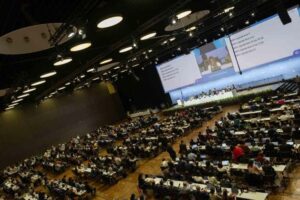
The mid-year UN climate talks in Bonn, Germany just wrapped up, and honestly, it was a mess.
If you're trying to figure out why nearly ten thousand delegates spent ten days at the World Conference Center only to achieve absolute gridlock, you aren't alone. The public expects progress. Instead, we got a masterclass in bureaucratic stalling. For a different look, check out: this related article.
Diplomats couldn't even agree to forward a basic text capturing their progress to the upcoming COP31 summit in Antalya, Türkiye. When you can't even agree on what you just talked about, the system is broken.
Let's strip away the diplomatic spin. The June 2026 climate meetings failed because of three massive, compounding pressures: severe geopolitical crises, bitter divisions over who pays for adaptation, and a total breakdown of trust between rich and developing nations. Related insight regarding this has been provided by Wikipedia.
Here is exactly what went wrong behind closed doors.
The Geopolitical Chokehold on Global Energy
You can't isolate climate negotiations from real-world chaos. As delegates sat in air-conditioned rooms in Germany, the sudden closure of the Strait of Hormuz was actively rewriting global economics.
The blockade choked oil supply chains, sending energy prices through the roof and triggering massive inflationary pressures across the globe.
The Reality Check: When fossil fuel supply chains break, politicians don't double down on green tech overnight. They panic about immediate energy security.
Rich nations spent the conference worrying about domestic inflation and securing short-term fossil fuel alternatives. Meanwhile, developing nations pointed to the skyrocketing fuel costs as proof that staying hooked on oil and gas is an economic death trap.
Compounding this chaos, the World Meteorological Organization dropped a brutal briefing mid-conference: this year’s El Niño is tracking to be one of the strongest on record. We're looking at imminent, catastrophic droughts and heatwaves.
The planetary warning signs were flashing red, but the geopolitical noise was simply too loud for anyone to listen.
The Backlash to the Belém Hangover
To understand the failure in Bonn, you have to look back at what happened at COP30 in Belém, Brazil.
Belém ended on a deeply sour note. Developing nations left frustrated by the distinct lack of concrete rules on transitioning away from fossil fuels. They were also furious about how technical indicators for tracking the Global Goal on Adaptation were rushed through.
Developing countries arrived in Bonn united. They demanded that wealthy nations deliver on their explicit promises—specifically, the pledge to triple adaptation finance by 2035.
Instead, wealthy nations spent ten days hiding behind procedural tricks.
According to analysts at the Centre for Science and Environment, developed nations systematically steered discussions away from historical responsibility and hard cash. They tried to substitute real material obligations with vague moral appeals to climate science.
When the Global South demanded money to build sea walls, protect crops, and reinforce health systems, they were met with proposals to turn adaptation tracking into an abstract measurement exercise.
Shifting Focus from Money to Platforms
The breakdown wasn't just about the total dollar amount. It was about how that money is controlled.
Take the UAE Just Transition Work Programme. In Bonn, this devolved into a fundamental argument over the scope of the just transition mechanism.
- Developing countries view this mechanism as a vital pipeline to secure funding, technology transfers, and industrial capacity building.
- Developed countries spent the week trying to shrink its scope, attempting to limit the entire mechanism to a mere "knowledge-sharing platform."
Basically, rich nations want a website where people can share PDFs. Developing nations need actual wealth and technology transfers to survive.
Because of this fundamental divide, key negotiations on the Mitigation Work Programme and the Adaptation Fund hit a total wall. Under the UN's strict rules, when parties reach this level of gridlock, the entire agenda item gets kicked down the road under "Rule 16." It means the clock resets, and discussions start over from scratch at the next meeting.
The Friction Points Nobody Wants to Talk About
If you look at the official press releases from groups like the European Union, they talk about "technical negotiations advancing." It's pure spin.
The real friction points were highly political, highly tense, and completely unresolved.
Wealthy nations spent the session demanding strict transparency from everyone else, pushing for compliance on Biennial Transparency Reports. They want to track every ounce of carbon entering the atmosphere.
But when developing nations brought up Article 9.1 of the Paris Agreement—which mandates that developed countries provide financial resources to assist developing countries—the room went cold.
Then came the issue of trade. The implementation of unilateral trade barriers, like the European Union's Carbon Border Adjustment Mechanism, infuriated manufacturing heavyweights like China and Brazil.
Developing countries view these mechanisms as protectionist tariffs disguised as climate policy. They argue these measures sap the exact capital they need to transition away from coal and gas.
What Happens Next
The failure in Bonn means the stakes for COP31 in Antalya, Türkiye are now dangerously high. There is no more buffer room. If you're tracking climate policy or managing corporate environmental strategies, the next six months require a massive pivot.
- Expect zero regulatory clarity: Do not assume international carbon markets under Article 6 will be operational or stable anytime soon. The technical rules are entirely bogged down in political infighting.
- Prepare for localized trade friction: With multilateral UN talks stalling, individual trading blocs will accelerate their own green tariffs. Monitor your supply chain exposure to regional penalties like the EU's border tax.
- Shift to local resilience: If your operations depend on agricultural supply chains or infrastructure in the Global South, don't wait for international adaptation funds to bail out local communities. The gridlock in Bonn proves that international funding is not coming anytime soon. Build your own localized climate resilience models now.