A single runway changes everything during a humanitarian disaster. On Saturday, a massive American C-17 military transport plane touched down on the tarmac at Simón Bolívar International Airport near Caracas. Just three days earlier, a brutal double earthquake ripped through northern Venezuela, shattering cities and completely shutting down the nation's primary aviation gateway.
The arrival of US military aircraft in Caracas isn't just an ordinary emergency relief operation. It represents a dramatic shift in geopolitical reality, forced by an unprecedented humanitarian catastrophe.
The twin earthquakes hit north-central Venezuela less than forty seconds apart on June 24, 2026. A magnitude 7.2 foreshock struck first, followed almost immediately by a devastating 7.5 mainshock. Experts call this a doublet event, a rare and deeply destructive seismic phenomenon that left northern coastal towns in absolute ruins. The official death toll has passed 920 people, thousands are injured, and tens of thousands remain missing under the weight of hundreds of collapsed structures.
With the main gateway in La Guaira heavily damaged, international rescue efforts faced a logistical wall. That wall just cracked open. One runway at the Caracas airport is operational again, and American aid is officially on the ground.
The Operational Reality at Caracas Airport
Simón Bolívar International Airport serves as the literal lifeline for any large-scale international intervention in Venezuela. The dual tremors tore through the airport infrastructure, leaving one critical runway entirely split, cracked, and useless.
Engineers worked around the clock to clear and inspect the surviving strip of asphalt. According to senior US officials, that single functional runway is now actively receiving heavy transport aircraft.
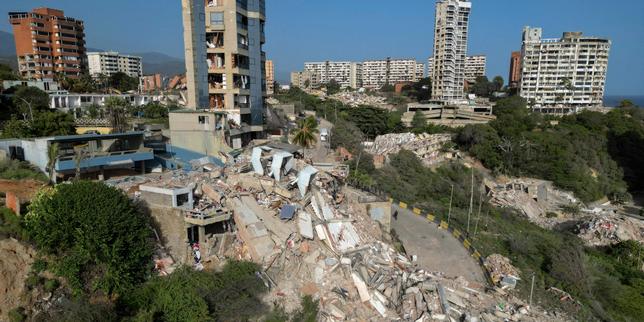
It is a tense, high-stakes environment. Air traffic controllers are managing incoming relief flights with minimal infrastructure. The coastal area surrounding the airport, including the cities of Catia La Mar, Caraballeda, and La Guaira, suffered the most intense destruction of the entire disaster zone. Entire rows of multi-story residential towers have been leveled to the ground. The airport itself sits right on top of the fault zone segment that ruptured.
Breaking Down the Washington Aid Package
The American response involves serious money and heavy hardware. Washington immediately released 150 million dollars in emergency funding to kickstart the relief pipeline.
The financial breakdown shows where the immediate priorities lie. One hundred million dollars goes directly through the United Nations Office for the Coordination of Humanitarian Affairs. The remaining 50 million dollars is split among field agencies like UNICEF and the World Food Programme to handle immediate survival needs like clean water and food security.
But cash doesn't pull people out of concrete ruins. The physical deployment matters far more right now.
Field Hospitals and Search Teams
The C-17 cargo planes that landed on Saturday didn't just bring boxes of blankets. They carried complete, self-sustaining field hospitals. Local medical centers in Caracas and La Guaira are completely overwhelmed or physically compromised by structural damage. These mobile field units will provide immediate trauma care right outside the worst-hit zones.
Alongside the medical gear, 250 specialized American search and rescue personnel have deployed. They brought advanced listening devices, search cameras, and heavy extrication tools. The clock is ticking loudly. The first 72 hours are known as the golden window for finding survivors beneath the rubble. That window is closing fast, making every single flight crucial.
Naval Assets on the Horizon
The logistical push extends to the Caribbean Sea. The US Navy vessel USS Fort Lauderdale has arrived in position just off the Venezuelan coast.
This amphibious transport dock ship changes the operational dynamic entirely. It functions as a floating logistics hub. The ship is launching heavy-lift helicopters to fly medical evacuations directly from isolated beach towns and transport emergency supplies straight into communities blocked by triggered landslides. Roads connecting Caracas to the coast are heavily fractured, so these air corridors are the only viable path.
Why the Destruction in La Guaira is Unprecedented
Acting President Delcy Rodríguez quickly declared the La Guaira region a disaster zone. It is a fair assessment. The geological mechanics behind this double earthquake explain why the destruction is so targeted and severe.
The rupture occurred along the San Sebastián fault system, which runs right along the Caribbean coast. Seismologists from the US Geological Survey noted that the first event initiated near Morón and propagated eastward at a terrifying speed of over three kilometers per second. Ten seconds later, a second, even larger rupture triggered offshore, north of Catia La Mar.
The energy release lasted for more than 90 seconds. For the millions of people living in the capital district and coastal resorts, it felt like an eternity.
The beachfront communities west of the airport are basically gone. Iconic local structures, including the massive Ritasol Palace apartment block and the historic Eduard's Hotel, collapsed entirely into mountains of dust and twisted steel. Families are currently sleeping in the streets, terrified of the 30-plus aftershocks that continue to rattle the region.
The Geopolitical Friction Behind the Relief Flights
You cannot talk about US military planes landing in Caracas without talking about politics. The relations between Washington and Caracas have been frozen in bitter ideological conflict for over two decades. Sanctions, diplomatic expulsions, and fierce rhetoric defined the relationship.
The sheer scale of this tragedy forced a pause on geopolitical posturing. When thousands of citizens are buried alive, refusing aid becomes a political impossibility.
Other nations are moving quickly too. France is deploying a specialized team of 85 rescuers. Brazil, Mexico, Spain, Portugal, and Qatar have all pledged significant aid packages. The international community is surging into a country that was previously highly insulated and suspicious of foreign intervention.
What Needs to Happen Next
The partial reopening of the airport is a good start, but it is just step one. If you want to understand how this crisis unfolds over the coming weeks, keep your eyes on these specific operational targets.
- Establish a continuous air bridge: A single functional runway is a bottleneck. Authorities must coordinate strict arrival slots for incoming flights from the US, Europe, and Latin America to avoid gridlock on the apron.
- Clear the highway corridors: The main highway connecting the port of La Guaira and the airport to the valley of Caracas is heavily damaged. Heavy engineering equipment must prioritize stabilizing these mountain passes so supplies can move inland.
- Secure water distribution networks: The earthquakes shattered municipal water mains across Miranda, Yaracuy, and Carabobo states. Without immediate clean water distribution, waterborne disease outbreaks will start within days.
- Expand heavy machinery mobilization: Local rescue teams desperately need cranes, excavators, and concrete cutters. Hand tools are not enough to clear the massive high-rise collapses in neighborhoods like Altamira and Los Palos Grandes.
The focus right now remains entirely on the rubble. Every hour that passes reduces the probability of finding survivors. The sound of American C-17 engines over Caracas is a stark reminder that nature doesn't care about borders or political sanctions. It is a race against time, and the clock is winning.