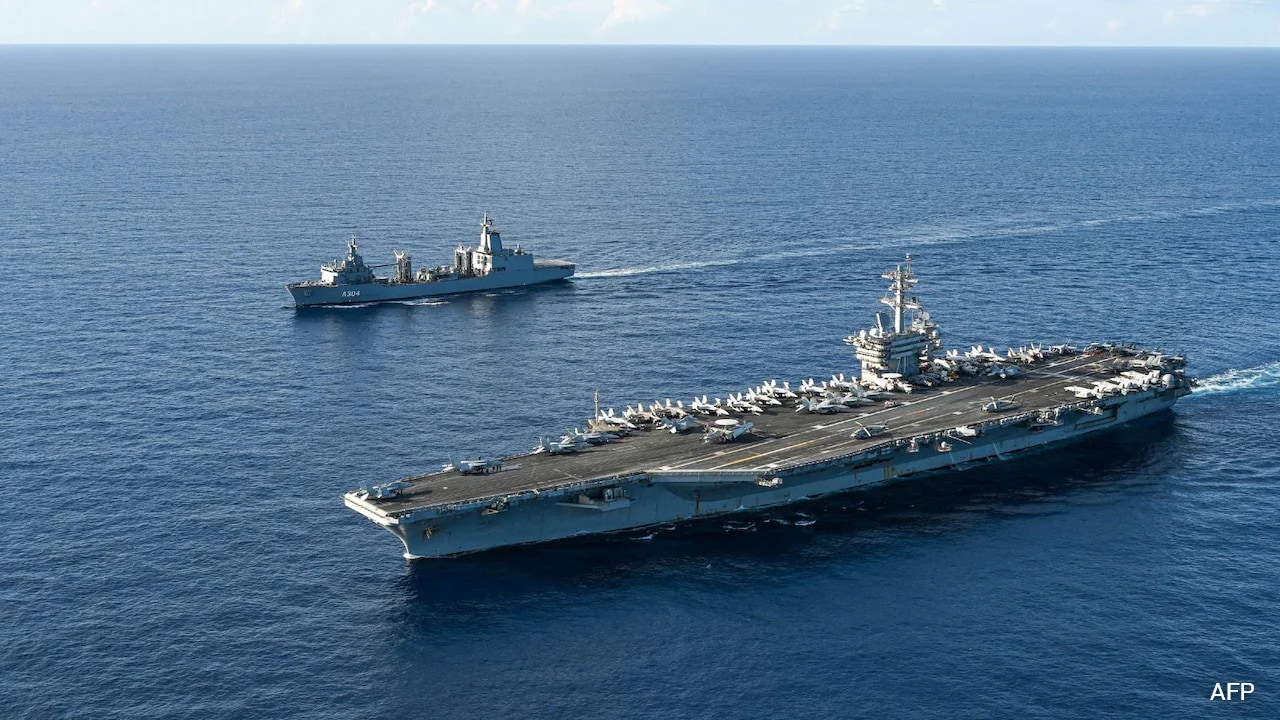
The Persian Gulf is turning into one of the most heavily armed maritime zones on the planet. When the USS Theodore Roosevelt steamed into the U.S. Central Command region, it wasn't just a routine deployment rotation. It marked the third American carrier strike group operating simultaneously in regional waters—a massive concentration of floating airbases, destroyers, and thousands of sailors.
This escalation didn't happen in a vacuum. It follows a direct drone strike by Iran's Islamic Revolutionary Guard Corps targeting radar infrastructure at a Bahraini air base, piercing what had been a fragile two-month lull in hostilities. If you're wondering whether diplomacy is dead or just on life support, the sight of three carrier strike groups gives you a pretty clear answer.
What's Actually Happening on the Ground
Let's look past the sterile Pentagon press releases. Over the past few days, Iranian drones and aerial threats have pivoted back toward Bahrain, a vital U.S. ally and home base for regional security operations. Tehran's Revolutionary Guards didn't hide their actions; they openly claimed responsibility for launching drones at the Riffa Air Base.
This wasn't random aggression. It's part of a cyclical game of retaliation. Tehran framed the strike as payback for an earlier American hit on an Iranian telecommunications tower. Every time a communications node or a radar dish gets blown up, both sides inch closer to a full-scale conflagration that neither Washington nor Tehran can easily manage.
The arrival of the USS Theodore Roosevelt—joining the USS George Washington and the USS George H.W. Bush—shifts the local balance of power overnight. Having three carriers in the theater gives military planners endless options for launching sustained air campaigns, enforcing strict maritime blockades, and intercepting incoming projectiles before they touch allied soil.
The Economic Chokehold and Iran's Reality
Military hardware is only half the story. While the warships patrol the sea lanes, the financial vise tightening around Iran is squeezing the regime harder than ever. U.S. officials recently pointed out that Tehran's economy is experiencing one of the fastest collapses in modern history, driven by comprehensive naval interdiction and aggressive enforcement targeting land-based supply routes.
Leadership in Tehran is feeling the heat. Iranian officials are cut off from international travel, private accounts, and the luxury lifestyle networks they once relied upon. Yet, cornered regimes rarely fold quietly. Even with economic pressure mounting, intelligence assessments indicate Iran still holds a massive stockpile of missiles, ensuring they retain the capability to strike back at regional infrastructure if total war resumes.
Why This Matters Beyond the Gulf
If you think a localized skirmish in the Middle East stays in the Middle East, history proves you wrong every single time. Energy corridors, global shipping insurance rates, and international markets react instantly to every drone launched near Bahrain or warship deployed to the Arabian Sea.
The Trump administration's strategy relies on maximum deterrence—stacking enough raw military might offshore to convince Tehran that any further attacks on allies will result in catastrophic retaliation. But deterrence only works until someone miscalculates. When you crowd three carrier strike groups and dozens of support vessels into a restricted body of water alongside an active adversary armed with hundreds of ballistic missiles, the margin for error vanishes entirely.
Keep an eye on how maritime traffic responds to the heightened naval patrols over the coming weeks. The current standoff has moved past saber-rattling. Every drone strike and carrier deployment brings the region one step closer to an irreversible tipping point.


