Statues don't stay bronze for long in modern America. They become targets, lightning rods, and physical manifestations of our deepest cultural hatreds almost the moment they're bolted down.
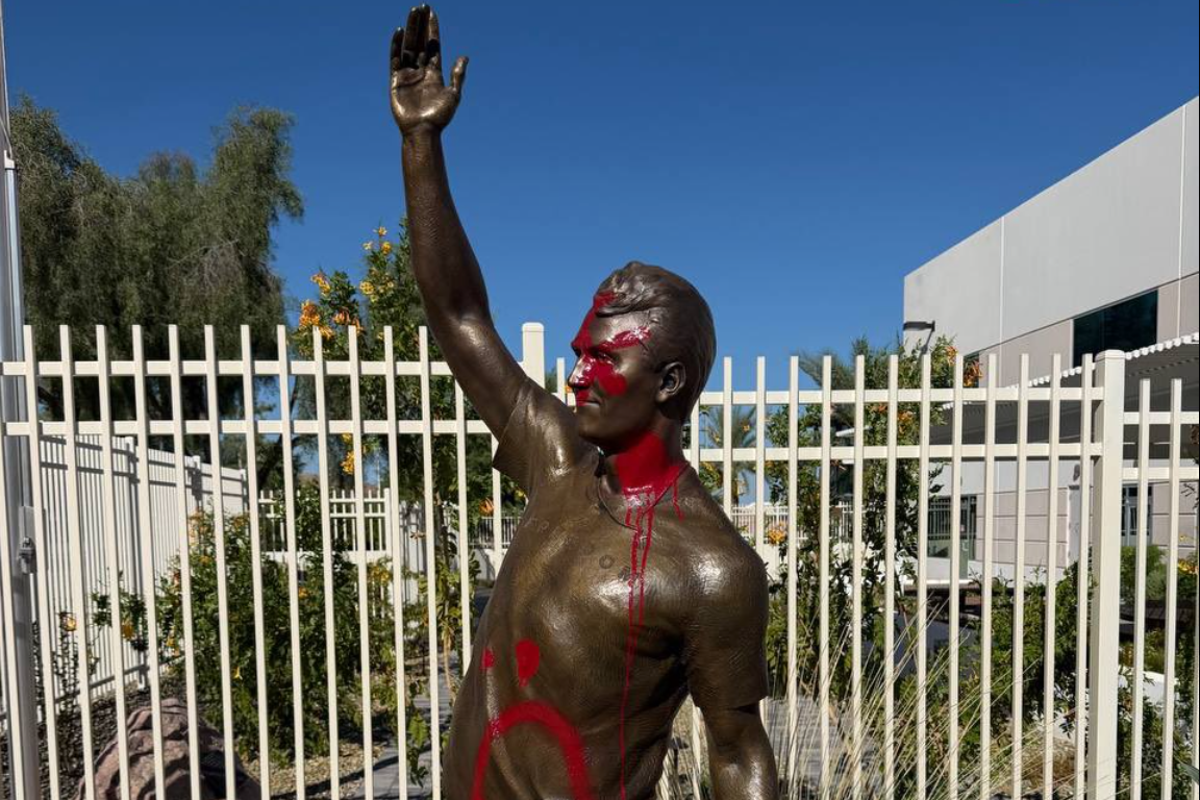
Outside Turning Point USA headquarters in Phoenix, Arizona, a newly installed memorial to the late conservative organizer Charlie Kirk lasted roughly twenty-four hours before someone smeared red paint across its face, neck, and torso. The red pigment on the neck wasn't random; it targeted the exact spot where Kirk was shot and killed a year prior while speaking at Utah Valley University. Nearby, a Christian tribute sign bearing the words "Jesus defeated death so you can live" was altered, with the word "Jesus" crossed out and replaced with "Satan."
It's a grim reminder of how toxic our public square has become. When memorialization itself triggers acts of political vandalism, we're staring at something much deeper than simple teenage rebellion or random property crime. We are looking at a society locked in a cycle of grievance where symbols of mourning are treated as provocations.
Phoenix police opened an investigation immediately, while Turning Point USA officials announced plans to clean the memorial and relocate it inside the building for security. Erika Kirk, who stepped up to lead the organization following her husband's assassination, responded sharply on social media. She quoted her late husband's maxim about building two statues for every one torn down, adding a defiant assertion that God will not be mocked. Tyler Bowyer, the group's chief operating officer, echoed that sentiment while calling for accountability for those responsible.
The timing adds fuel to an already volatile fire. The statue's unveiling coincided with the one-year mark of Kirk's death on September 10, 2025—an event that shocked the political landscape and drew intense national focus. Legal proceedings are currently moving forward against the suspect accused of the shooting, with a judge ruling that the accused must stand trial for aggravated murder, facing a potential death penalty if convicted.
Yet, the physical attacks on memorials point to a broader operational reality for political organizations today: public monuments are sitting ducks. Whether it's historical figures or contemporary partisan figures, outdoor memorials have effectively turned into flashpoints. Turning Point USA learned this lesson the hard way. The organization now has to treat its own headquarters like a fortress, moving a bronze tribute indoors simply because outdoor displays invite immediate sabotage.
This incident also highlights the strange logistics surrounding these tributes. Days prior, another statue depicting Kirk sitting cross-legged in a folding chair with a microphone popped up in the back of a pickup truck in Utah, making rounds after a campus memorial event. That piece, created independently, sparked confusion over campus guidelines and public property rules before plans were made to transport it down to Arizona. Monuments are traveling, shifting, and sparking controversy before they even find a permanent home.
When you look at what happened in Phoenix, you realize the debate isn't just about vandalism. It's about whether public grief can exist anymore without immediately turning into a battleground. Every memorial becomes a statement, and every act of destruction becomes a counter-statement in an endless war of symbols.
If you're tracking how political polarization manifests on the ground, watch the security footage coming out of Phoenix. The investigation is ongoing, and as Turning Point USA prepares to reinforce its perimeter, the message is clear. In today's climate, even bronze cannot protect you from the rage outside.