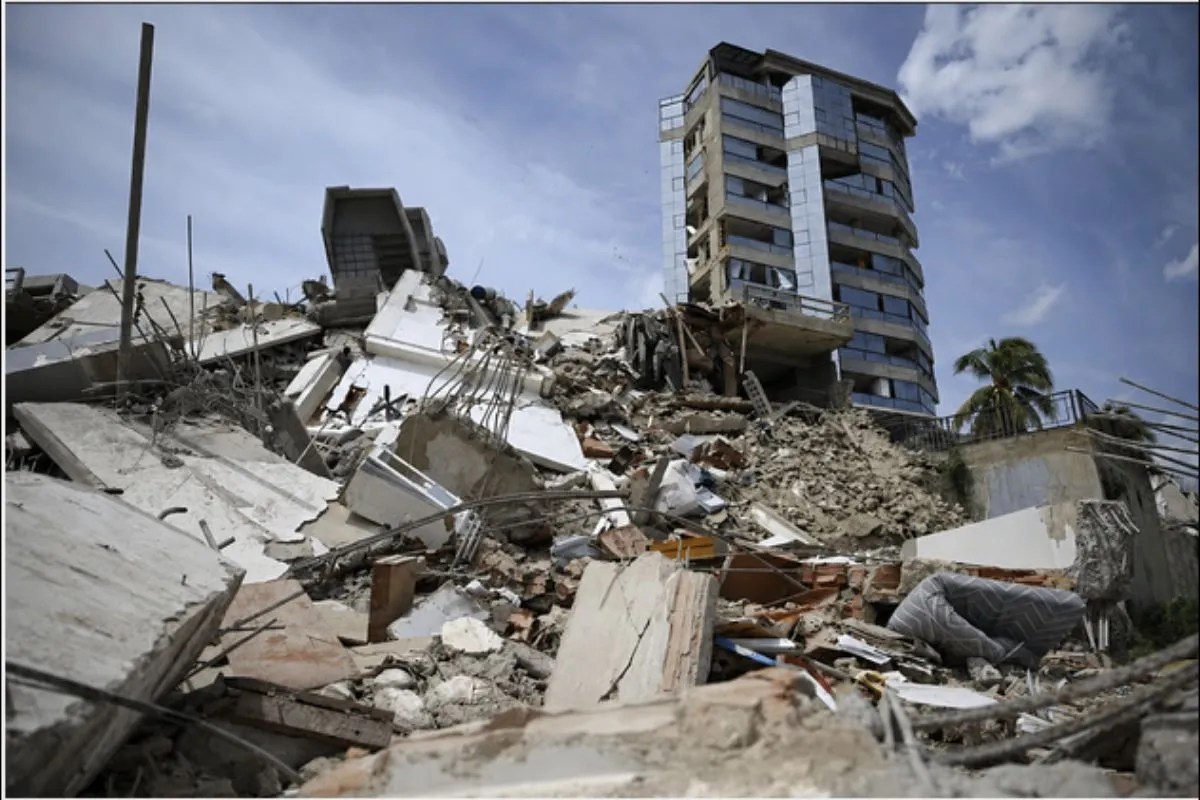
People in Caracas didn't even have time to clear the dust from their clothes before the ground started shaking again. Just days after a horrific twin seismic event leveled high-rises and left hundreds confirmed dead, a sharp 4.7 magnitude aftershock rattled the northern coast of Venezuela. It wasn't the biggest tremor the country has felt this week, but it didn't need to be. When your apartment building already has structural cracks wide enough to slide a hand through, a 4.7 feels like a death sentence.
Thousands of residents ran into the streets screaming, refusing to return to what remains of their homes. This fresh wave of panic highlights a terrifying reality that structural engineers and seismologists are currently trying to handle on the ground. The initial disaster wasn't just a single bad earthquake followed by minor settling. It was an incredibly rare, back-to-back double punch that has completely altered how we look at seismic risks along the Caribbean coast. Also making waves in related news: Why The Us Iran Ceasefire Just Collapsed In The Strait Of Hormuz.
To understand why a moderate aftershock is causing total chaos right now, you have to look at the sheer violence of what happened just a short while before.
The One Two Punch That Shocked Seismologists
On Wednesday evening around 6:00 PM, people were wrapping up their day, traveling home from work, or watching television when the first major shock wave hit. It registered as a massive 7.2 magnitude earthquake, centered near San Felipe. For most communities, that would be the defining disaster of a generation. But the earth wasn't done. More information on this are covered by BBC News.
Exactly 39 seconds later, before the sound of twisting steel and collapsing concrete had even subsided, a second, even larger 7.5 magnitude quake exploded along a neighboring fault structure.
Seismologists call this a doublet. It is not the typical pattern where a massive mainshock is followed by significantly smaller aftershocks hours or days later. Instead, these are two distinct, near-equal monsters waking up at almost the exact same time. The US Geological Survey notes that while doublets happen occasionally around the globe, seeing them hit a heavily populated zone with a gap of less than a minute is vanishingly rare.
Think about the physics of that for a second. The first quake compromises the structural integrity of a building, snapping support columns and shifting foundations. While the concrete is mid-shatter, the second, stronger wave hits from a slightly different angle. It means buildings that might have survived a 7.2 were absolutely obliterated when the 7.5 arrived 39 seconds later.
The Silent Fault Lines Beneath Caracas
The Caribbean and South American tectonic plates grind past each other at a rate of roughly two centimeters a year. That might sound slow, but in the world of geology, it is a massive amount of movement. It builds up a staggering amount of friction along the Boconó fault line, a 300-mile system running right through the spine of the Venezuelan Andes.
When the rupture happened on Wednesday, the displacement was mostly horizontal strike-slip faulting. The ground didn't lift up or drop down dramatically; instead, two massive blocks of rock slammed sideways past each other.
What makes Venezuela uniquely vulnerable right now isn't just the geometry of the faults. The country completely lacks a functional early earthquake warning system. In places like Japan or California, a network of deep underground sensors detects the initial, non-destructive P-waves of a quake and instantly sends alerts to cell phones, giving people five to thirty seconds to drop, cover, and hold on. In Caracas, there was nothing. The first sign of trouble was the floor dropping out from beneath people's feet.
Local emergency management groups are overwhelmed. The initial official reports tried to downplay the tragedy, citing a low double-digit death toll, but the reality on the streets quickly tore through that narrative. The current official count has passed 180 dead, with more than 1,500 injured and thousands still missing under the concrete slabs of La Guaira and Caracas. The USGS models suggest the actual economic and human toll could crawl significantly higher as remote coastal areas finally get reached by emergency teams who are currently clearing rockslides by hand.
Why the Aftershocks are Logistically Catastrophic
This brings us back to the recent 4.7 tremor. In a normal scenario, a 4.7 magnitude earthquake causes some rattling dishes and minor anxiety. But in post-doublet Venezuela, it stops rescue operations in their tracks.
When a 4.7 hit, search teams inside collapsed buildings had to immediately drop their tools and scramble out of the rubble piles. Every second spent evacuating a search zone is a second that a trapped survivor goes without water or medical care. The shifting concrete during these smaller tremors can instantly crush pockets under the rubble where victims are still clinging to life.
The psychological toll is just as severe. Thousands of families are currently sleeping on asphalt sidewalks, park benches, and open plazas across northern cities. They are too terrified to step foot inside structures that look perfectly fine from the outside. Honestly, you can't blame them. When the earth tricks you twice in less than a minute, you lose all faith in solid ground.
Emergency shelters are stretched to a breaking point. Venezuela was already struggling with massive inflation, infrastructure decay, and medical supply shortages before the earth split open. Now, hospitals are performing triage in parking lots under plastic tarps because doctors are worried the hospital ceilings might cave in during the next tremor. Clean drinking water has become a major currency because primary water mains snapped during the 7.5 shake.
Breaking Down the Doublet Misconceptions
A lot of the initial news coverage has incorrectly labeled these events as a massive mainshock and a big aftershock. That is a dangerous mistake because it misrepresents the threat level moving forward.
An aftershock happens on the same fault plane that originally ruptured, caused by the crust adjusting to the new pressure layout. A doublet sequence involves two separate faults or two distinct segments of a highly complex fault system. The first quake essentially acts as a trigger, transferring its immense stress directly onto an adjacent fault that was already locked and loaded.
This means the entire northern region of the country is now in a highly unstable state. The USGS dropped a sobering statistic following the latest tremors: there is a 99% chance of more magnitude 4 aftershocks over the coming days, and a troubling 24% chance that another major magnitude 6 or higher event could cook up along the fault lines. The danger is nowhere near over.
Practical Survival Moves for High Risk Zones
If you find yourself living or traveling in a region with high seismic activity, relying on luck will get you killed. The events in Venezuela show that waiting for an official warning is a luxury you won't get. You need a personal blueprint for when things start to shake.
First, stop trying to run out of a building while the ground is actively moving. This is the single biggest cause of injuries during an earthquake. Falling masonry, breaking glass, and collapsing stairwells kill people who are running. Instead, immediately drop down to your hands and knees. Cover your head and neck under a sturdy piece of furniture, like a heavy wooden table or desk. Hold on to that shelter with one hand and stay put until the shaking stops completely.
Second, if you live in an apartment complex, locate your utility shutoffs today. Knowing how to instantly turn off your gas line can prevent the post-earthquake fires that historically do more damage than the shaking itself. Keep a heavy wrench near your main valves so you aren't hunting for tools in the dark.
Third, pack a simple go-bag that sits right by your front door. Do not overcomplicate it with survivalist gear you don't know how to use. It needs three liters of water per person, a high-quality flashlight with extra batteries, a basic first-aid kit, copies of your critical identification documents in a waterproof bag, and any essential daily medications. If you have to run out into the night like the residents of Caracas, you will have the bare essentials to survive on the street for 72 hours.
The emergency response in Venezuela will take months to transition from rescue to recovery. The country is looking at a long, painful rebuilding process that will require heavy international technical support to construct buildings capable of surviving another doublet event. For now, the focus stays on the rubble, where time is running out for the missing.