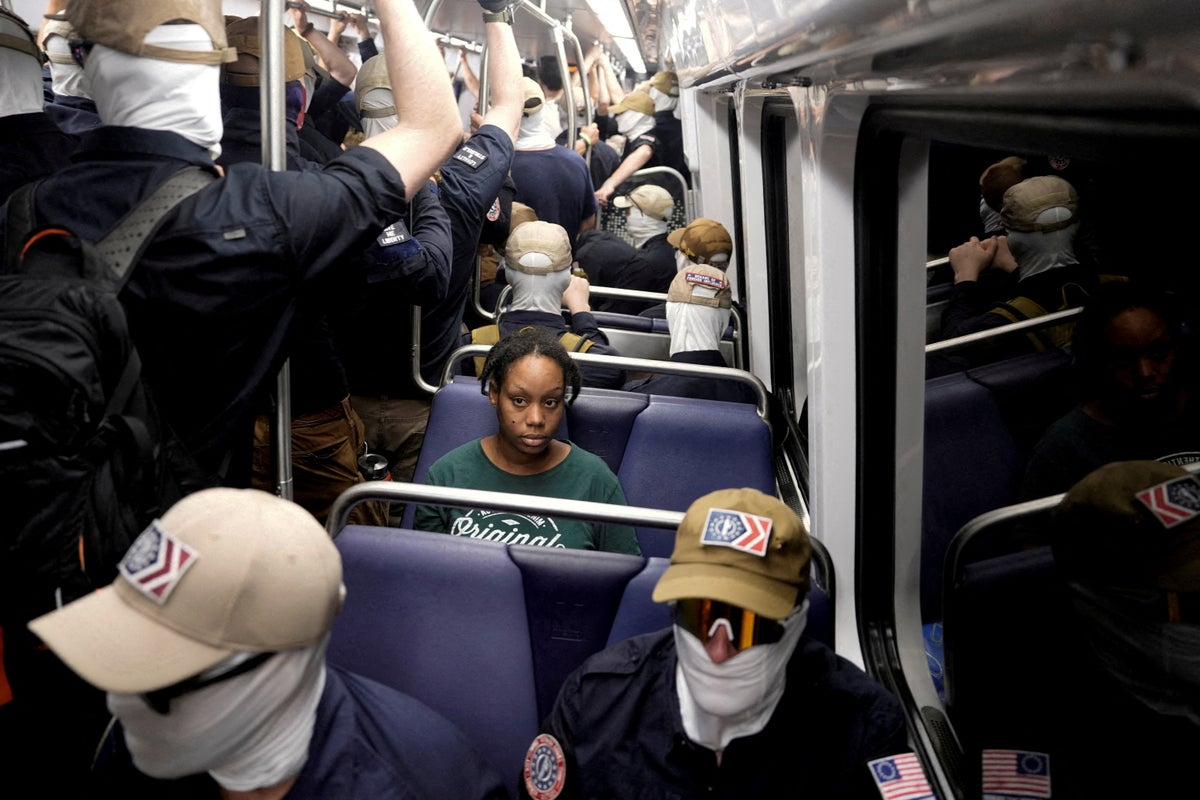
The defining image of America's 250th birthday didn't feature fireworks over the National Mall or a red, white, and blue parade. Instead, it took place inside a cramped Washington, D.C. Metro train.
A lone Black woman sits anchored to her seat. Surrounding her is a sea of masked white nationalists from the extremist group Patriot Front, their faces hidden behind sunglasses and white gaiters. Taken by Reuters photographer Cheney Orr, the photo quickly caught fire online, viewed by millions as a chilling, modern mirror of the nation's deepest contradictions.
But behind the viral sensation is a real person. After days of intense online speculation, the family of Bernita Bowlding has broken their silence, revealing the terrifying reality behind the lens and rejecting the notion that she should simply be used as a political symbol.
The Face of Dignified Terror
When Paul Bowlding scrolled through Instagram on the Fourth of July, he wasn't expecting to see his older sister. Zooming in on the only exposed, uncovered face in a crowded subway car, he recognized 33-year-old Bernita Bowlding, a mother of two. She had casually mentioned earlier that day that she was heading toward Silver Spring, Maryland. She didn't expect her routine commute to turn into a psychological battlefield.
The contrast in the image is what makes it sting. The men of Patriot Front hide like cowards behind uniform masks, intentionally unseen, wielding anonymity as a tool of collective intimidation. Bernita sits completely exposed. Her thousand-yard stare isn't a performance of bravery; it's a calculated survival tactic.
For Black women in America, this scene isn't just an isolated incident. It's a hyper-visible manifestation of the everyday reality of navigating spaces where your presence is treated as an inherently political statement or an invitation for hostility. You're just trying to get home from a shift, run an errand, or exist in a public space, and suddenly you're forced to confront a threatening crowd while maintaining absolute composure.
More Than a Historic Mirror
A lot of commentators immediately compared Bernita's photo to iconic civil rights imagery, specifically Elizabeth Eckford walking past a jeering mob outside Little Rock Central High School in 1957. While the historical parallels are obvious, Bernita’s family wants people to remember that she isn't a museum exhibit.
Her family endured an incredibly anxious Saturday night after the photo went viral. Bernita had lost her phone, making it impossible to reach her. It wasn't until Sunday morning that she safely walked into her mother's house.
Honestly, the most telling part of the family’s response is how normal they kept things. Her mother noted that the photo didn't even come up during their initial conversation when Bernita arrived. They were just glad she was safe. Her brother made it clear that while the world sees a symbolic portrait of American racism, he just sees his sister—a mother who shouldn't have to be "brave" just to ride the subway.
The Cruelty of Forced Resilience
The narrative surrounding the photo highlights a frustrating double standard. Society loves to praise Black women for their strength, resilience, and quiet dignity under pressure. But that praise is often a cop-out. It shifts the focus away from the toxic behavior of the aggressors and places the burden of maintaining peace squarely on the shoulders of the person being targeted.
Bernita wasn't physically harmed on that train, but the threat of violence was thick in the air. Patriot Front didn't fill that car by accident; they were in D.C. to march and assert dominance. Expecting a lone commuter to act as the moral compass of a democracy while surrounded by masked extremists is a lot to ask.
Your Next Steps
If you want to move past just staring at a viral photo and actually address the issues it highlights, here's what you can do next:
- Support Local Anti-Hate Initiatives: Organizations like the Southern Poverty Law Center and the Anti-Defamation League track the movements of groups like Patriot Front. Educate yourself on how these organizations operate in your community.
- Practice Active Bystander Intervention: If you see someone being targeted or intimidated in a public space, don't just pull out your phone to film it. If it's safe, sit next to the person, strike up a conversation, and help de-escalate the isolation they're experiencing.
- Challenge the "Strong Black Woman" Narrative: Check yourself when you're quick to call a marginalized person "brave" for enduring a hostile situation. Shift the accountability to the systems and individuals creating the danger in the first place.