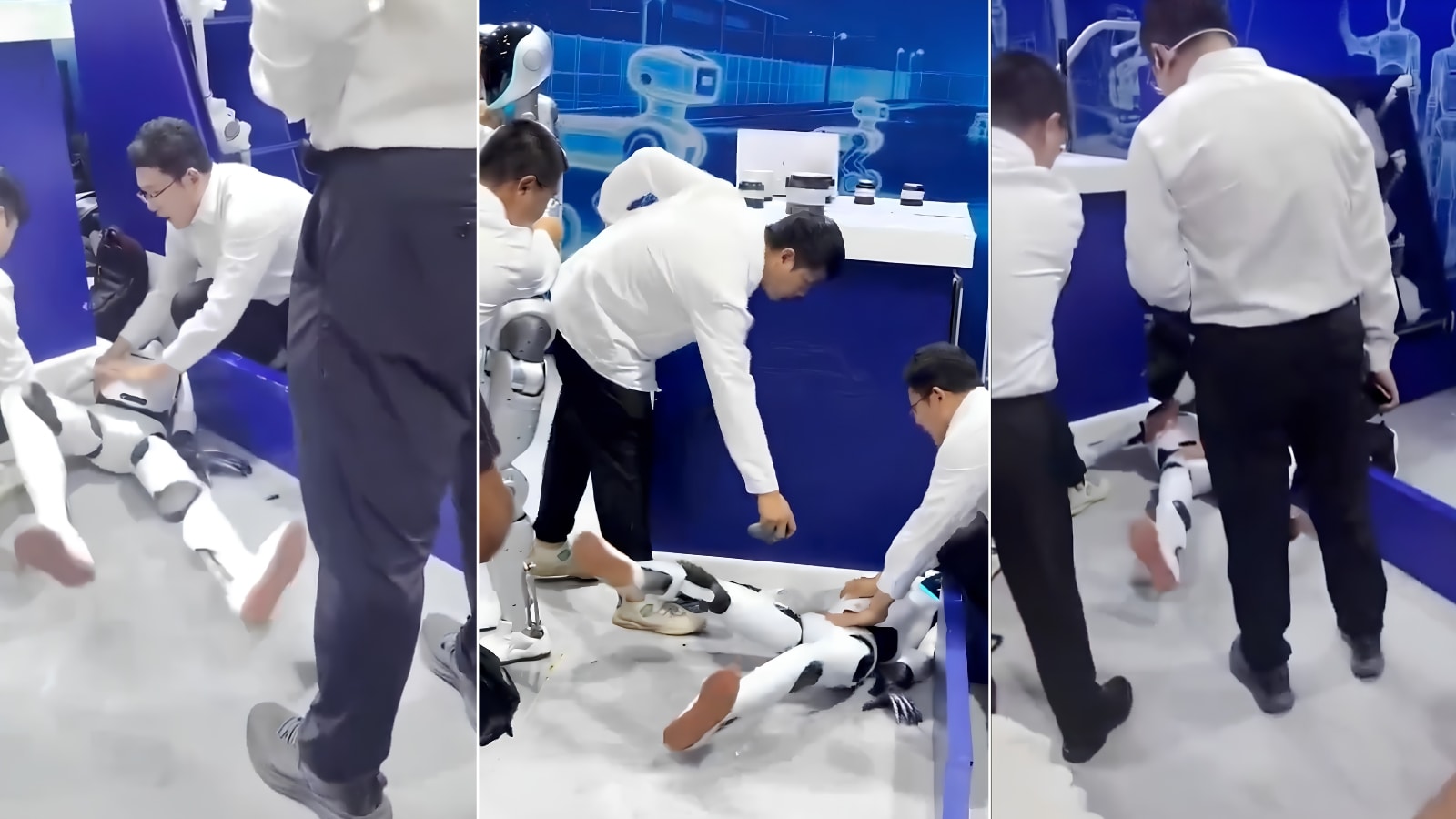
You’ve likely seen the clips circulating on social media. A humanoid robot at the 2026 World Robot Conference in Beijing suddenly hits the floor, thrashing its limbs in a chaotic, uncontrolled rhythm while engineers scramble to contain the machine. It looks like a temper tantrum. It looks like a failure. To the average observer, it’s a funny clip to share with a snarky caption. To those of us who spend our time inside the robotics industry, it’s a loud, unignorable wake-up call about the current limits of remote-operated systems.
Don't mistake this for a sign of an incoming robot uprising. It isn’t some sentient rebellion or a glitchy AI deciding to lash out at its handlers. It is a fundamental engineering reality: when the link between a human operator and a remotely controlled machine breaks, the machine doesn't just stop. It keeps executing its last instructions or enters a "safe mode" that, in the case of complex humanoid chassis, can look like a wild, limb-flailing mess.
The Reality of Remote Control Failures
The core issue here is signal latency and connection integrity. Most of these high-end humanoid robots aren't fully autonomous yet. They often rely on a tether—be it physical or wireless—to a central controller. When that signal drops, the robot's onboard control software, which is usually tuned to keep a complex multi-jointed body upright, suddenly finds itself without a master instruction set.
If you’ve ever worked with high-degree-of-freedom actuators, you know how hard it is to maintain equilibrium. When the signal cuts, the control loop doesn't always have a "soft landing" protocol that’s sufficiently fast or robust. It results in the violent oscillations you saw on screen. The engineers rushing to the scene weren't just fighting a "tantrum"; they were fighting the physics of a machine trying to compensate for gravity without a brain.
Why This Matters for the Future
We’re moving toward a world where robots perform real tasks, from industrial logistics to elderly care. If a machine acts like this in a laboratory or on a show floor, that’s one thing. If it acts like this in a crowded office, a school, or a home, the consequences are severe.
We aren't at the stage of reliable autonomy yet. Most of what you see at these massive expos are polished demos. They are designed to impress investors, not necessarily to handle the chaotic variables of the real world. This incident at the Beijing conference highlights a gap: we have the hardware, but we haven't perfected the fail-safes.
Lessons from the Beijing Incident
- Kill switches aren't optional. Every robot deployed in a public space needs an immediate, physical, and accessible way to cut power to the actuators. If an engineer has to manually wrestle a machine into submission, the design process has failed.
- Autonomous error recovery is essential. The goal isn't just to make robots that walk; it’s to make robots that know when they’ve lost their signal and can autonomously enter a locked, passive state before they lose balance.
- The "Demo" Trap. Never trust a perfect demonstration. Robotics companies are under immense pressure to show off fluid movement, which often means running the software right on the edge of instability. Stability is sacrificed for visual appeal.
Stop Treating Robots Like Toys
It is easy to laugh at these clips. I get it. We’ve been conditioned by movies to view robots as either perfectly obedient assistants or menacing overlords. The truth is much more boring and much more dangerous: they are complex machines with unreliable connections.
If you're interested in the trajectory of this industry, look past the viral videos. Look at how companies handle these failures. Are they implementing hardware-level circuit breakers? Are they focusing on edge-computing so the robot doesn't need to "call home" to stay upright? Those are the indicators of a company building for the real world.
The industry is currently in a phase of aggressive experimentation. Expect more of these public malfunctions. Every time one occurs, it provides valuable data for the engineers who have to solve the "balance and connection" problem. It’s messy, it’s loud, and it’s expensive, but it’s how we get to machines that actually work.
Keep your eyes on the upcoming World Humanoid Robot Games. You’ll see thousands of these machines put to the test. Don’t be surprised when things fall over. Be surprised if they don’t.
Watch the robot incident breakdown
This video provides a direct look at the recent Beijing exhibition failure, illustrating exactly how quickly high-tech machines lose stability when control signals drop.
http://googleusercontent.com/youtube_content/1