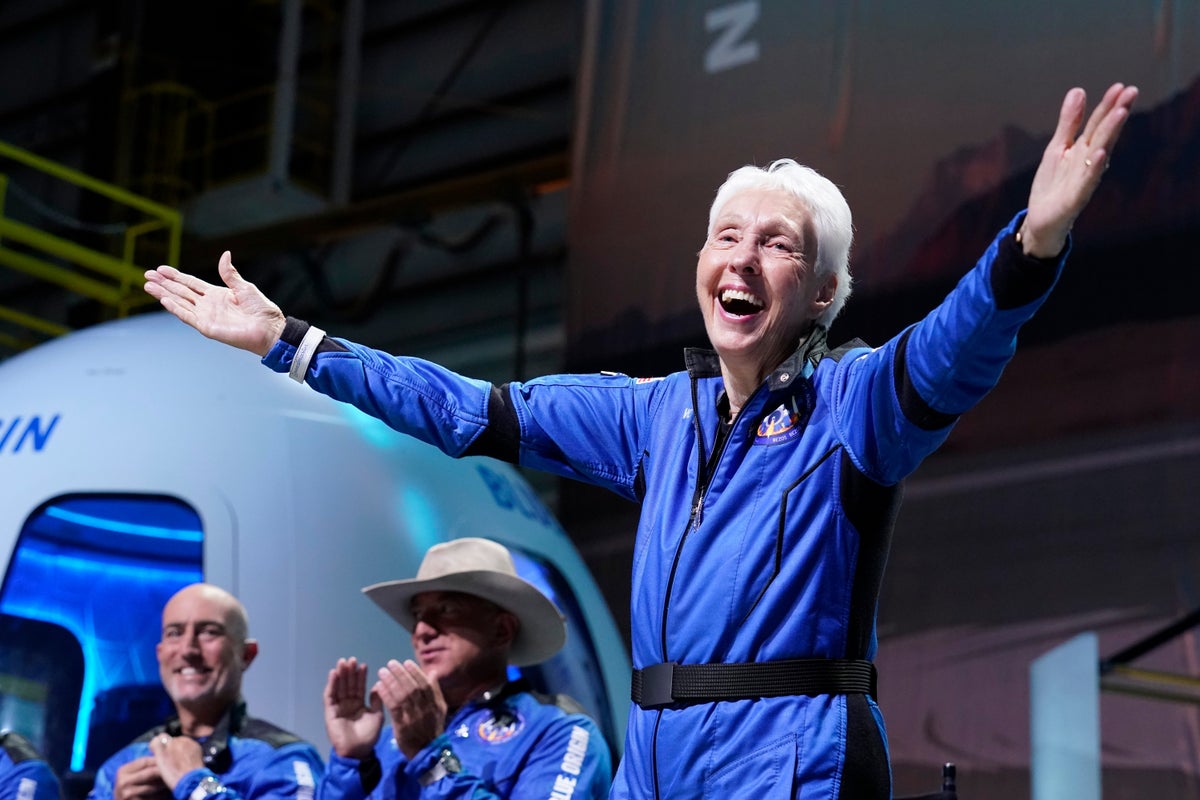
Wally Funk did not wait around for permission to make history. When NASA shut the door on her back in the 1960s simply because she was a woman, she didn't get bitter. She just flew higher.
The aviation icon and space pioneer passed away at 87 in her Grapevine, Texas home. Her caregiver and close friend, Duff O'Dell, confirmed she died peacefully after facing complications from recent falls and a leg infection. While her physical journey has ended, the trail she blazed across seven decades remains an absolute blueprint for anyone fighting against a system stacked against them. You might also find this connected article interesting: Why The Silence In Mashhad Matters More Than The Shouting.
You might know her as the energetic 82-year-old who buckled into Jeff Bezos's Blue Origin rocket in 2021, instantly becoming the oldest woman to ever travel into space. But reducing her life to a single ten-minute suborbital flight does a massive disservice to who she actually was. She was a powerhouse who spent her whole life eating and breathing aviation, racking up massive achievements while the establishment tried its best to ignore her.
The Brutal Truth About the Mercury 13
To understand the sheer grit of Wally Funk, you have to look back at 1961. She was the youngest woman selected for the privately funded Mercury 13 program, a grueling initiative designed to see if women could handle the physical and psychological toll of spaceflight. As reported in latest articles by The Guardian, the implications are significant.
She didn't just pass the tests. She completely destroyed them.
Funk spent over ten hours floating in a sensory deprivation tank without a single hallucination, outperforming nearly every male and female candidate in the running. Doctors and instructors told her she did better and completed the work faster than the guys in NASA's official astronaut corps.
Yet, the program was abruptly canceled. The official excuse? NASA required all astronaut candidates to have engineering degrees and military jet test-pilot experience. Because the US military banned women from those roles, it was a perfectly constructed bureaucratic trap. When Funk and her fellow pilots took their case to Congress, they were met with condescension. Even American hero John Glenn testified that the concept of women in space was simply against our social order.
Turning Rejection Into a Masterclass in Resilience
Most people would throw their hands up after being blocked by the highest powers in the country. Funk just went back to the tarmac.
She applied to NASA four more times once they finally started accepting women in the late 1970s. They kept turning her down, citing her lack of an engineering degree despite her staggering amount of actual cockpit experience. So, instead of waiting for a government agency to validate her skills, she went out and broke barriers in commercial aviation.
- She became the first female flight instructor at Fort Sill, a US military base.
- She was hired as the first female inspector for the Federal Aviation Administration (FAA).
- She broke through as the first female air safety investigator for the National Transportation Safety Board (NTSB).
Think about the mental toughness that requires. She spent her days investigating plane crashes and enforcing safety rules for the very industry that refused to let her fly to the stars. Over her career, she taught more than 3,000 people how to fly. Every single Saturday, well into her late 70s and 80s, you could find her at the airfield instructing students. She logged over 18,600 flying hours. She once yelled during an interview that she would be flying until the day she died. She pretty much did.
That Unforgettable July Morning in West Texas
When Jeff Bezos invited Funk to be his honored guest on the inaugural crewed flight of the New Shepard rocket on July 20, 2021, it wasn't just a PR stunt. It was a 60-year debt finally being paid.
Watching her board that capsule at 82 years old was electric. She didn't look nervous. She looked like she was finally going home. The rocket blasted her past the Kármán line, the internationally recognized boundary of space, hitting speeds over 2,500 miles per hour.
For three glorious minutes, she floated weightless. She did somersaults. She threw her hands up. When she landed back in the Texas desert, she stepped out of the capsule with a smile that could have lit up a city and said it was the greatest feeling in the world.
While her age record was later broken by William Shatner and Ed Dwight, Funk permanently holds the record as the oldest woman to ever cross into space. More importantly, she was the only member of the Mercury 13 who ever got to see the curve of the Earth.
What We Do Next to Honor Her
Wally Funk proved that dreams don't have an expiration date, but she also proved that waiting around for the world to change is a losing game. If you want to carry on her legacy, stop waiting for institutional permission to chase what you want.
If you are a young woman looking at a career in aerospace, aviation, or tech, remember that Funk did the heavy lifting so you wouldn't have to face the same closed doors. Go sign up for a discovery flight at your local airport. Apply for that engineering scholarship. Support organizations like Women in Aviation International, which Funk championed for decades.
The next time someone tells you "no," don't get mad. Channel your inner Wally Funk, get stubborn, and find a way to fly right past them.