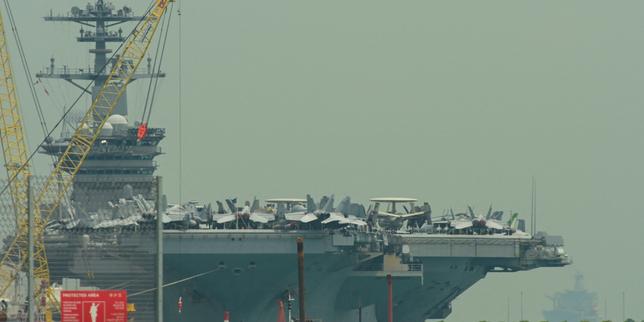
Warships don't park in volatile regions just to stretch their legs. When the Pentagon positions three massive floating airbases in a single hotspot, heads turn.
The arrival of the USS Theodore Roosevelt marks a sharp escalation in U.S. military posture across the Middle East. We are looking at a rare concentration of naval strike power. This isn't routine posture maintenance. It's a loud, unblinking signal to regional adversaries that Washington wants an immediate cooling of hostilities, backed by hundreds of combat aircraft and thousands of sailors.
You need to understand what this buildup actually means on the ground. Let's break down the strategy, the hardware, and why this specific deployment changes the calculus for every actor involved.
The Real Muscle Behind the Movement
Let's look at the numbers. A Nimitz-class or Ford-class carrier isn't just a ship. It's a floating city housing over five thousand personnel, packing an air wing of roughly seventy aircraft.
When you cluster three of these behemoths in proximity, you project absolute air and missile dominance. The Theodore Roosevelt joins other strike groups already operating on station or in adjacent waters. That means hundreds of tactical fighter jets, early warning aircraft, and electronic warfare platforms ready to act within minutes.
People often ask why the U.S. relies so heavily on carriers instead of land bases. Simple logistics and sovereignty. Land bases require host-nation approval, diplomatic clearance, and face constant rocket or drone threats from local militias. Carriers move where Washington wants them, when Washington wants them. They bring their own floating airfields, impervious to local political shifting.
Strategic Pressure Cooker
Regional dynamics are brittle right now. Deterrence is a fragile game of perception. If adversaries think you're bluffing, they test your boundaries. By bringing in a third carrier, the Pentagon removes any doubt about its regional commitment.
Think about the operational tempo. Maintaining continuous carrier presence requires rotating groups constantly. Having three groups overlapping in the theater gives commanders staggering flexibility. They can conduct strike operations, provide missile defense coverage, and maintain constant airborne surveillance without burning out their crews.
Yet, heavy steel brings heavy risks. Concentrating high-value assets in a constrained maritime corridor creates target rich environments for sophisticated missile and drone arsenals. Adversaries have spent years studying how to counter U.S. carrier strike groups. They've built anti-ship ballistic missiles and swarm drone tactics designed to make life difficult for blue-water navies.
What Washington Hopes to Accomplish
The ultimate goal of this naval surge is simple: containment through overwhelming force. Washington wants to deter a wider regional conflagration by making the cost of escalation entirely prohibitive.
When
Why the USS Theodore Roosevelt Arrival in the Middle East Changes Everything
news
Three carrier strike groups in a single operational zone isn't a routine deployment. It's a heavy-handed message. The arrival of the USS Theodore Roosevelt in the Middle East marks a massive escalation in regional force posture, bringing an undeniable wave of naval air power right to America's most volatile theater.
Let's look at the reality on the ground. When Washington triples its primary floating airbases in a hot zone, defense analysts don't just shrug. They take notice. You're looking at floating cities housing thousands of sailors, packed with F/A-18 Super Hornets, electronic warfare jets, and guided-missile destroyers. This isn't just about showing the flag. It's about maintaining absolute dominance in contested airspace and securing strategic choke points where a single miscalculation could ignite a broader conflict.
Understanding the Strike Group Dynamic
The USS Theodore Roosevelt doesn't operate in a vacuum. It rolls with a lethal escort package that includes Aegis-equipped cruisers and destroyers. These ships carry a staggering number of Tomahawk land-attack missiles and advanced air-defense systems.
Why push a third carrier into this specific region right now? Deterrence. Traditional diplomacy has stalled out. Regional proxies keep testing red lines. By positioning the Roosevelt alongside other naval assets already on station, the Pentagon ensures it has continuous strike capability 24 hours a day, without gaps for maintenance cycles or transit times.
You hear politicians talk about peace through strength all the time. This deployment is the literal embodiment of that phrase. It shortens response times. It complicates enemy target planning. If a coordinated drone swarm or ballistic missile salvo gets launched, a triple-carrier posture provides overlapping intercept rings that single patrols simply cannot match.
The Logistics Behind the Power Projection
Moving a nuclear-powered aircraft carrier across oceans requires an invisible army of supply ships, tankers, and planning cells. People forget the sheer mechanical grind of running these operations. You cannot just park a floating airfield anywhere you want. It needs deep-water ports, constant refueling, and secure lines of communication.
The maintenance strain on the U.S. Navy right now is historic. Sailors are working grueling shifts. Rotations are compressed. When the Theodore Roosevelt steams into theater, it's operating at the absolute limit of fleet readiness. Pushing ships this hard creates long-term maintenance backlogs back at naval yards in San Diego or Norfolk. But Washington has decided the short-term risk of a regional vacuum outweighs the long-term cost to fleet wear and tear.
What This Means for Regional Stability
Every action triggers a reaction. Regional actors view this deployment through a lens of extreme suspicion. Rivals see an imminent threat. Allies see a reassuring shield.
The calculus for local militias and state sponsors shifts overnight. Operating under the flight path of hundreds of carrier-based combat aircraft forces a change in tactics. Hit-and-run strikes become much riskier when surveillance aircraft are blanketing the horizon.
Yet, massive firepower also raises the stakes for accidental escalation. With so many military assets crammed into narrow seas like the Red Sea or the Arabian Gulf, radar screens are crowded. Communications get jammed. A stray navigation signal or a misidentified commercial vessel can turn into a crisis in seconds.
Looking Ahead at the Maritime Strategy
Naval warfare has fundamentally changed over the last few years. Traditional carrier groups face new threats from low-cost anti-ship missiles and asymmetric drone attacks. Deploying the USS Theodore Roosevelt into this environment is a stress test for modern naval defense systems.
Watch the supply lines. Watch the diplomatic backchannels. When naval power moves this aggressively, political maneuvers usually follow right behind it. Keep your eyes on how regional actors respond to the shifting balance of air and sea dominance over the coming weeks.