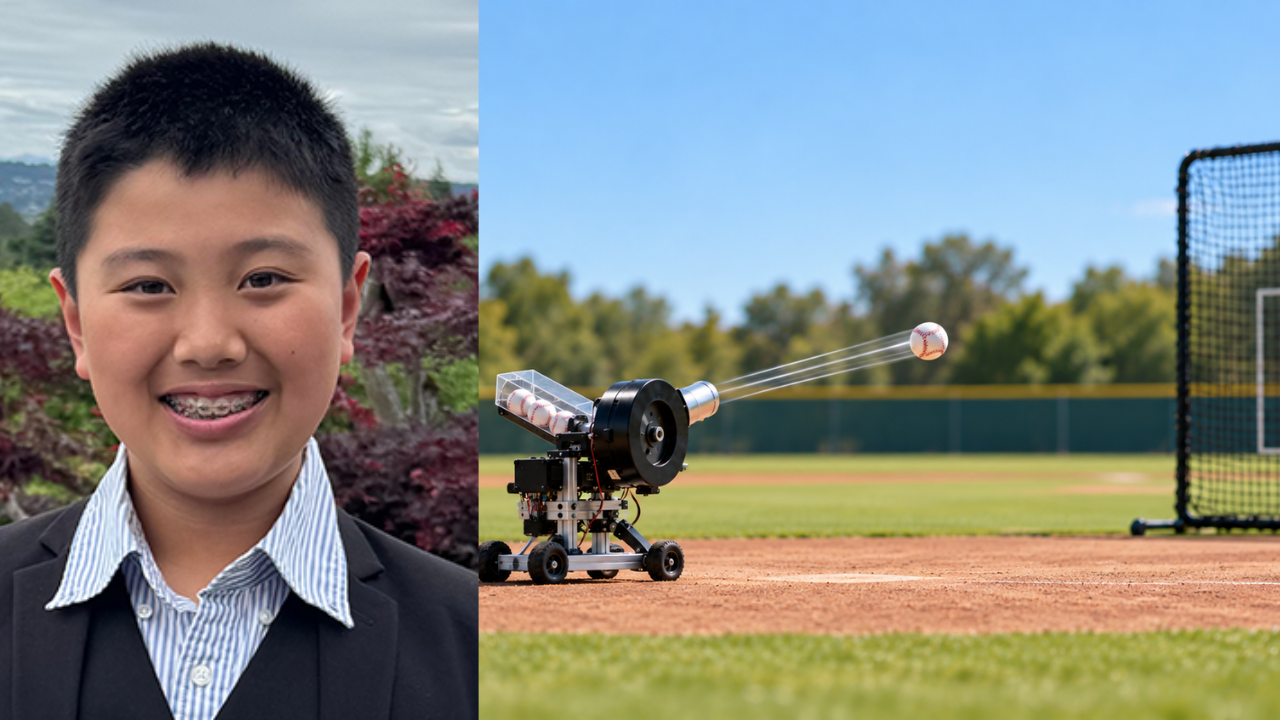
Commercial baseball training gear costs thousands of dollars, yet many youth players still struggle to translate practice success into real-game hits. Andrew Sun-Zhuang, a middle school student in Shoreline, Washington, noticed a frustrating gap in his own athletic development. While his batting average against standard training machines sat comfortably high, his real-game performance lagged behind. Instead of accepting the high cost of elite athletic gear, he built his own machine using affordable hobbyist hardware and computer vision.
The resulting prototype, named VisionStrike, cost just two hundred sixty dollars to assemble. More importantly, it achieved impressive precision on the mound. During testing, the device delivered a strike accuracy rate of ninety-four percent for fastballs and eighty-six percent for front-toss pitching. That kind of reliability usually requires industrial-grade engineering backed by massive corporate budgets.
Building a smart athletic trainer from scratch requires clear design choices. Andrew started by combining a Raspberry Pi microcontroller with a standard camera, servo motors, and basic actuators. The core intelligence relies on a custom computer vision model trained on two hundred distinct photographs of the young athlete himself.
This model tracks six critical anatomical landmarks on the batter: the end of the bat, wrist, elbow, shoulder, hip, and knee. By mapping these spatial coordinates, the system calculates the ideal strike zone dimensions tailored precisely to the individual standing in the batter's box. Once the batter stands still for two seconds to let the camera capture their stance, the system computes the launch angle and fires the ball. Traditional pitching machines lack this personalized spatial awareness, often serving up uniform pitches that fail to simulate live pitching variety.
Standard commercial pitching machines range from one thousand to over five thousand dollars, putting them out of reach for most backyard athletes and local youth leagues. By relying on open-source microcontrollers and widely available electronic components, Andrew proved that modern athletic technology does not require an enterprise budget.
The financial breakdown of the project relies on off-the-shelf components. The Raspberry Pi forms the computational core, while standard servos handle the mechanical adjustments. Sourcing these parts through hobbyist electronics suppliers kept the bill of materials remarkably low. This approach opens up DIY hardware development for student athletes who want customized training tools without breaking the bank.
Behind the technical build is a routine rooted in youth sports. Andrew has played baseball since age five, progressing from early Little League seasons to competitive All-Star play. Balancing athletics and competitive robotics programs requires discipline and time management.
Robotics offers an immediate outlet for turning theoretical physics and software design into functional hardware. When a machine fails to throw a strike or miscalculates an angle, the programmer must debug the code and adjust the hardware setup. That iterative loop mirrors sports training, where every missed swing prompts an adjustment in stance or timing.
Reaching a national STEM final with a budget-friendly athletic project highlights a shift in how young creators approach engineering. You do not need a university lab to build useful hardware. Accessible microcontrollers, affordable cameras, and pre-trained machine learning libraries lower the barrier to entry for garage inventors everywhere.
For aspiring student innovators, the path forward starts with identifying a frustrating everyday problem and breaking it down into smaller technical components. Measure your baseline metrics, design a low-cost prototype, test it relentlessly, and refine the code until the results speak for themselves.