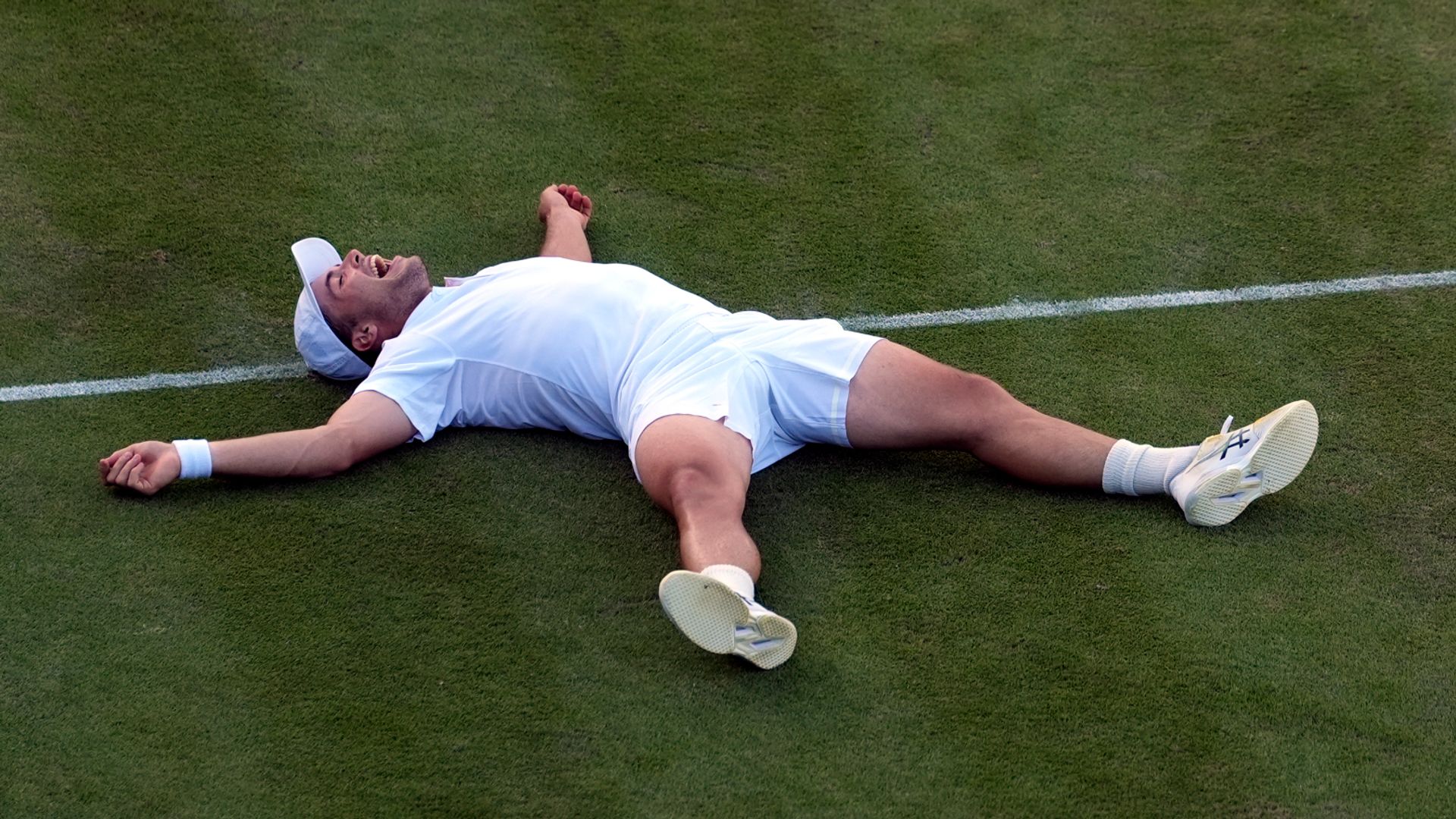
The hospital room in Asunción did not smell like a football stadium. It smelled of antiseptic and cold fear. In December 2022, a towering twenty-two-year-old goalkeeper stood beside an incubator where his newborn son, Lautaro, was fighting to breathe. The medical bills were mounting with a terrifying velocity that a reserve player earning a meager salary in the lower tiers of professional football could not hope to match. Desperation strips a man of his history until only the barest essentials remain. The young giant went home and systematically emptied his life, selling his training gear, his football boots, and his clothes. Finally, his hands lingered on a specific piece of fabric: the red-and-white striped jersey he had worn for the Paraguay Under-20 national team. It was the physical manifestation of a boy's dream, a keepsake he had intended to guard forever. He sold it to a friend for 200,000 guaraní, roughly thirty-three dollars, because a piece of cloth cannot bargain for a child's life. Four years later, under the relentless lights of the 2026 FIFA World Cup, Orlando Gill stood beneath the crossbar in Foxborough, Massachusetts, his hands wrapped in latex, guarding something much larger than a net.
The trajectory of a professional athlete is often curated to look like a geometric progression, an unbroken line from talent to triumph. The reality is far messier, dictated by the sudden fractures of human vulnerability. For the six-foot-six shot-stopper, the path to the grandest stage in North America was not paved with lucrative corporate sponsorships or early adulation. It was forged in the quiet anxiety of the Argentine Primera División reserve league with San Lorenzo de Almagro, where he waited for an opportunity that felt perpetually out of reach. When national team manager Gustavo Alfaro finally called him up for his senior international debut in September 2025, a 1–0 qualifying victory against Peru, the world saw only a massive figure commanding his penalty box. They did not see the man who had slept in his car to save money, nor did they know that the jersey of his youth belonged to someone else.
The Ghost on the Line and the Modern Giant
To understand the immense pressure bearing down on a Paraguayan goalkeeper, one must reckon with the shadow of José Luis Chilavert. The legendary captain was a volcano in neon foam padding, a mercurial figure who defined the nation's footballing identity during the 1990s with his ferocious leadership and uncanny ability to score free-kicks. Chilavert did not merely protect the goal; he governed it. When this new, quiet colossus took the field for the tournament opener against the United States, the result was a catastrophic 4–1 thrashing. From the commentary booths, Chilavert publicly questioned the young player's temperament, labeling him as too quiet, a mute presence lacking the necessary arrogance to wear the number twelve shirt.
The criticism stung because it targeted the precise trait that makes the current custodian different. Where his predecessor used fury as fuel, the young man from San Lorenzo relies on a stillness cultivated during the darkest nights of his personal life. If you have watched your infant son fight for oxygen in an intensive care unit, the theatrical anger of a footballing legend loses its power to terrify. The true test of this resilience arrived in the knockout stage against Germany, a team constructed with the clinical precision of a luxury machine.
For 120 grueling minutes, the German attack unleashed twenty-one shots, dominating possession and threatening to tear the South American defense apart. The goalkeeper transformed his penalty box into an impenetrable fortress. He recorded five world-class saves during regular time, including an extraordinary reflex stop to deny Kai Havertz. When the final whistle blew at a 1–1 stalemate, the match moved into the cruel theater of a penalty shootout, a space where statistics dissolve and the psychological weight of a man's entire life is concentrated into a twelve-yard sprint.
Standing on the goal line, Orlando Gill looked less like an athlete and more like a monument of pure instinct. He guessed perfectly against the elite penalty takers of European football. He threw his massive frame low to smother Havertz’s clinical strike, then rose to deny Nick Woltemade, orchestrating Germany’s first-ever penalty shootout defeat in World Cup history. When he was named the player of the match, the giant did not celebrate with theatrical chest-thumping. He wept. His voice trembled into the microphone as he dedicated the historic triumph to a hospitalized nephew, proving that the human spirit cannot be neatly quantified by a post-match data sheet.
The Price of the Return
The news of the historic upset reverberated from Boston to Asunción, but it was a social media post by his wife, Melissa Ávalos, that captured the true magnitude of the narrative. She reminded the world of the sacrifices that had occurred long before the stadium lights were turned on, detailing the systemic liquidation of their belongings to pay for Lautaro’s medical care. The story caught the attention of Pedro Suarez, the friend who had purchased that cherished Under-20 jersey years prior during the family's financial ruin. Suarez had never viewed the shirt as a collectible or a piece of sports memorabilia; he had treated it as a sacred trust.
As the national team prepared to travel to Philadelphia for a monumental Round of 16 clash against France, Suarez delivered a message to the goalkeeper that elevated the upcoming match into something mythic. He promised to return the jersey free of charge, refusing to take a single coin for its repatriation. The transaction, however, carried a solitary, heavy condition. Suarez told him that the shirt was waiting, but he had to beat France to claim it.
The challenge carried a profound historical resonance. Twenty-eight years earlier, during the 1998 World Cup in France, a legendary Paraguayan squad had pushed the host nation to the absolute brink in the Round of 16, falling only to a Laurent Blanc golden goal six minutes before a penalty shootout. The current squad is not just playing for a spot in the quarterfinals; they are chasing the ghosts of a generation that almost achieved immortality.
In the hours leading up to the kickoff in Philadelphia, the rumors of European transfer interest from clubs like Torino began to circulate, a sign that the global football market was finally waking up to his talent. Yet, the commercial valuation of a six-million-euro transfer fee feels trivial compared to the currency of the heart. The boy who gave up his past to save his family's future has become a man capable of carrying the hopes of an entire nation on his shoulders.
As he walked onto the pitch to face the formidable attack of Les Bleus, his gloved hands adjusted the straps on his wrists, ready to defend the net for another ninety minutes. He knew that across the ocean, a small room held a faded red-and-white striped shirt, waiting to be brought home by the father who had valued a life far more than the sacred cloth.