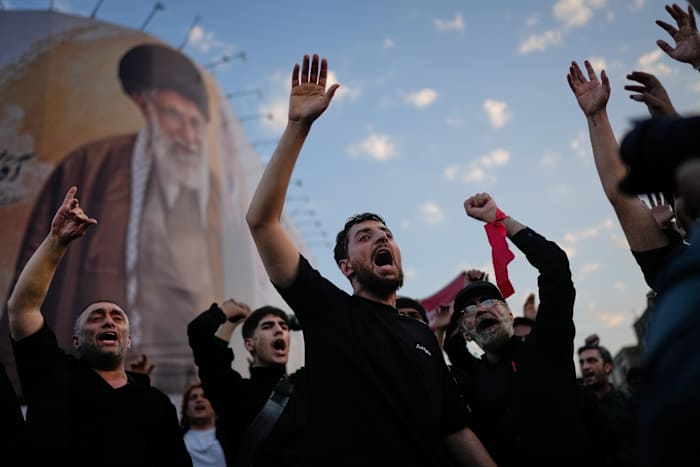
Tehran is completely gridlocked, shut down, and pulsing with a strange mix of grief and calculated political theater. If you’re tracking the news out of Iran right now, you’ve likely seen the headlines about the funeral procession for late Supreme Leader Ayatollah Ali Khamenei. The 86-year-old leader is dead, killed months ago alongside his family members during a devastating February airstrike. Now, the government is staging a massive 12-hour procession through the heart of the capital to project strength.
Most international coverage focuses entirely on the sea of mourners or the fiery anti-Western rhetoric. But that misses the actual point. This massive event isn't just about saying goodbye to a man who ruled for more than 35 years. It’s a high-stakes endurance test for a bruised theocracy trying to show the world it hasn't collapsed after weeks of direct military conflict with Israel and the United States.
You need to understand the deeper reality behind the heavy security, the festival-style food stalls, and the paused diplomatic talks that make this specific moment so incredibly fragile.
The Reality on Tehran Streets Today
The logistics of today’s procession are staggering. Organizers mapped out a grueling 10 to 12-hour route designed to maximize public exposure, moving the flag-draped coffins of Khamenei and his family members on the back of a heavily decorated truck. Revolutionary Guard Gen. Hasan Hasanzadeh is running the show, directing a path that snakes through central Tehran toward Mehrabad International Airport. From there, the bodies go to Mashhad for a Thursday burial at the Imam Reza shrine.
For regular citizens, daily life has simply ceased. Airspace is locked down, schools and government offices are dark, and major thoroughfares are completely barricaded.
What makes this procession different from a typical state funeral is the sheer proximity to recent violence. Khamenei didn't die of old age. He was wiped out on February 28 in a targeted strike that instantly plunged the region into open war. Carrying his coffin through the streets today is a deliberate attempt by the remaining leadership to signal that the state is still fully operational. They want to show that the administrative machinery can still command the loyalty of millions, even when the literal head of the state was removed by foreign intelligence.
The Ghost of 1989 and the Mania of Crowd Control
If Iranian authorities seem incredibly anxious about the crowd size today, it's because they're haunted by history. Back in 1989, the funeral of Iran’s first Supreme Leader, Ayatollah Ruhollah Khomeini, devolved into utter madness. An estimated 10 million people choked the streets. The crowd grew so frantic and uncontrolled that mourners mobbed the vehicle carrying Khomeini's body, tearing his burial shroud to pieces and tumbling his corpse onto the dirt. Officials eventually had to deploy a military helicopter to rescue the body and finish the burial. Over a dozen people died in the stampedes that day, and thousands more ended up in hospitals.
The current regime cannot afford that kind of chaotic imagery right now. They want to project total order, not desperate fanaticism.
To prevent a repeat of the 1989 disaster, security teams built massive concrete walls around the Grand Mosalla religious complex where the bodies lay in state. The truck carrying the coffins today is fortified, elevated, and designed to look like a rolling religious shrine, keeping the frantic crowds at a safe distance. The state needs the optics of a massive turnout, but they need that turnout perfectly contained. Any sign of a stampede or a breakdown in security would immediately be interpreted by foreign adversaries as a sign of structural weakness inside the regime.
Behind the Festival Atmosphere of a War-Torn Nation
Walk a few blocks away from the central mourning plazas, and the tone shifts in a way that feels deeply bizarre to outside observers. Alongside the black flags and weeping crowds, hundreds of state-sponsored stalls have popped up across Tehran. They are blasting electronic music and handing out free food, juices, and cold drinks to anyone walking by.
It feels less like a somber wake and more like a summer street festival.
This isn't an accident. The regime is using every tool available to bribe and entice people into the streets. After months of grueling economic sanctions, military tension, and the constant fear of airstrikes, public morale is scraping the bottom of the barrel. Offering a carnival-like environment disguised as religious piety helps ensure that working-class citizens show up, line the routes, and stay there for the full 12 hours. It’s an aggressive propaganda push disguised as hospitality.
At the same time, the anger on display is very real. Mourners are carrying freshly printed signs calling for the deaths of U.S. President Donald Trump and Israeli Prime Minister Benjamin Netanyahu. The U.S. government has been tracking these assassination threats for years, especially since the 2020 killing of Gen. Qassem Soleimani. Now that Khamenei himself has been killed, the rhetoric has reached a boiling point. The regime is actively channeling the public’s fear and grief into a weaponized focus on revenge, ensuring that the next generation of leaders can maintain an anti-Western mandate.
The Geopolitical Stakes While the World Watches
While the streets of Tehran are filled with smoke and chanting, a much quieter game is happening behind closed doors. The United States and Iranian negotiators have been working on a massive diplomatic package behind the scenes. The goals are straightforward: fully reopen the blockaded Strait of Hormuz, scale back Iran's advanced nuclear program, and find a permanent off-ramp to the current war.
Right now, those critical talks are completely frozen.
Diplomats have quietly acknowledged that nothing will move until Khamenei is safely in the ground in Mashhad later this week. The Iranian negotiating team, led by prominent figures like parliament speaker Mohammad Bagher Ghalibaf, cannot afford to look weak or compromised while the country is actively mourning its symbolic father. Ghalibaf has been incredibly visible during these ceremonies, using the spotlight to burnish his own credentials for the post-Khamenei era.
This creates a highly volatile window of time. For the next few days, Iran is effectively a ship without an official captain, relying on an interim council and the Revolutionary Guards to keep things steady. If an accidental clash occurs in the Persian Gulf or if a hardline faction decides to launch a rogue strike to avenge Khamenei during the funeral, the entire diplomatic framework could shatter before the burial even finishes.
What Happens After the Mourning Ends
When the flags are packed away and the streets are swept on Friday, Iran faces a brutal reckoning. The country is trying to navigate a massive transition of power while actively fighting a hot war.
If you want to understand where this crisis goes next, you need to look past the funeral footage and watch three specific areas.
First, keep a close eye on Mojtaba Khamenei, the late leader's son. Portrals of him are already being carried by select groups in the crowd, signaling a potential dynastic push for the supreme leadership. His rise is heavily contested by reformists and some traditional clerics, and how the internal clerical establishment handles his potential ascension will dictate the country's domestic stability for the next decade.
Second, watch the immediate resumption of the Strait of Hormuz negotiations next week. If the Iranian regime returns to the table with an aggressive, uncompromising stance, it means the hardline factions won the internal power struggle during the funeral week. If they push for a quick deal to stabilize the economy, it means pragmatists like Ghalibaf have successfully seized the wheel.
Finally, monitor the internal security apparatus. A massive public gathering like this allows the intelligence services to gauge public compliance. Once the state-mandated mourning period ends, any sudden outbreak of domestic protests or labor strikes will show whether the public's apparent solidarity this week was genuine or merely enforced by the barrel of a gun.