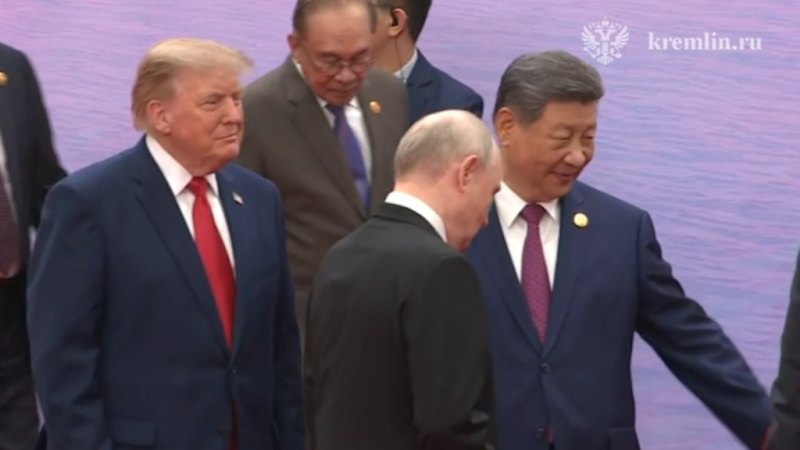
When Donald Trump, Vladimir Putin, and Xi Jinping walked into Kylin Villa in Shenzhen, the body language told the real story before anyone said a word. Trump called it "making history". Putin grinned alongside his first major Western stage appearance in years. But make no mistake: Xi Jinping set the seating chart, set the agenda, and positioned China squarely as the manager of global strategic balance.
Hosting the first-ever trilateral summit between the leaders of the three major nuclear powers was a masterclass in diplomatic staging. With the New START treaty expiring in February 2027 and regional conflicts grinding on from Eastern Europe to the Middle East, Xi used the APEC sidelines to project Beijing as the sole steady hand in an increasingly volatile world.
Here is what actually happened in Shenzhen, what the four-point declaration really signifies, and why this meeting was less about immediate peace deals and more about who commands the room.
The Optics of Kylin Villa
For months, Washington and Moscow have traded threats over nuclear posture and economic sanctions. Yet in Shenzhen, Xi effectively placed himself between two unpredictable leaders, turning a potentially chaotic standoff into a controlled photo-op.
China’s state media wasted no time framing the summit as a triumph of Chinese diplomacy. By bringing Trump and Putin to a table on Chinese soil, Beijing signaled to the Global South that it no longer just reacts to Western policy—it shapes the venue where global decisions are negotiated.
Trump arrived needing a dramatic headline after weeks of domestic political pressure and foreign policy friction over Iran. Putin arrived looking for legitimacy, eager to show that Western isolation campaigns haven't stripped Russia of its superpower seat. Xi gave both men what they wanted visually, while taking the geopolitical credit for orchestrating the spectacle.
What the Four-Point Declaration Actually Means
Critics were quick to point out that the signed "Heads of State Declaration toward Peace" lacks concrete enforcement mechanisms. It didn't settle the frontline realities in Ukraine, nor did it unlock a sudden cease-fire in the Middle East. But dismissing it as empty paper misses how Beijing uses process to build leverage.
The declaration focused on four main pillars:
- Strategic Stability: A vague commitment to keep channels open on nuclear risk reduction as New START faces expiration.
- United Nations Reform: A long-held Chinese priority aimed at reshaping global governance structures away from pure Western dominance.
- Energy Supply Chains: Agreement on stabilizing global refined petroleum flows, aligning Chinese consumption needs with Russian production.
- Diplomatic Immunity and State Consent: A subtle nod that shields sovereign leaders from international judicial overreach.
Notice what was missing? No mention of Taiwan, no specific concessions on AI chip export controls, and no direct text on Kyiv. Beijing deliberately kept the focus high-level so it could claim the role of global peacemaker without tying its hands on regional security disputes.
Nuclear Pragmatism Meets Political Theater
The elephant in the room was the impending collapse of formal nuclear arms limits. Washington has pushed for months to drag Beijing into a three-way arms control treaty, arguing China’s expanding arsenal makes bilateral U.S.-Russia caps obsolete. China has historically resisted, claiming its warhead counts are nowhere near the U.S. or Russian stockpiles.
During the open session, Xi made headlines by calling for nuclear weapons to be "completely prohibited and thoroughly destroyed". It sounds lofty, but it’s classic Chinese strategic phrasing. It allows Xi to claim the moral high ground while avoiding hard commitments to caps that could restrict China's military modernization.
Meanwhile, Trump leaned into his transactional style, pitching three-way dialog as a victory in itself. By sitting down together, all three leaders avoided an immediate breakdown in communication, even if no actual warheads were trimmed from any country's inventory.
Why Europe and Asia Are Watching Warily
While the headlines highlighted the smiles in Shenzhen, officials in European capitals were scrambling to decipher what this means for Ukraine and NATO. Following the summit, U.S. envoys quickly dialed into a Berlin meeting with Ukrainian President Volodymyr Zelenskyy and European leaders to assure them that American security commitments remain intact.
In Asia, neighbors like Japan, South Korea, and the Philippines viewed the trilateral through a different lens. A China that can successfully mediate between Washington and Moscow is a China with increased leverage across the Indo-Pacific.
If Beijing can position itself as indispensable to global stability, it makes it far harder for Western coalitions to enforce trade sanctions or challenge Chinese maritime moves without risking wider diplomatic fallout.
How to Track What Happens Next
Don't judge the Shenzhen summit by the initial press statements. Track these three practical indicators over the coming months to see if the meeting actually reshaped global power dynamics:
- Watch the G20 Summit in Florida: Look at whether Xi and Trump build on this framework during their next scheduled bilateral meeting, particularly around the expiring trade truce and technology export limits.
- Monitor Bilateral Arms Talks: Keep an eye on whether working-level nuclear safety teams are established between the U.S., Russia, and China before the New START expiration date.
- Follow Energy Trade Routes: Track whether Russia and China finalize long-term, non-dollar energy settlement mechanisms following their joint statements on petroleum protection.
The Shenzhen summit wasn't about solving every global crisis in an afternoon. It was about setting the stage for who dictates the rules of engagement in a multi-polar world—and Xi Jinping just made sure China sits right in the center of that stage.