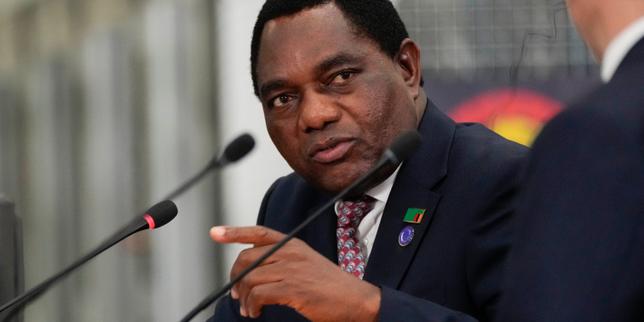
Zambian President Hakainde Hichilema has officially secured a second five-year term, but the celebratory atmosphere you might expect in a stable democracy is nowhere to be found. Instead, the country is caught in a tense stand-off. With the Electoral Commission of Zambia declaring a victory of 61.4 percent of the vote, Hichilema has effectively avoided a run-off. Yet, the aftermath of this election looks more like a volatile security crisis than a standard democratic transition.
If you’re wondering why a victory of this magnitude feels so unstable, you have to look at what happened behind the scenes. This wasn’t just a battle of policy papers and campaign promises. It was an election marred by the suspension of vote counting, the deployment of the military, and a midnight police raid that saw 11 opposition figures arrested.
The arithmetic of a contested win
The official numbers are clear enough on paper. Hichilema secured approximately 2.96 million votes, while his primary challenger, Brian Mundubile, pulled in roughly 1.86 million, or about 38 percent of the total. On its face, this looks like a decisive mandate. However, numbers only tell half the story.
The election process was anything but smooth. Last Friday, the Electoral Commission of Zambia took the extraordinary step of halting the vote count for several hours. Their reasoning? Attacks on polling station officials and the alleged theft of ballot papers. In a country that has prided itself on being a relatively stable democracy since 1991, the subsequent deployment of the army in Lusaka was a move that caught everyone off guard.
Why this election mattered
This vote was supposed to be a referendum on Hichilema’s economic track record. Since taking office in 2021, the 64-year-old president has been the face of Zambia’s debt restructuring efforts. He inherited a nation in the grip of a major default, and his supporters argue that he has successfully reined in inflation and stabilized the local currency.
For the average Zambian, though, the "macroeconomic stabilization" touted by the government is often hard to reconcile with the daily reality of electricity shortages and the high cost of living. Mundubile’s surprisingly strong performance—capturing nearly 40 percent of the vote on his first attempt at the presidency—suggests that a massive segment of the population isn't feeling the benefits of the recovery plan yet.
The security crackdown
The most jarring aspect of this election was the night of August 13. While votes were still being tallied, a police raid at a property where Mundubile was present ended in gunfire and the detention of several opposition officials. The government was quick to issue a statement, claiming those arrested were in possession of military-grade weapons and posed a threat to national security.
Mundubile hasn't just disputed these claims; he’s called the raid an attempt on his life. When you have the leading opposition leader claiming he’s being targeted for assassination, the gap between the government and the electorate widens into a chasm. It’s a dangerous dynamic. Even as international observers like the European Union pointed out that the election was largely peaceful, they were careful to note that the broader electoral environment limited fundamental freedoms.
Looking ahead
Hichilema’s second term comes with a very specific, ambitious goal: to triple Zambia’s copper production to 3 million tons annually by 2031. He has positioned himself as the leader who can turn the country into a global powerhouse for critical minerals, something the United States and China are watching very closely.
But can he deliver this while the country remains politically fractured? His rhetoric after the announcement was conciliatory. He reached out to those who voted against him, saying, "To those citizens who preferred the ideas presented by our opponents, we hear you."
It’s the right sentiment, but words might not be enough to calm the unrest. The next steps for the opposition are still uncertain, and the legal challenges to these results could drag on, keeping the country in a state of suspended animation. If Hichilema wants to avoid a permanent state of tension, he’ll have to prove that his economic policies can actually improve the lives of the people who didn't vote for him. Until then, the stability of Zambia remains a question mark.
If you’re monitoring the situation, keep an eye on the official reports from the Electoral Commission of Zambia regarding the remaining constituencies and any potential legal filings. The transition phase will be the ultimate test of whether this election results in a functioning government or a prolonged political stalemate.