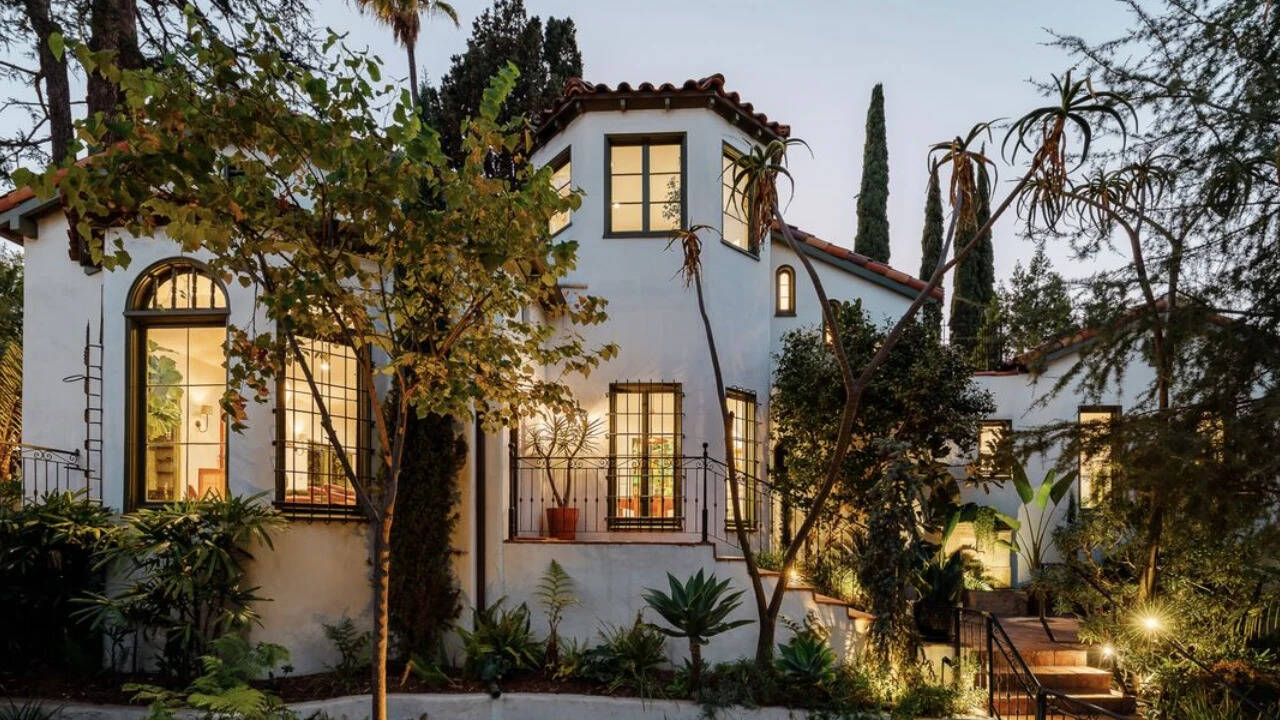
Old Hollywood legends die hard, especially when a property comes with a juicy silent-film rumor attached. Take the Killian House in Whitley Heights, a 1923 Spanish Revival jewel that recently fetched $2.5 million. Local lore insists silent screen icon Rudolph Valentino built the place for his paramour, actress Pola Negri. Historians keep pointing out there's zero documentation proving Valentino actually commissioned it, but real estate markets don't run on archive receipts. They run on romance, architecture, and scarcity.
James Roncal and Stuart Marks bought the hillside property in 2016 for $1.05 million. At the time, the home needed a careful hand. Instead of slapping on cheap gray laminate flooring and flipping it for a quick buck, the owners spent years restoring original character while carefully upgrading the functional spaces. That patience paid off when the home sold for $205,000 above its asking price after spending just two weeks on the market.
The Reality of Restoring a 1920s Spanish Revival Home
Renovating a century-old house in Los Angeles isn't for the faint of heart. Most people underestimate the sheer stubbornness of old infrastructure. Plaster cracks, electrical wiring crumbles, and historical preservation boards watch your every move.
Roncal and Marks chose to respect the bones built by architect Arthur S. Barnes back in 1923. Original hardwood floors, intricate ironwork, and leaded casement windows remained intact. In the primary bedroom, the original Batchelder tiles—an Arts and Crafts treasure highly coveted by collectors—survived the overhaul.
At the same time, they didn't live in a museum. They modernized the kitchen with custom walnut cabinets, dark quartz worktops, and high-end Wolf and Sub-Zero appliances. They updated the bathrooms and two of the three fireplaces, blending mid-century functionality with vintage charm. That balance is precisely why buyers lined up. Too many historic flips destroy the very soul of the property by gutting every original detail, while others leave the plumbing stuck in the Coolidge administration. Hitting the middle sweet spot is rare.
Why Whitley Heights Still Commands Top Dollar
Whitley Heights isn't just another Los Angeles neighborhood. Developed in the early 1920s by H.J. Whitley, it was designed as a Mediterranean hillside village with winding staircases, red tile roofs, and lush greenery that made visiting European stars feel at home. It attracted royalty, directors, and legends like Charlie Chaplin, Jean Harlow, and James Dean.
Over the decades, freeway construction sliced through parts of the area, and neighborhoods shifted. Yet Whitley Heights retained an elusive, secretive aura. Driving up Iris Circle feels like stepping off a movie set. Properties rarely come up for sale here, and when they do, buyers pay a massive premium for the exclusivity.
Sorting Fact From Fiction About Valentino and Negri
Let's address the elephant in the room. Real estate listings love a good romance. The narrative that Valentino built this villa for Pola Negri makes for incredible marketing copy.
The truth is more mundane. Arthur S. Barnes built the Killian House as a speculative or private residential commission. While Valentino and Negri were undeniably the power couple of the 1920s silent film era, no paper trail ties the Latin Lover to this specific address. Negri's legendary grief at Valentino's 1926 funeral—where she dramatically fainted by his casket—cemented her place in tabloid history, but this villa wasn't their love nest.
Does the lack of documentation hurt the home's value? Not at all. Buyers are paying for the authentic 1923 Spanish Revival architecture, the 2,500 square feet of thoughtfully curated space, the 1930s detached casita on the grounds, and the rooftop viewing tower overlooking the Hollywood Sign. The myth is just fun bonus trivia.
What Property Flippers Keep Getting Wrong
If you look at the numbers behind this sale, a clear lesson emerges. Roncal and Marks held the property for roughly a decade, putting capital into meticulous preservation rather than generic cosmetic upgrades.
Most real estate investors panic if a project takes longer than six months. They rely on cheap cosmetic tricks to manufacture artificial equity. True appreciation in historic neighborhoods comes from asset integrity. When you protect original craftsmanship—like artisan tiles, custom woodwork, and period-correct hardware—you attract buyers who understand architectural history. They aren't looking for a cookie-cutter box. They want a piece of Los Angeles history that won't fall apart during the next minor earthquake.
Next time you see a historic listing splashed across real estate headlines with a celebrity backstory, look past the gossip. Focus on the zoning, the architect, the neighborhood scarcity, and the quality of the renovation work. That is where the real value lives.