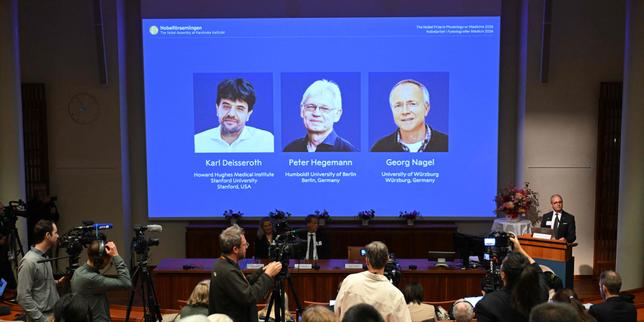
You can't fix what you can't measure. For decades, neuroscience ran into a brick wall because scientists could record brain activity or stimulate it, but they couldn't do both with precision at the speed of thought. That changed when Karl Deisseroth, Peter Hegemann, and Georg Nagel unlocked the mechanics of optogenetics, earning them the 2026 Nobel Prize in Physiology or Medicine.
If you've ever wondered how scientists actually control living neurons using colored light, you're looking at one of the most brilliant marriages of microbiology and optics in modern science. The 12 million Swedish kronor prize money is well-earned. But the real story isn't the Stockholm ceremony. It's how shining a blue light inside a mouse's brain lets researchers switch specific memories on and off like a living circuit board.
How Algae Explained the Human Mind
Science often looks in the strangest places for answers. Peter Hegemann didn't start his research by staring at mammalian brains. He wanted to figure out how a tiny, single-celled alga called Chlamydomonas managed to swim directly toward sunlight.
Back in the early 2000s, Hegemann and Georg Nagel pinpointed channelrhodopsin. That's a unique algal protein sitting right on the cell surface. Hit it with blue light, and it instantly opens a microscopic gate, letting charged ions flood into the cell. That ion flow creates an electrical impulse.
Here's where it gets wild. Proteins don't care what kind of cell they live in. If you transplant that light-sensitive gene into another cell type, that cell suddenly responds to light.
Most biologists thought it was a neat trick for botany labs. Karl Deisseroth saw an entirely different horizon.
From Petri Dishes to Living Neural Circuits
In 2005, Deisseroth took the channelrhodopsin gene and dropped it straight into rat nerve cells. When he flashed blue light on those neurons, they fired. No electrodes. No messy chemical baths. Just pure photon-driven activation.
By 2007, he proved it worked in the brains of living mice. Think about what that means for a second. Traditional electrical stimulation of the brain is like using a sledgehammer on a Swiss watch—it fires everything in the neighborhood. Optogenetics acts like a laser-guided scalpel. You can target one specific cluster of neurons responsible for fear, movement, or addiction while leaving the surrounding tissue completely untouched.
Per Svenningsson, Chair of the Nobel Committee for Physiology or Medicine, noted that this gives researchers a way to map the brain that we could once only dream of. He's not exaggerating.
What This Means for Medicine Right Now
You might be asking what a light-gated ion channel has to do with everyday healthcare. The answer is everything.
Neurological and psychiatric disorders are messy wiring problems. Parkinson's disease, major depression, severe anxiety, and epilepsy all involve misfiring neural circuits. When you can track exactly which circuits cause a tremor or trigger a depressive spiral, you can build targeted therapies.
Beyond mental health, researchers are actively using optogenetic techniques to restore sight in people blinded by retinal degenerative diseases. By making surviving retinal cells sensitive to light using engineered proteins, clinical trials are pushing toward functional vision restoration.
We've moved past the era of guessing how thoughts form. We're now watching them happen in real time, beam by beam.
:max_bytes(150000):strip_icc()/GettyImages-157329538-9fc77790d89e4de3a6bf44db17963eb0.jpg)