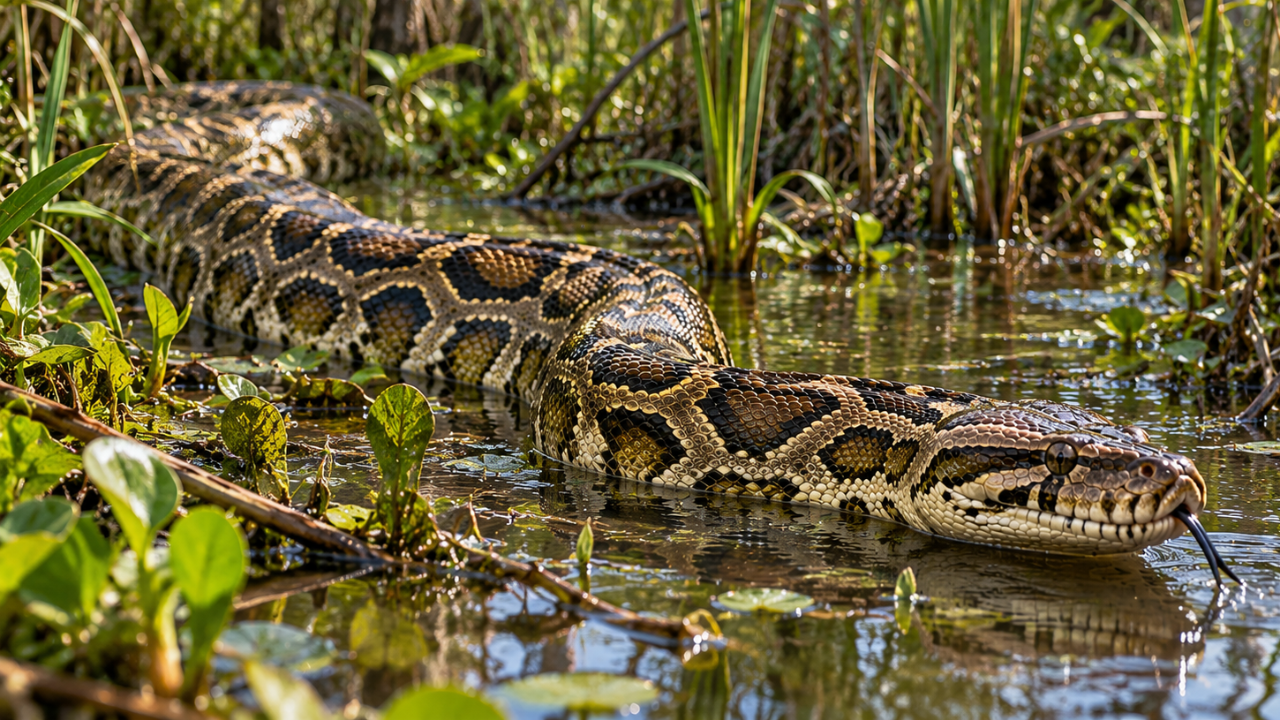
Invasive species rarely arrive alone. When they crash into a new ecosystem, they bring baggage, and sometimes that baggage is microscopic.
Recent scientific findings from the Journal of Virology show that Florida's invasive Burmese pythons are hosting three previously unknown RNA viruses alongside known serpentoviruses. If you live near the Everglades or care about ecological preservation, this isn't just background noise. It's a flashing warning light about how alien species quietly rewrite local disease dynamics. If you enjoyed this piece, you might want to check out: this related article.
Researchers examined 40 Burmese pythons captured in and around the Greater Everglades Ecosystem. They weren't flying blind. The study kicked off after an unusual 2020 disease outbreak struck eastern mudsnakes, leaving them writhing on riverbanks with frothy oral discharge. While those specific sick mudsnakes didn't test positive for the exact ferlavirus linked to that historic event, the genetic screening of the pythons revealed a startling viral cocktail.
The New Viral Trio Hiding in Plain Sight
Out of 40 pythons tested, more than half carried multiple viruses simultaneously. That co-infection rate sits at 57.5 percent. That's not a minor anomaly. It's an active reservoir. For another perspective on this story, refer to the latest coverage from CDC.
The study isolated three undescribed viruses:
- Eden alphavirus (EDEV): Found in 30 percent of the pythons tested. This marks the first new terrestrial alphavirus detected in the continental United States in over half a century. Lab cultures couldn't grow it, and its exact disease profile remains a blank slate.
- Burmese python hepacivirus (BuPyHV): The heavyweight of the group, showing up in 65 percent of the snakes. While it belongs to the same viral genus as the hepatitis C virus, it's genetically distinct and doesn't pose a known threat to humans.
- Burmese python arterivirus (BuPyAV): Found in 10 percent of the animals. It marks the first reptilian arterivirus ever reported in North America, with distant genetic cousins traced all the way to China.
Why This Matters for Native Snakes
Pythons share the damp, crowded terrain of South Florida with countless native species. When an apex invasive predator harbors multiple novel pathogens, the risk isn't necessarily direct human infection. The real threat points straight at cross-species transmission to vulnerable native wildlife.
Think about how diseases jump barriers. If a native snake species crosses paths with a shedding python, or if shared vectors like ticks and mosquitoes intermediate the transfer, the results could devastate local populations already stressed by habitat loss.
We don't yet have smoking-gun proof that these three specific viruses have jumped from pythons to native mudsnakes or rat snakes. But finding them thriving inside 40 random pythons means the ecological stage is set.
What Happens Next in the Field
Field biologists and virologists face a massive uphill battle. Finding viral RNA in a swab doesn't automatically mean the animal is actively sick or shedding an infectious dose. Scientists must now figure out if these viruses can replicate inside other hosts and what clinical damage they might cause.
If you're tracking wildlife management in Florida, keep your eyes on the peer-reviewed follow-ups. The genetic sequences are already uploaded to GenBank, meaning researchers worldwide are actively testing samples against native populations.
Stop waiting for a Hollywood-style outbreak headline. The real ecological friction happens quietly in marsh grass and swamp water. Stay informed, watch how state wildlife agencies respond to these baseline viral shifts, and support local eradication efforts before invasive pathogen pools expand further.
:max_bytes(150000):strip_icc()/GettyImages-157329538-9fc77790d89e4de3a6bf44db17963eb0.jpg)