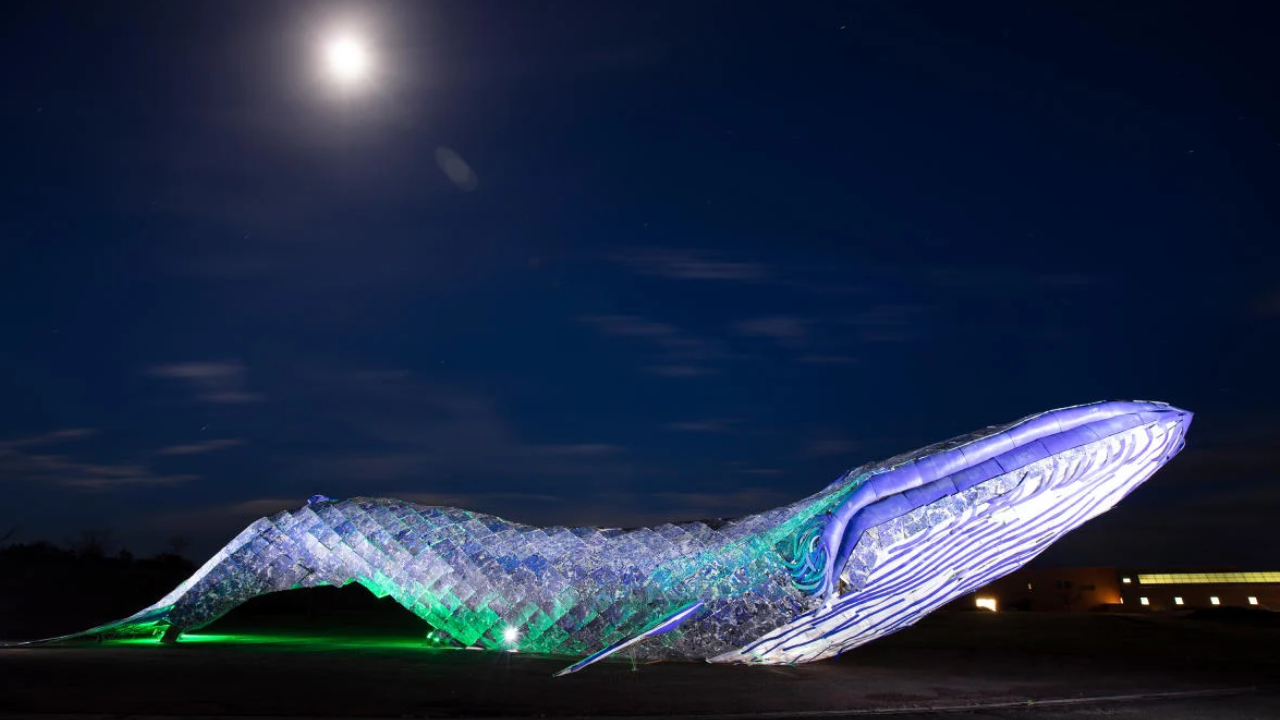
You don't expect to run into a massive marine mammal while driving through the high desert of New Mexico. Yet, right there on the campus of Santa Fe Community College, an 82-foot blue whale rests under the endless southwestern sun.
It isn't carved from stone or cast in bronze. It's built entirely from five thousand pounds of discarded plastic.
Artists Joel Dean Stockdill and Yustina Salnikova built this colossal sculpture back in 2018. Originally commissioned by the Monterey Bay Aquarium in California, the project aimed to visualize an uncomfortable reality. That five-thousand-pound figure wasn't chosen at random. It represents the exact amount of plastic waste entering our global oceans every nine minutes.
Let that sink in.
Turning Garbage into a Monumental Record
Building an 82-foot sculpture out of single-use trash sounds like a chaotic fever dream. It required an industrial-scale recycling effort.
Stockdill and Salnikova didn't just glue milk jugs together. They gathered thousands of pounds of discarded polyethylene, including old trash bags, discarded containers, and packaging material. Working in San Francisco, they melted down the plastic and reshaped it into sturdy panels. These panels formed the rigid, weather-resistant outer skin of the creature.
The scale matches an adult blue whale down to the last foot. When finished, it secured an official spot in record books for the largest recycled plastic sculpture. But building the thing was only half the battle. Moving an 82-foot whale across state lines is an entirely different kind of logistical nightmare.
Moving a Giant Across the American Southwest
After its stint in the San Francisco Bay Area, the sculpture needed a permanent home with room to breathe. Enter Meow Wolf. The Santa Fe-based arts collective purchased the whale and donated it to Santa Fe Community College in 2019.
Transporting a whale into a landlocked desert state required taking the entire structure apart. Crews loaded the pieces onto trucks, hauled them across state lines, and meticulously reassembled the creature on campus grounds.
If you visit today, the contrast is striking. A creature belonging to the deep ocean sits surrounded by juniper trees, sagebrush, and arid high-desert dirt. College officials folded the installation straight into sustainability courses. Students walk past it daily, confronted by the physical bulk of our disposable culture.
Why This Landmark Matters Right Now
Public art often fades into the background. People snap a quick photo for social media and forget what they're looking at. Ethyl the Whale works differently.
Years after its creation, the sculpture continues to spark conversations. Roadside America recently named it a Sight of the Week, bringing fresh waves of curious travelers, roadside enthusiasts, and environmental groups to the college campus.
The high-desert weather tests the plastic panels daily. Freezing winter nights and baking summer heat beat down on the surface. Yet the structure holds strong.
You can walk the full length of the 82-foot beast. You can look closely at the fused fragments of milk jugs and packaging scraps. It forces you to look at your own trash consumption.
Next time you grab a single-use plastic bottle, picture the whale. Real change starts when we stop ignoring where our everyday convenience ends up.