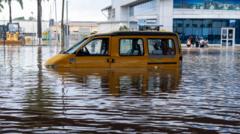
Accra is underwater again, and this time the cost is 13 lives. Sunday night's torrential downpours turned the streets of Ghana's capital into raging rivers, trapping families in their homes and sweeping vehicles off the asphalt. While the floodwaters are slowly beginning to recede, the danger is far from over. The Ghana Meteorological Agency just dropped a grim warning: a massive storm system is rapidly brewing to the east, heading straight for the city.
The government's official advice right now is simple. Stay indoors. Move to higher ground if your home starts taking on water. But for hundreds of thousands of people living in the capital's low-lying areas, those instructions feel easier said than done.
Emergency crews from the Ghana National Fire Service have been working around the clock, wading through murky waters to pull survivors from submerged buildings and recover bodies. It's a chaotic, devastating scene that has become tragically familiar to anyone who lives in Accra. Every single year, the rainy season hits, the infrastructure fails, lives are cut short, and everyone asks the same question: why can't we fix this?
The Fatal Sunday Night Deluge
The storm that hit on Sunday night wasn't just a typical tropical rain shower. It was an intense, concentrated cloudburst that dumped immense volumes of water onto a city that simply has nowhere to put it. Within hours, major roads became completely impassable. In neighbourhoods like Circle, Odawna, and parts of Kaneshie, the water levels rose to chest height, trapping residents on roofs and the upper floors of structures.
The Ghana National Fire Service confirmed that most of the 13 casualties resulted from people getting trapped in flooded vehicles or being swept away by fast-moving currents while trying to navigate the waters on foot. When a flash flood hits Accra, the transition from dry street to deadly river happens in minutes. You don't have time to plan. You only have time to react.
Right now, emergency responders are shifting from rescue mode to recovery. They are clearing debris, searching clogged drainage channels, and trying to assess the full extent of the structural damage. Property losses are already estimated to be in the millions of cedis, with small business owners losing entire lifespans of inventory overnight.
Why Accra Floods Every Single Year
To understand why a few hours of heavy rain turns lethal in Accra, you have to look past the clouds and look at the ground. This isn't just a natural disaster. It's a human-made crisis driven by decades of rapid, poorly managed urban development.
The Concrete Jungle Effect
Accra has grown exponentially over the last few decades. Green spaces, wetlands, and natural floodplains that used to absorb rainwater have been systematically paved over. When you replace soil with concrete and asphalt, water can't sink into the ground. Instead, 100% of the rainfall becomes surface runoff, rushing down streets and looking for the lowest point.
The Clogged Arteries of the City
The Odaw River and the Korle Lagoon form the primary drainage heart of Accra. In theory, runoff should flow into these channels and empty into the Atlantic Ocean. In reality, these channels are completely choked. Plastic pollution is a catastrophic issue here. Millions of single-use plastic bags, bottles, and household waste find their way into the drainage systems. When a storm hits, these blockages act like massive dams, forcing water backward into residential areas.
Building in the Wrong Places
Enforcement of building codes in the capital is notoriously weak. People regularly build homes and commercial structures directly inside designated waterways and floodplains. When you build a wall in the middle of a natural drainage path, the water doesn't stop. It builds up behind the structure until it bursts through, creating a flash flood zone for everyone living downstream.
Surviving the Approaching Eastern Storm
With another major storm system tracking from the east toward the capital, you can't afford to take a wait-and-see approach. If you are currently in Accra, taking immediate, proactive steps could save your life.
Map Out Your Escape Route Right Now
Don't wait for the water to reach your doorstep to figure out where to go. Identify the highest geographic point in your immediate neighbourhood. If you live in a single-story building in a known flood zone, make arrangements with a neighbor, friend, or relative who has a multi-story building or lives on higher ground.
Prepare an Emergency Quick-Bag
Pack a small, waterproof bag with your absolute essentials. This needs to include:
- Your national ID cards, passports, and important land or business documents sealed in plastic bags.
- Essential medications for your family.
- A fully charged power bank and your mobile phone.
- Enough bottled water and non-perishable snacks to last 48 hours.
- A reliable flashlight.
Know When to Stay and When to Run
If the rain starts falling heavily and you are already in a safe, elevated brick structure, stay put. Traveling through Accra during a storm is incredibly risky. Most flood deaths happen on the road. However, if your structure is fragile, built from wood or corrugated sheets, or sits directly next to a major drain, evacuate to a solid shelter before the heavy downpour begins. Never try to drive or walk through moving water that looks deeper than your ankles. It takes surprisingly little current to knock an adult off their feet or stall a car engine.
Breaking the Cycle of Disaster
Fixing Accra's flood problem isn't a mystery. Engineers and urban planners have laid out the solutions for decades. What's missing is the sustained political will and civic discipline to execute them.
First, the city needs an aggressive, zero-tolerance approach to structures built on waterways. No matter who owns the building, if it blocks the flow of water, it has to come down. Second, Ghana must revolutionize its solid waste management. Until there is a reliable system for collecting and recycling plastics, they will continue to end up in the gutters, and the city will continue to drown.
Finally, we need massive engineering investments to widen and deepen the Odaw channel and build large-scale retention basins outside the city center to hold storm runoff before it reaches the urban core. It's expensive work, but it's vastly cheaper than paying the price in human lives year after year.
Keep your eyes on the sky over the next 24 hours. Listen to local radio updates, monitor weather alerts, and look out for your neighbours. Let's make sure the death toll stops at 13.