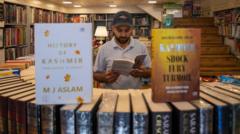
Who gets to decide who is a hero and who is a villain? In Jammu and Kashmir, that question isn’t academic. It is a political flashpoint. A massive row has erupted across the region after the local administration ordered educational institutions to scrub their shelves of "objectionable" material. It is a sweeping directive that covers everything from primary school library books to university research papers.
The government says it is protecting children from radical propaganda. Critics say it is an attempt to erase the region's complex history.
Here is what is actually going on behind the headlines.
The Spark That Ignited the Library Row
The latest controversy started with a book on a shelf. Specifically, copies of a series titled Great Personalities and Legends of J&K (Series 4), published by Obrai Books Service. The books were purchased and distributed under the government-funded Samagra Shiksha Scheme for the 2025–26 academic year.
They were meant to introduce kids to regional historical figures. Instead, they triggered a political earthquake.
The books contained chapters on several controversial Kashmiri figures. Among them were Maqbool Bhat, Syed Ali Shah Geelani, and Shabir Ahmad Shah—prominent separatist and militant leaders. The text painted these individuals as "legends" and "great personalities". Some passages even referred to Jammu and Kashmir as "Indian Occupied Kashmir".
When the opposition Bharatiya Janata Party (BJP) and local advocacy groups like the Jammu and Kashmir Peoples' Forum (JKPF) realized what was in these library books, they went ballistic. They accused the regional government, currently led by Chief Minister Omar Abdullah’s National Conference, of letting anti-national propaganda slip into public schools.
The backlash was swift and severe. The Lieutenant Governor's administration suspended eight senior education officials, terminated a contractual employee, and blacklisted the authors and publishers of the controversial books. The National Commission for Protection of Child Rights (NCPCR) was dragged into the fray, with activists demanding a full child-rights audit of all educational materials in the territory.
A Wide and Blurry Net
If the crackdown had stopped at withdrawing those specific titles, the public reaction might have been quieter. But the administration's subsequent directive went much further.
The government ordered all educational institutions—schools, colleges, universities, and coaching centers—to thoroughly screen all published materials on their premises. This includes academic theses and research papers. The goal? To root out anything that violates "religious sentiments, laws, educational values, and established norms."
But there is a glaring problem here. The directive does not clearly define what actually makes a book "objectionable."
When asked by journalists, school education officials confirmed that a review committee had been set up but couldn't provide a concrete definition of what would trigger a ban.
This vagueness is what worries local educators and writers the most. When the rules are blurry, people self-censor out of fear. Librarians don't want to lose their jobs over a book that was perfectly acceptable last week but might be deemed "sensitive" today.
This Is Part of a Much Bigger Pattern
To understand why this library audit is causing such a panic, you have to look at what has happened in Kashmir over the last few years. This is not an isolated incident. It is the continuation of a systematic campaign to control the narrative.
Ever since the Indian government revoked Kashmir's special semi-autonomous status in 2019, the region has been under intense security and administrative scrutiny. Control over history, education, and identity has become a central battleground.
Just last year, authorities banned 25 books. That list included Colonizing Kashmir: State-Building under Indian Occupation by academic Hafsa Kanjwal, alongside works by Booker Prize-winning novelist Arundhati Roy and prominent constitutional expert A.G. Noorani. The government claimed these books promoted secessionism and "false narratives."
Before that, police conducted raids on several bookstores in Srinagar, seizing hundreds of books. Most of the confiscated titles were written by Abul A'la Maududi, a highly influential 20th-century Islamic scholar. Maududi's writings on Islamic political thought are widely read across the subcontinent, but because he founded the Jamaat-e-Islami—an organization banned by India in 2019—his books are now treated as contraband by local police.
Police justified the raids by saying they were stopping the spread of unlawful content that could disturb public order.
But critics pointed out that these books are widely available online. Seizing physical copies from small, local bookstores does not stop anyone from reading them. What it does do is create a culture of fear among shopkeepers, who now worry that stocking basic religious or historical literature could get them arrested.
The Clash of Two Narratives
There are two entirely different ways of looking at this crackdown.
The state's argument is straightforward. No sovereign country can allow its own public school system to distribute books that glorify armed militancy or question its territorial integrity. From New Delhi's perspective, teaching children that separatist leaders are "legends" is a direct path to radicalization. They argue that school curricula should focus on national integration, scientific temper, and objective, constructive learning.
But local academics and civil society members see something much more concerning. They see an attempt to completely sanitize Kashmir's history.
History is messy. You cannot understand the current political situation in Kashmir without studying the figures who shaped the conflict over the last seven decades, whether you agree with them or not. By removing these names and perspectives from libraries and universities, critics say the state is trying to enforce a single, government-approved version of reality.
As one local academic pointed out, you cannot simply erase decades of political struggle by empty shelves. It doesn't make the history go away; it just makes the conversation go underground.
What Happens Next?
This latest library row has put the newly elected regional government in a very tight spot. The National Conference party, which won the local elections, has to walk a delicate tightrope. They want to appease the local population, which is highly sensitive to state censorship. At the same time, they cannot afford to look soft on separatism in the eyes of New Delhi.
For now, the sweeping book review is moving forward. School administrators are frantically checking their libraries, and academics are watching their research papers with nervous eyes.
If you are a student, teacher, or researcher in Kashmir, the immediate next steps are clear. Expect tighter institutional oversight on what you can read, write, and reference. Academic freedom in the region is shrinking, and the line between historical analysis and "objectionable" content has never been thinner.
A deeper look into the Kashmir conflict and its long history of media and academic censorship explores how journalists, writers, and educators navigate the immense pressure of state surveillance and control in the region.
http://googleusercontent.com/youtube_content/1