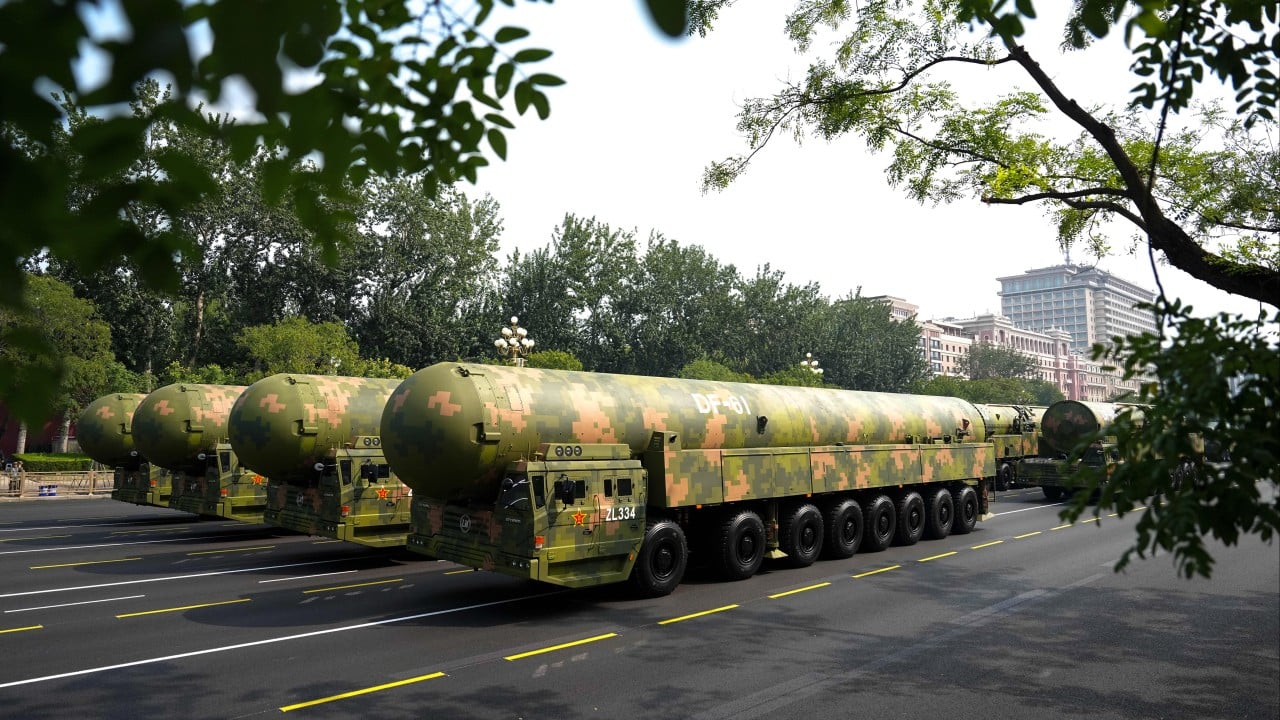
When a massive eight-axle launcher rolls through a public parade, defense analysts usually start a long countdown. They assume years of testing, bureaucratic delays, and stubborn factory bottlenecks stand between a public debut and actual frontline service. But Beijing is rewriting that script. The recent induction of weapons like the DF-61 intercontinental ballistic missile into routine training units shows that the People's Liberation Army Rocket Force is cutting down the distance between public disclosure and operational readiness.
If you look closely at how fast these systems hit the field, you realize that traditional Western assumptions about Chinese military procurement speeds are completely outdated. For a deeper dive into similar topics, we recommend: this related article.
The Illusion of a Slow Timeline
People see a missile unveiled at a parade and assume that is day zero of its development. That is a massive mistake. By the time a system rolls past the viewing stands, the heavy lifting—design finalisation, factory tooling, trial equipping, and rigorous baseline testing—is already done.
When the DF-61 transitioned from its public appearance to active brigade training in a matter of months, observers panicked about a sudden acceleration in manufacturing. In reality, it reflects a maturation phase that happened behind closed doors. The public reveal isn't the birth of the weapon; it's often the victory lap or the final sign-off before mass integration. To get more context on this development, extensive coverage can also be found on TechCrunch.
This compressed public timeline changes everything for strategic planners in Washington and allied capitals. When a new road-mobile ICBM goes from parade asphalt to field drills so quickly, it means the supporting infrastructure—training simulators, specialized maintenance crews, and secure garrison facilities—is already built out and waiting.
Why Fast Integration Actually Matters
Speed in weapon fielding isn't just about showing off industrial might. It changes the math of deterrence.
Traditional nuclear arsenals took decades to modernize because every single component had to pass through sluggish bureaucratic cycles. China’s centralized defense-industrial complex operates differently. When supply chains are tightly integrated and state-directed, manufacturing scale meets military demand without the usual friction.
Consider what rapid induction does for mobile deterrence. A road-mobile intercontinental ballistic missile relies on constant movement, unpredictable positioning, and rapid launch procedures to survive a first strike. If training units get their hands on new hardware faster, operators master concealment, site surveying, and quick-fire drills years ahead of enemy projections.
You aren't just buying missiles; you're compressing the learning curve for the crews who have to hide them in mountain tunnels and forested terrain during a crisis.
Cracking the Procurement Black Box
Of course, speed comes with its own set of internal pressures. The massive anti-corruption purges inside the Rocket Force and the defense sector over recent years prove that rapid expansion hasn't been smooth. Shoddy parts, quality control failures, and rushed oversight can plague any fast-moving military program.
Yet, external assessments show that despite these internal purges and disciplinary removals, the institutional drive to scale up the nuclear inventory remains entirely intact. Beijing views strategic parity as an urgent necessity, not a casual long-term project. The leadership is willing to absorb administrative shocks if it means getting advanced hardware into the hands of soldiers today rather than tomorrow.
Strategic analysts tracking these developments often miss the operational reality. They focus too much on the factory output numbers and too little on the human element. Integrating an eight-axle monster into a brigade requires thousands of hours of specialized driver training, electrical diagnostics, and software synchronization. The fact that crews are clearing these hurdles rapidly points to standardized digital training environments that didn't exist a decade ago.
What Comes Next for Strategic Stability
The takeaway here is simple. Stop expecting slow, predictable military modernization from Beijing. The traditional gaps between prototype, parade, and patrol are shrinking across the board.
As mobile missile forces grow more complex and harder to track, crisis stability takes a massive hit. When both sides can field and integrate strategic assets at unprecedented speeds, miscalculations happen faster, too. The question isn't just whether Beijing can build and field nuclear missiles quicker than before—it's whether global deterrence frameworks can adapt to a pace of military evolution that leaves very little room for error.