You wake up, look out the window, and think you're on Mars. Or maybe inside a heavy Instagram filter from 2012.
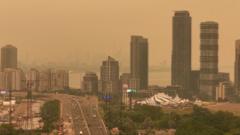
That is exactly what millions of people across southern Ontario and the northern United States experienced on July 15, 2026. The sky did not just turn a gloomy gray. It turned a thick, glowing, apocalyptic shade of orange. Landmarks like Toronto's CN Tower practically vanished behind a heavy curtain of choking particulate matter. In related developments, we also covered: Why The Trust Scandals Surrounding Jeffrey Rath Matter Far Beyond Alberta.
This isn't a scene from a science fiction movie. It's the direct result of hundreds of forest fires raging in northwestern Ontario, sending plumes of dense smoke thousands of miles south. The air quality in Toronto got so bad that the city briefly ranked as the single most polluted major city on earth, beating out global pollution hotspots like Delhi and Kinshasa.
If you are wondering how forest fires in remote northern forests can completely hijack the skies of major metropolitan areas, you are not alone. Let's break down exactly what is happening on the ground, the physics behind that eerie orange sky, and what you need to do to protect your lungs. Associated Press has also covered this fascinating topic in great detail.
The Crisis in Northwestern Ontario
While residents in big cities are dealing with itchy eyes and ruined outdoor plans, communities in northwestern Ontario are fighting for their homes.
The Ontario Ministry of Natural Resources reports that there are currently 148 active wildland fires burning in the northwest region of the province. Out of those, 69 are completely out of control. These fires are concentrated in districts like Sioux Lookout, Red Lake, Dryden, Nipigon, and regions bordering Minnesota.
Massive blazes are burning through thousands of hectares of dry boreal forest every single day. The situations near communities like Armstrong and several First Nations are particularly terrifying. Evacuation orders have been issued for residents of the Whitesand First Nation, Lac La Croix First Nation, Collins First Nation, and Lac des Mille Lacs First Nation. Some of these areas have suffered devastating property damage, and local leaders have reported that the fires have completely overrun key parts of their communities.
The infrastructure impact is massive too. A dramatic video went viral on July 15 showing Canadian National (CN) rail employees in a train surrounded on both sides by roaring flames near Armstrong. CN had to halt rail operations in the area, cutting off a vital transport artery.
Across Canada, the 2026 wildfire season started relatively slowly compared to the record-shattering, catastrophic seasons of 2023 and 2025. But by mid-July, persistent multi-year droughts and a brutal summer heatwave turned the northern forests into a giant tinderbox. There are now over 830 active wildfires burning across Canada, with Ontario, Manitoba, and Saskatchewan bearing the brunt of the mid-summer surge.
The Physics of an Orange Sky
Why does wildfire smoke turn the sky such a bizarre, unnatural orange color?
It all comes down to how light travels through our atmosphere. Usually, the sky looks blue because of a phenomenon called Rayleigh scattering. Sunlight contains all the colors of the rainbow. The gas molecules in the Earth's atmosphere are very small, and they are highly efficient at scattering shorter wavelengths of light, which correspond to blue and violet. This scattered blue light bounces around and hits our eyes, making the sky look blue.
Wildfire smoke changes the game completely.
Smoke is not made of tiny gas molecules. It is made of relatively large, physical particles of soot, ash, and organic compounds. These particles are much larger than the wavelengths of visible light. Instead of scattering only the short blue wavelengths, these larger smoke particles block and scatter almost all of the short-wavelength light. Blue, green, and yellow light get scattered away or absorbed long before they can reach your eyes.
Only the longest wavelengths of light, red and orange, can successfully punch through the thick blanket of smoke. When you look up, you are only seeing the light that survived the journey through the plume.
Meteorologists on the ground on July 15 noted that the smoke was so incredibly thick that it blocked a massive amount of solar radiation. This actually caused surface temperatures in Toronto to drop by about five degrees Celsius compared to what was originally forecasted for the day. Drivers had to turn on their headlights in the middle of the afternoon just to see the road in front of them.
Toronto Becomes the Most Polluted City on Earth
For a brief period on Wednesday morning, Toronto held a title no city wants. It ranked number one on IQAir’s global ranking of major cities with the worst air quality.
The Air Quality Health Index (AQHI) spiked to an 8, which is classified as high risk. This forced Environment Canada to issue a rare orange-level air quality warning. An orange alert means the weather or air quality is severe enough to cause major, widespread disruptions and significant health impacts over several days.
To make matters worse, this smoky invasion coincided with the tail end of a punishing heatwave. Temperatures in downtown Toronto shattered previous records, soaring to a stifling 37.6°C (99.7°F), with humidex values making it feel closer to 45°C.
The combination of extreme heat and toxic air created a hazardous environment. City officials and sports organizers had to make some tough calls:
- The massive FIFA Fan Festival, celebrating the countdown to the World Cup, was abruptly cancelled due to safety concerns for staff, volunteers, and the public.
- Local summer camps, including one in Muskoka Lakes, had to treat several youth participants for acute respiratory distress.
- Public health units actively urged residents to stay indoors and cancel all strenuous outdoor activities.
To help residents who do not have air conditioning or high-quality air filtration at home, Toronto Mayor Olivia Chow activated the city's wildfire smoke response strategy. This opened up several air-filtered "cleaner air spaces" across the city, including Metro Hall, Toronto City Hall, and civic centres in North York, Scarborough, York, and East York.
Crossing the Border into the United States
Wildfire smoke does not care about national borders.
Propelled by strong northwest winds, the massive smoke plumes from northwestern Ontario quickly moved southeast. The smoke swept across the Great Lakes and blanketed a huge portion of the Midwestern and Northeastern United States.
An orange haze quickly settled over parts of Michigan, Ohio, and New York state. Air quality dropped to levels deemed unhealthy for sensitive groups in major metropolitan areas, including Manhattan, Brooklyn, and Queens. Health departments in New York issued air quality advisories, urging residents with asthma or heart conditions to take immediate precautions.
Fortunately, meteorologists do have some good news regarding the immediate forecast. The current northwest winds keeping the smoke trapped over southern Ontario and the northern US are expected to shift by Friday.
While this wind shift will bring relief to Toronto and New York, it means the smoke will simply be pushed in a different direction. The plume will head north, displacing the air quality crisis toward communities north of the active fires. Until those 69 out-of-control blazes in northern Ontario are contained, the smoke will continue to go wherever the wind blows.
How to Protect Yourself from Wildfire Smoke
Vague warnings about "poor air quality" do not tell you what to do. Wildfire smoke contains fine particulate matter known as PM2.5. These particles are less than 2.5 micrometers in diameter, which is about thirty times smaller than the width of a human hair.
Because they are so incredibly small, your body's natural defense systems in your nose and throat cannot filter them out. When you breathe in smoky air, these particles travel deep into your lungs and can even enter your bloodstream, causing systemic inflammation.
If you are currently living under an orange sky or an air quality advisory, you need a concrete plan. Do not wait until you start coughing to take action.
Upgrade Your Mask Game
A standard cloth mask or a loose surgical mask will not protect your lungs from PM2.5. They are designed to stop droplets, not microscopic smoke particles. You need a well-fitted respirator mask, such as an N95 or a KN95. Make sure it seals tightly against your face. If air is leaking out of the sides when you breathe, the mask is not doing its job.
Create a Clean Air Space at Home
Keep all your windows and doors tightly shut. Run your air conditioner, but make sure the fresh-air intake is closed so you are not pulling smoky air from outside. Set it to "recirculate" instead. If you have a portable HEPA air purifier, run it in the room where you spend the most time, typically your bedroom.
Build a DIY Corsi-Rosenthal Box
If you cannot find or afford a commercial HEPA filter, you can build a highly effective air purifier for about forty dollars. Buy a standard box fan and four MERV 13 furnace filters. Tape the filters into a cube shape behind the fan so the fan pulls air through the filters. Research from organizations like the UC Davis Energy and Efficiency Institute shows these DIY boxes perform just as well as, or even better than, many expensive commercial air purifiers at clearing particulate matter from a room.
Recognize the Warning Signs
Pay close attention to how your body feels. Mild and common symptoms of smoke exposure include:
- Itchy, watery, or burning eyes
- Runny nose and sinus irritation
- Mild cough or a scratchy throat
- Mild headaches
However, you need to monitor yourself for more severe symptoms. If you or anyone in your household experiences wheezing, chest tightness, shortness of breath, or a severe, hacking cough, seek medical attention immediately. These are signs of significant respiratory distress.
Protect Vulnerable Populations
Some people are far more susceptible to the toxic effects of wildfire smoke. If you are over 65, pregnant, or managing a chronic lung or heart condition like asthma or COPD, you should remain indoors entirely when the AQHI is high. The same applies to infants and young children, whose lungs are still developing and who breathe in more air per pound of body weight than adults.
Actionable Next Steps
Do not wait for the air to clear to prepare for the next smoke event. Wildfire seasons are getting longer and more intense, and this orange haze will happen again. Take these steps today:
- Download an Air Quality App: Install an app like AirNow or IQAir on your phone. Get into the habit of checking the local AQHI before you plan outdoor workouts or children's playdates.
- Stock up on Supplies: Buy a box of N95 masks and replacement MERV 13 filters for your HVAC system or DIY air purifier now. Do not wait for a smoke storm to hit, because stores will sell out of these items immediately.
- Inspect Your Home’s Seals: Walk around your home and check the weatherstripping on your doors and windows. Sealing up drafts does not just save you money on heating and cooling; it keeps toxic smoke out of your living space.
The orange skies over Toronto and the northern US are a stark reminder of how interconnected our environment is. A fire burning in a remote northern forest can affect the health of someone walking down a street in Manhattan. Take care of your lungs, stay informed, and keep your indoor air clean.