Coaching your own kid in varsity football sounds romantic until the third straight turnover in a rivalry game and the ride home stretches into forty-five minutes of heavy silence.
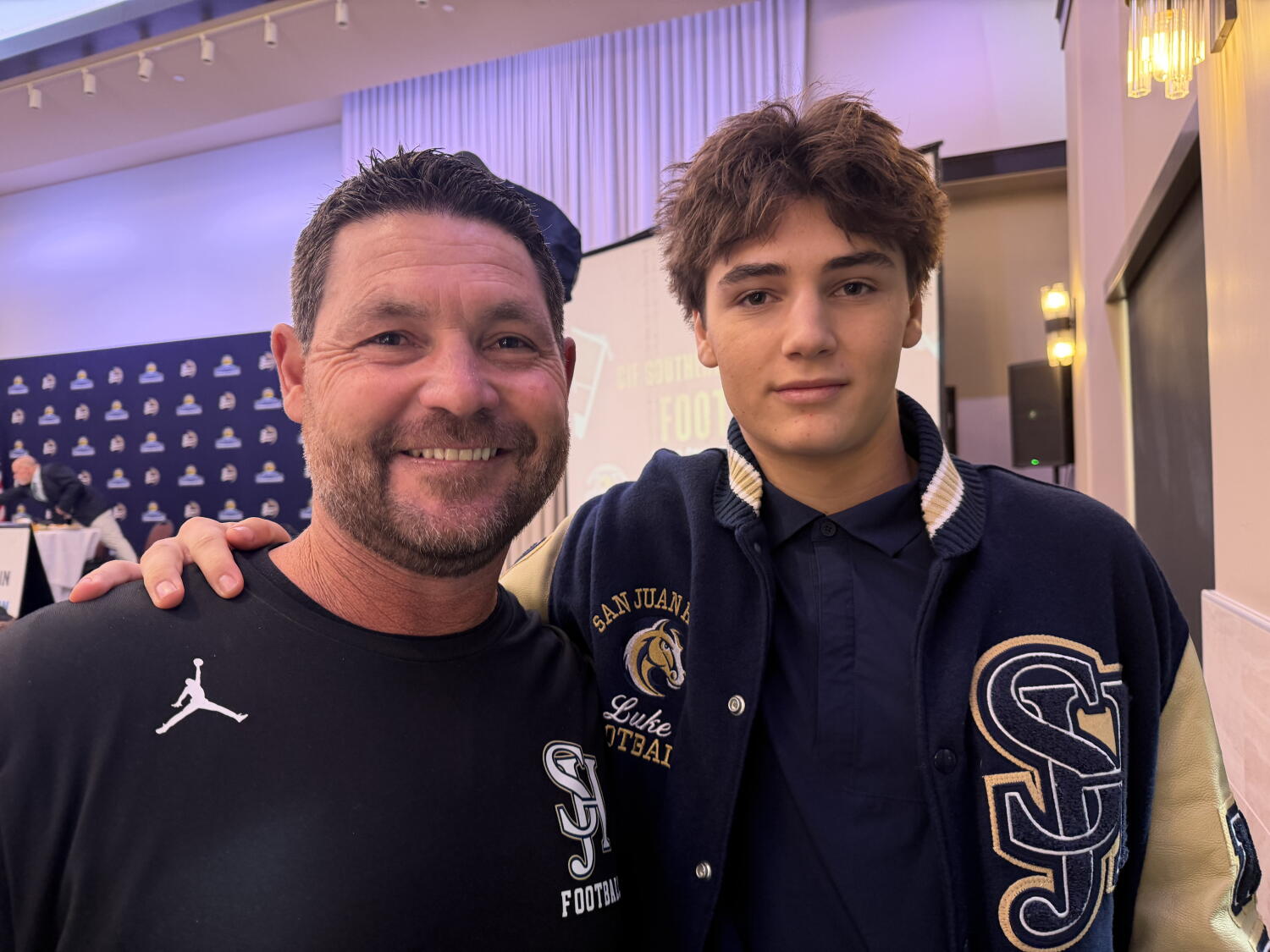
I've watched it up close for years as a youth and prep sports writer covering Southern California sidelines, and honestly, the outside story usually misses the real friction. People look at a father-son duo finishing a four-year high school run and see a neat bow on a childhood dream. When head coach Robert Frith and wide receiver Luke Frith wrapped up Luke's four-year high school chapter at San Juan Hills in San Juan Capistrano, California, their story captured what makes Southern Section football so personal: a dad running the program and his son growing up inside it from freshman year through a senior postseason run that pushed the Stallions deep into the 2026 CIF Southern Section Division 2 playoffs.
The user intent behind a story like Robert and Luke Frith isn't just box scores or a quick pat on the back. Readers want to know how a coach-parent and a player-son actually survive four years under the same roof and on the same sideline without blowing up the relationship. They want to know why "daddy ball" accusations sting so much, what happens when life outside football reminds a family how fragile everything is, and what practical boundaries keep a household intact when Friday nights carry real stakes.
What Coaching Your Own Kid Really Looks Like Over Four Years
Most folks assume a coach's son gets an easy lane. In my experience covering high school programs, the exact opposite happens more often than not. A head coach has to look forty or sixty other families in the eye every single week, which means coaching your own son usually comes with sharper corrections, higher expectations, and zero room to look like you're playing favorites.
Luke Frith came up through the San Juan Hills football pipeline starting in the Class of 2027, lining up at wide receiver, safety, and kick returner as a roughly six-foot, 175-to-180-pound playmaker who eventually committed to Texas State in June 2026 after drawing college interest from programs like UNLV, Cal Poly, San Jose State, Colorado State, and UC Davis. By his senior season in 2026, San Juan Hills was competing in the brutal Alpha League and battling through Division 2 postseason games—including a tense 13-10 playoff win over Tustin, a 16-12 grind against Rancho Cucamonga, and a 35-21 victory over Chaparral—with the Stallions pushing their overall record to 11-2 during that playoff stretch.
Watching a kid grow from a freshman learning varsity speeds to a college-committed senior leader is wild enough on its own. Doing it while his dad is the head coach changes the daily rhythm of the entire household. Film sessions don't end at the fieldhouse door. Bad routes, missed tackles, and blown coverages have a habit of drifting into Saturday breakfast unless someone sets hard rules.
The Myth of Favoritism Versus Extra Scrutiny
Let's be real about the "daddy ball" label that hangs over almost every coach's kid in prep sports. Skeptical parents in the stands love a convenient scapegoat when playing time feels unfair. Yet when a head coach has to answer to boosters, assistants, and a locker room full of teenagers who watch every rep with eagle eyes, cutting your own kid slack is career suicide.
Research on parent-coach dynamics backs up how delicate that trust line is. A study published in PMC examining coach-parent relationships found that perceived favoritism or a lack of transparency chips away at team culture fast, while clear boundaries and emotional regulation keep relationships healthy (PMC coach-parent relationship study). When the parent is the head coach, those two roles collide daily. On the practice field, the coach demands standard execution. At home, the dad still owes his son unconditional love regardless of whether the offense threw for 400 yards or stalled out in the red zone.
Perspective Shifts When Everything Changes in Seconds
Sometimes football stops feeling like the biggest thing in the room. In December 2025, Robert Frith suffered a sudden cardiac arrest while playing pickleball at Richard Steed Memorial Park in San Clemente, collapsing on the court before fast-acting bystanders—including an Orange County Fire Authority member, an off-duty firefighter who jumped a fence to start CPR, an off-duty nurse, and an Orange County Sheriff deputy with an AED—helped keep him alive until paramedics arrived.
That kind of scare rewires how a family talks about wins and losses. You can argue about red-zone play calls all winter, and then a single afternoon reminds everyone that a four-year high school run is a gift, not a birthright. I've seen plenty of coaches treat every November loss like a tragedy until health or family scares force them to zoom out. Once you've stared down something that sudden, watching your son catch passes under Friday night lights looks a whole lot different.
Why Southern California Prep Football Tests Families Harder
Southern California high school football doesn't operate in a quiet bubble. Between league realignment, transfer movement, college recruiting noise, and tough bracket football in the CIF Southern Section, a four-year varsity arc feels closer to a mini-college tenure than casual recreation.
Over his time leading San Juan Hills—a stretch that included an earlier CIF championship breakthrough in 2019 and a roller-coaster ride through different league alignments and divisions—Robert Frith has navigated the exact highs and lows that define Southern Section coaching. One year a program is rolling; another year injuries, tough schedules, or shifting league tiers test every ounce of patience on the staff.
For Luke Frith, coming of age inside that environment meant learning early how to separate noise from work. Recruits today deal with star ratings, social media clips, and college offers long before graduation. When your dad runs the show, you don't get to act like a rock star around the building—you still have to earn your stripes with teammates who have known you since middle school.
What Research Says About High-Stakes Youth and Prep Sports
Studies on sports expertise and family involvement show two truths that seem contradictory until you put them side by side. Research in the Journal of Expertise on father-son athletic pairs highlights how a knowledgeable parent can model work ethic, structure opportunities, and reinforce high standards (Journal of Expertise study on father-son sport dyads). At the same time, youth sport guidance from institutions like George Mason University's College of Education and Human Development warns that blurred lines, pressure, or mismatched goals can create friction for young athletes.
That tension is real, and pretending otherwise doesn't help anyone. Some father-son coaching pairs thrive because both guys genuinely love the craft and respect the chain of command. Others burn out because neither person knows how to turn the "coach" switch off in the driveway. There's no universal formula, and anyone claiming coaching your own kid is effortless hasn't spent four seasons doing it.
Lessons Every Coach-Parent Learns Too Late
Looking at four-year runs like Robert and Luke Frith's at San Juan Hills, a few patterns jump out right away:
- The car ride home is a trap. Breaking down every target, coverage read, or penalty five minutes after walking off the field turns a celebration or a tough loss into an interrogation.
- Teammates watch the double standard. A coach doesn't have to be harsher than necessary to be fair, yet holding your own son to the exact same accountability standard—or slightly higher—protects the locker room.
- Recruiting adds invisible pressure. Once college coaches start calling, every practice rep and every game clip can feel audition-heavy unless someone keeps the focus on helping the team win right now.
- Four years goes fast. It feels endless during grueling August two-a-days and brutal league nights, right up until the final buzzer sounds and the next chapter starts.
What Families Can Actually Do Differently
If you're a coach-parent heading into a high school season—or a parent trying to keep sports from swallowing your relationship with a teenage athlete—good intentions aren't enough. You need practical habits before tension builds.
Start by picking a clear rule for postgame talk. Many families use a simple cool-down window—waiting until the next day or until after dinner—before discussing game film or performance. When your teen wants to vent, listen as a parent first instead of immediately handing out a scouting report.
Next, check your own ego when things go sideways. If your kid struggles or doesn't get the ball on a key fourth down, ask yourself honestly whether you're reacting to what's best for the team or protecting your pride as a parent. And if a health scare, injury, or rough losing streak hits your family, let it reset your priorities rather than making everyone carry extra weight.
Most of all, enjoy the ride while you're still in it. Four years of high school sports passes in a blink, and the wins you'll care about ten years from now aren't just on the scoreboard—they're the moments you kept your cool, backed your teammates, and still liked each other when the cleats came off.