Military coups get you thrown out of international alliances. Rewriting the constitution gets you a red carpet.
That is the quiet playbook defining modern authoritarian creep across the globe. Forget tanks rolling down the boulevard at dawn. Today's aspiring autocrats don't overthrow the government—they use the government to overthrow democracy. They keep the courts, hold the parliaments, and use procedural tricks to destroy competition from inside the system.
It is clean. It is quiet. And most dangerously, it is legal.
The Death of Term Limits Through Law
Look at Zimbabwe. When a military takeover ended Robert Mugabe's decades-long grip on power, many hoped for a fresh start. President Emmerson Mnangagwa had other ideas. Instead of stepping down, he signed a constitutional amendment lengthening presidential and parliamentary terms from five to seven years. Elections got pushed back.
Zimbabwe isn't an isolated case. Across Africa, Latin America, and beyond, leaders are using domestic legal machinery to rewrite their job descriptions.
In Djibouti, parliament voted unanimously to scrap the presidential age limit so a sitting leader well past 75 could keep running. In Chad, term limits vanished overnight, replaced with seven-year terms that effectively reset the clock for the ruling family. In El Salvador, a packed supreme court reinterpreted constitutional text to clear the path for consecutive re-election before lawmakers abolished term limits entirely.
The strategy is brilliant in its cynicism. If you control the legislature and pack the judiciary, you can turn any power grab into a statute.
Writing Rivals Out of the Game
Once term limits are gone, the next step is rigging the ballot box before voters even see it. You don't need to stuff boxes if you simply disqualify everyone else.
In Nicaragua, Daniel Ortega locked up viable challengers and then declared the country would stop holding elections altogether, writing political exclusion directly into new constitutional drafts. In Côte d'Ivoire, courts decided a constitutional rewrite reset an 83-year-old incumbent's term count to zero. Authorities cleared the ballot of real opposition weeks before the vote, handing the victor a predictable landslide.
When the rules guarantee victory, elections stop being democratic exercises. They become expensive coronation ceremonies.
Why International Watchdogs Look Away
The glaring hypocrisy of global governance is how it treats military coups versus legislative takeovers.
When soldiers remove a president by force, regional bodies like the African Union suspend the country within twenty-four hours. Assets get frozen. Sanctions drop. Yet when a civilian president dismantles institutional checks, packs high courts, and abolishes term limits through a parliamentary vote, international bodies usually shrug.
The African Charter on Democracy, Elections and Governance actually gives organizations the tools to punish constitutional coups. They just refuse to use them. Because the dictator wore a suit and followed parliamentary voting procedures instead of wearing fatigues, international watchdogs treat the assault on democracy as an internal political matter.
Every time a legal power grab goes unpunished, the barrier drops for the next leader looking to stay in office forever.
The Cost of Compliance
Legal autocracy doesn't happen in a vacuum. It relies on coordinated repression to silence anyone who spots the trap.
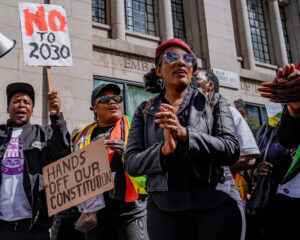
When student leaders in Harare campaign against term extensions, they face abduction and torture. When opposition politicians in Chad or the Democratic Republic of the Congo organize street protests, security forces respond with tear gas and live rounds. Journalists covering parliamentary hearings find themselves trapped by ruling-party loyalists and forced to delete footage of legislative bullying.
Autocracy wrapped in a legal code still hurts. The bruises are real, even if the judges signed off on them.
The real threat to modern democracy isn't a sudden violent uprising. It is the slow, deliberate erosion of institutions by the very people sworn to protect them. If the international community keeps rewarding procedural cleverness and punishing only crude military takeovers, we will watch every democracy on earth vote itself out of existence.