Football does not care about your storybook endings. It does not care that Luka Modrić has spent two decades orchestrating midfields with the grace of a ballet dancer, or that a generation of fans wanted to see him bow out with a shiny gold medal around his neck. When Portugal and Croatia clashed in the Round of 32 at the 2026 FIFA World Cup in Toronto, the script was written for a legendary goodbye. What we got instead was a brutal, technological punch to the gut that sent one icon marching on and another into international retirement.
Portugal won 2-1. But those bare numbers do not even begin to tell the real story of what went down in Canada. They do not capture the sheer madness of a match that was decided by what might be the most controversial, minute, and agonizing video assistant referee decision in World Cup history.
Let's look closely at how a single millimeter of margin ended one legendary career while keeping Cristiano Ronaldo's final dream alive.
The Stoppage Time Chaos That Broke Croatia
The game was already deep into the twilight of extra time. Portugal had taken a late lead through Gonçalo Ramos in the 94th minute, turning the stadium into a sea of red and green celebration. The Portuguese fans thought they had wrapped it up. They thought the whistle would blow and they could comfortably celebrate their ticket to the Round of 16.
Croatia refused to pack up.
In the 103rd minute of the game, substitute Josko Gvardiol managed to poke the ball toward the net. Chaos erupted. Mario Pašalić converted, sending the Croatian bench into pure, unadulterated ecstasy. Players piled on top of each other. Modrić looked to the sky, breathing a massive sigh of relief. The fans were screaming so loud the stadium structure shook. They had done it again. The master survivalists of modern tournament football had pulled off another miracle at the death.
Then the referee pointed to his ear.
Everything stopped. The joy in the stadium vanished, replaced by that modern, anxious silence that only a VAR check can bring. It wasn't just a standard offside check either. The officials were looking at something incredibly specific. They pulled out Snicko technology to determine if Croatian forward Igor Matanovic had managed to flick the ball mid-air before it struck Portugal's Renato Veiga on its path to Pašalić.
The verdict came back after a grueling delay. Disallowed. Offside.
The Croatian fans went ballistic. Plastic bottles and projectiles rained down onto the pitch from the stands. The raw emotion of a last-minute equalizer was violently ripped away in a matter of seconds. It was impossible to tell from standard broadcast angles if the ball's spin changed. Even former England international Matt Upson noted on the live broadcast that he didn't think there was a clear touch. The decision required a massive amount of courage from the officials, but it left an entire nation feeling completely robbed.
One Final Meeting of Madrid Icons
This match wasn't just another knockout game. It was an unprecedented clash between two men who share over 400 international caps between them. Cristiano Ronaldo and Luka Modrić spent years conquering Europe in the white shirt of Real Madrid, lifting Champions League trophies side by side. They formed the spine of a team that defined an era. Seeing them square off as opposing captains at 41 and 40 years old felt surreal.
Ronaldo spent the early parts of this World Cup tournament facing heavy criticism. His starting spot in Roberto Martínez's side was heavily questioned after an opening loss against DR Congo. Pundits argued that his celebrity status was outweighing his actual on-pitch substance. But Ronaldo did what he always does. He shut them up by scoring a double against Uzbekistan in the groups, and when the pressure reached a boiling point against Croatia, he stepped up to smash home a 68th-minute penalty.
Modrić, on the other hand, had struggled early in the tournament cycle too, even giving away a clumsy penalty against England. It looked like the pace of the modern game was finally catching up to his 40-year-old legs. But as the tournament progressed, he found his rhythm. He controlled the tempo against Portugal, picking passes and escaping tight spaces like he was ten years younger.
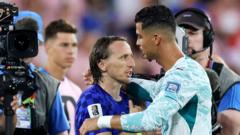
When the final whistle blew shortly after the VAR drama, the contrast was heartbreaking. Mateo Kovačić was openly weeping on the grass. Modrić stood in absolute shock, staring blankly at the pitch. Ronaldo walked over to comfort his old friend, holding him as the reality of the situation sank in. This was the end of Modrić's international road.
The Statistical Reality of a Golden Era
To understand why this loss feels so heavy, you have to look at what Modrić built. He didn't just play for Croatia; he carried them to a World Cup final in 2018 and a third-place finish in 2022. He won a Ballon d'Or in 2018, breaking up the historic duopoly held by Ronaldo and Lionel Messi.
Ronaldo's numbers remain staggering as he chases his obsession with reaching 1,000 career goals. He's now scored in six different World Cups. He has won five Ballon d'Or awards and Euro 2016. He has nothing left to prove to anyone, yet he's still running himself into the ground in the Canadian summer heat.
The difference now is the supporting cast. Portugal can afford to sub off Ronaldo in the 81st minute because they have guys like Gonçalo Ramos ready to pop up and score 94th-minute winners. Croatia relies on every ounce of Modrić's magic just to stay competitive against the elite sides. When technology took away their final miracle, the burden simply became too heavy to bear.
What Happens Next
If you watched the post-match scenes, you know you witnessed history. Modrić didn't make a grand announcement on the pitch, but everyone knows the truth. The international stage is officially done with one of its greatest ever artists.
Portugal moves on to the Round of 16, and Ronaldo's hunt for the one trophy that has eluded his entire career continues. They aren't playing perfect football under Martínez, but they have the depth to survive ugly games.
For the rest of the tournament, keep your eyes on how Portugal handles the minutes of their aging captain. The knockout rounds don't give second chances, and as Croatia just learned the hard way, the margin between a legendary comeback and going home is now measured in digital audio spikes and automated lines. Go watch the official highlights from the tournament broadcasters to see the disallowed goal for yourself, and judge whether technology got it right.